USDJPY Resilient Advance Eyes Key Resistance as Divergent Central Bank Policies Weigh Heavily on the Japanese Yen

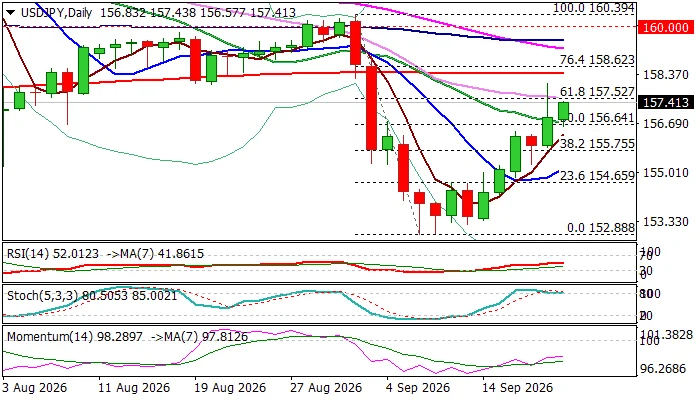
The USD/JPY currency pair staged a robust recovery on Monday, comprehensively erasing the bearish signals generated by Friday’s sharp upside rejection. Late last week, the pair carved out a long upper shadow on its daily candlestick, prompting initial market fears of a potential bull-trap just above the critical 157.52 Fibonacci barrier. However, Monday’s aggressive buying pressure quickly invalidated those concerns, keeping near-term bullish momentum firmly intact. As spot prices press higher, traders and analysts are closely monitoring pivotal technical thresholds, macroeconomic fundamental drivers, and the broader monetary policy divergence between the Federal Reserve and the Bank of Japan that continues to dictate the trajectory of the world’s most heavily traded Asian currency pair.
Technical Landscape and Price Action Dynamics
The fresh upward push observed at the start of the week has successfully pressured the pivotal 157.52 Fibonacci level. This threshold represents the crucial 61.8% retracement of the broader 160.39 to 152.88 bear-leg, and it coincides closely with the 30-day moving average (30DMA). A decisive, sustained break above this immediate hurdle would clear the runway for a renewed assault on the much more significant 200-day moving average (200DMA) barrier, currently situated at 158.40.
A closer examination of the daily technical charts reveals an increasingly constructive picture. The Relative Strength Index (RSI) has climbed back above the neutral 50 baseline, indicating a return of underlying buying momentum. Furthermore, the 10-day and 20-day moving averages are arranged in a classic bullish configuration. This positive technical alignment is further reinforced on higher timeframes by a striking weekly bullish engulfing pattern, which typically signals a strong continuation of the upward trend.
Nevertheless, caution remains warranted among market participants. Momentum indicators flash mixed signals: the stochastic oscillator is currently lingering in overbought territory, and the 14-day momentum indicator remains anchored in negative territory. These conflicting readings serve as a warning that the advancing bulls may encounter intermittent headwinds and choppy price action as they attempt to conquer higher ground.
On the downside, structural support has shifted higher. The previously broken 50% retracement level at 156.64—which is strongly reinforced by the 20-day moving average—has successfully reverted to a reliable support floor. Market consensus dictates that this zone must hold during any intraday pullbacks to preserve the prevailing near-term bullish bias.

Fundamental Drivers: Divergent Central Bank Policies
The underlying fundamental narrative for USD/JPY continues to be dominated by the stark divergence in monetary policy paths pursued by the Bank of Japan (BOJ) and the United States Federal Reserve. This policy gap has left the Japanese Yen languishing on the defensive, unable to mount a sustained recovery against the dominant US Dollar.
The vulnerability of the Yen was exacerbated following the Bank of Japan’s recent policy meeting. Despite implementing what financial markets characterized as a "dovish hike," the central bank’s communication failed to provide the aggressive tightening trajectory that hawkish Yen bulls had anticipated. The BOJ’s hesitation to signal a rapid sequence of subsequent rate normalization measures has reinforced the view that Japanese interest rates will remain exceptionally accommodative relative to the rest of the developed world.
Conversely, the US central bank has adopted a notably more assertive stance. Following a rate adjustment that marked a significant milestone in its ongoing battle against persistent domestic inflation, Federal Reserve officials have signaled a renewed willingness to maintain a restrictive policy posture. Speculation regarding the potential commencement or extension of a tightening cycle in the United States has injected fresh vitality into Treasury yields, widening the interest rate differential between US and Japanese sovereign bonds. Because institutional investors continuously chase yield differentials, this widening gap naturally encourages capital outflows from yen-denominated assets into higher-yielding greenback instruments.
Chronology of Recent Market Events
To fully comprehend the current positioning of the USD/JPY pair, it is necessary to examine the sequence of events that unfolded over the preceding trading sessions:
- Mid-Week Policy Announcements: Both the Bank of Japan and US monetary authorities delivered high-stakes policy updates, setting the stage for heightened foreign exchange volatility. The BOJ’s cautious adjustment disappointed expectations for a swift exit from ultra-loose monetary policy, while US officials maintained a firm, data-dependent stance on interest rates.
- Friday’s Upside Rejection: As the trading week drew to a close, USD/JPY spiked toward the 157.52 Fibonacci barrier. However, aggressive profit-taking and technical resistance triggered a sharp pullback, leaving a prominent long upper shadow on the daily candle. This price action briefly convinced short-term speculators that a bull-trap had been sprung.
- Monday’s Recovery and Rebound: Defying Friday’s bearish candle structure, the pair rebounded swiftly on Monday morning. Buyers stepped in near key moving average supports, driving spot prices back toward the 157.52 resistance cluster and invalidating the immediate bearish outlook.
Official Responses and Broader Market Reactions
While central bankers rarely comment directly on day-to-day foreign exchange fluctuations unless volatility crosses into disorderly territory, fiscal authorities in Tokyo have maintained heightened vigilance. Japanese finance ministry officials have repeatedly reminded market participants that they are monitoring currency movements closely and remain prepared to intervene in the foreign exchange market to curb excessive, one-sided depreciation of the Yen.
Despite these verbal warnings, currency traders have largely treated Ministry of Finance rhetoric as a temporary psychological barrier rather than a fundamental trend-reversal catalyst. Without concrete intervention or a definitive shift in the BOJ’s baseline policy outlook, market participants appear willing to test the resolve of Japanese authorities, pushing USD/JPY progressively higher toward psychological and technical resistance milestones.
Broader Economic Impact and Implications
The persistent weakness of the Japanese Yen carries profound implications for both the domestic Japanese economy and the global trade landscape. For Japan, a chronically weak currency inflates the cost of essential imported commodities, including energy, raw materials, and foodstuffs. While this dynamic has historically helped large Japanese multinational corporations by boosting the translation value of their overseas earnings, it simultaneously squeezes domestic household purchasing power and weighs on consumer sentiment.
Globally, the strong US Dollar environment complicates macroeconomic conditions for emerging markets and trading partners that must contend with imported inflation driven by greenback strength. Furthermore, persistent currency depreciation tests the credibility of the BOJ’s policy normalization framework, forcing economists and market strategists to continually reassess when and how Japanese authorities might be forced to alter their policy stance to stabilize the currency.
Key Technical Levels Summary
For traders and institutional strategists navigating the USD/JPY market in the sessions ahead, the following predefined boundaries will serve as critical guideposts:
-
Resistance Levels:
- First Resistance: 157.52 (61.8% Fibonacci retracement / 30DMA)
- Second Resistance: 158.05 (Intermediate psychological and technical barrier)
- Third Resistance: 158.40 (Significant 200-day moving average barrier)
- Fourth Resistance: 158.62 (Extended upper objective)
-
Support Levels:
- First Support: 157.00 (Psychological round-number threshold)
- Second Support: 156.64 (50% retracement level reinforced by the 20DMA)
- Third Support: 155.75 (Interim reaction low)
- Fourth Support: 155.28 (Base of the recent consolidation zone)
As the week progresses, market attention will remain fixated on whether the buying momentum can successfully breach the 157.52 barrier and target the formidable 200DMA at 158.40, or if overbought technical indicators will trigger a deeper correction back toward the 156.64 support shelf.