The Myth of the Whale: A Rigorous Quantitative Investigation into Bitcoin Market Signaling


Every time a massive wallet shifts several thousand Bitcoin onto a centralized exchange, crypto social media channels erupt with automated alerts. These Whale Alerts, often interpreted by retail traders as precursors to a major sell-off or, conversely, a "smart money" accumulation phase, have long served as a centerpiece of speculative discourse. While some market participants treat these movements as actionable intelligence, others dismiss them as lagging noise that merely confirms price action that has already occurred. Determining which perspective holds empirical weight has remained a point of contention until now.
A recent research project conducted by Hui Min Neo as part of the Executive Programme in Algorithmic Trading (EPAT) has provided a definitive, data-driven answer to this long-standing debate. By utilizing machine learning classifiers to analyze the predictive power of on-chain network activity and derivatives positioning against traditional price data, the study sought to determine whether whale activity acts as a leading indicator for next-day Bitcoin (BTC/USDT) returns. The results, rigorously tested through a pre-registered research protocol, indicate that these whale-centric signals failed to provide a sustainable trading edge.
The Research Protocol and Methodology
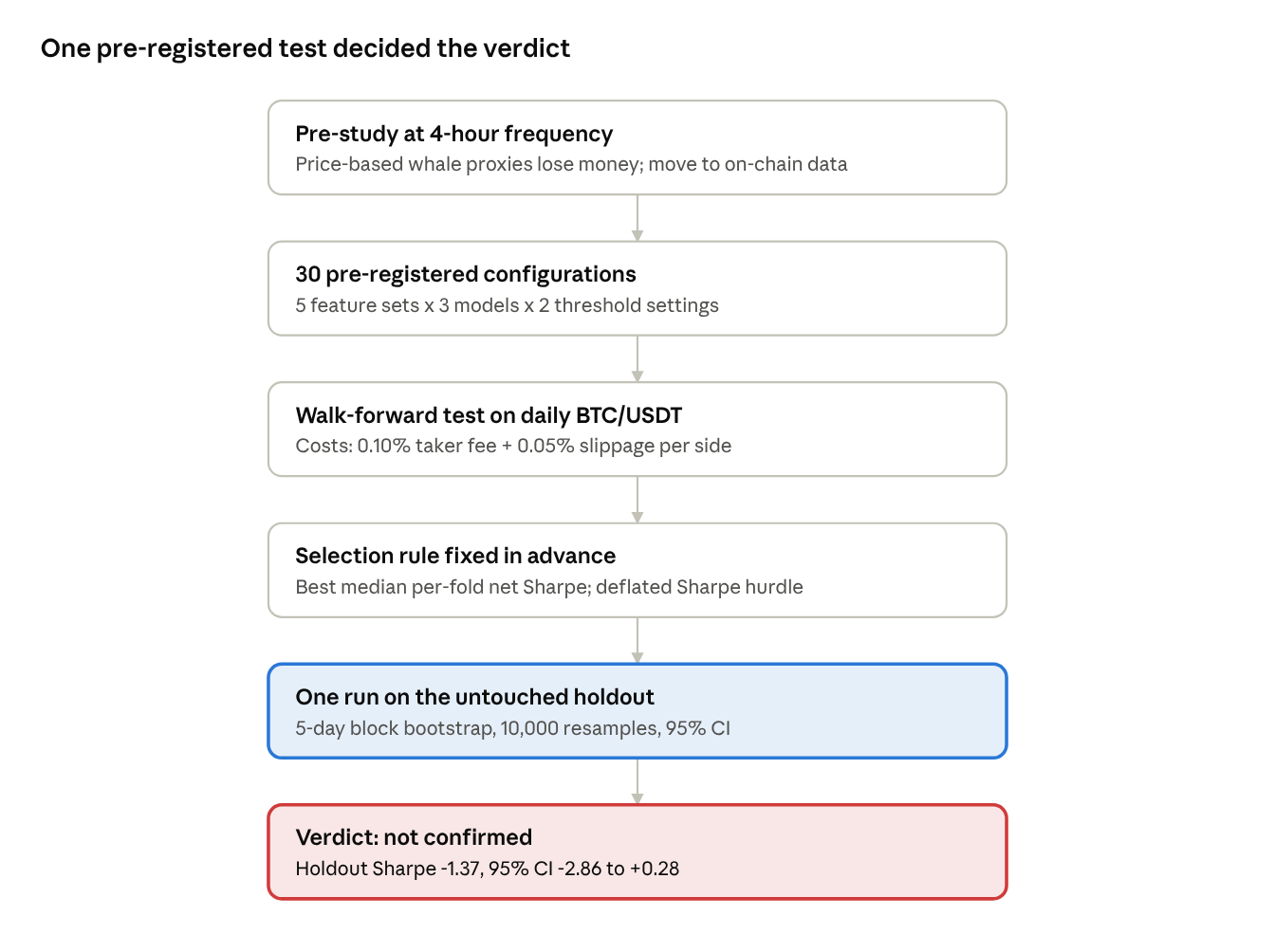
The project, which spanned 1,747 trading days from November 15, 2020, to May 7, 2026, was designed to avoid the common pitfalls of data mining and look-ahead bias that often plague quantitative backtesting. Rather than simply hunting for a profitable configuration, the research utilized a "pre-registration" approach. This method involves locking in a hypothesis, a selection rule, and success criteria before ever touching the final holdout data. By doing so, the researcher ensured that the findings were not the result of "p-hacking" or the incidental success of one of many tested models.
The study analyzed three distinct categories of input:
- Market Data: Traditional price and volume metrics, including lagged returns, volatility, RSI, and MACD indicators.
- Whale On-Chain Activity: Metrics derived from the Bitcoin blockchain, such as transaction volume spikes, fee surges, and mempool congestion levels.
- Derivatives Positioning: Insights into the futures market, utilizing CoinGlass data on open interest, funding rates, and top-trader long/short ratios.
To maintain professional rigor, the project implemented a strict 0.15% per-side cost assumption, totaling a 0.30% round-trip friction, which accurately reflects the reality of trading on major venues like Binance. The models tested included logistic regression, random forest, and XGBoost, with results validated via block bootstrap confidence intervals—a technique that accounts for the non-independent nature of daily financial returns.
Chronology of the Investigation
The investigation progressed through four distinct phases:
- Pre-Study (Initial Assessment): Before committing to complex on-chain data, the research began with simple "whale proxies" derived from 4-hour price and volume data. This phase served as a reality check, and the results were immediate: every variant tested resulted in financial loss, suggesting that simplistic price-based interpretations of whale activity lack predictive utility.
- Development Phase (Walk-Forward Testing): Over a period of 1,550 days, 30 different model configurations were subjected to walk-forward testing. This process involved training models on expanding windows of historical data to mimic real-world strategy deployment.
- Selection and Deflation: Following the development phase, a specific configuration—logistic regression using derivatives features—was identified as the "winner" based on its median Sharpe ratio. To ensure the validity of this choice, the researcher applied a "deflated Sharpe ratio" hurdle, which statistically accounts for the fact that 30 different configurations were tested.
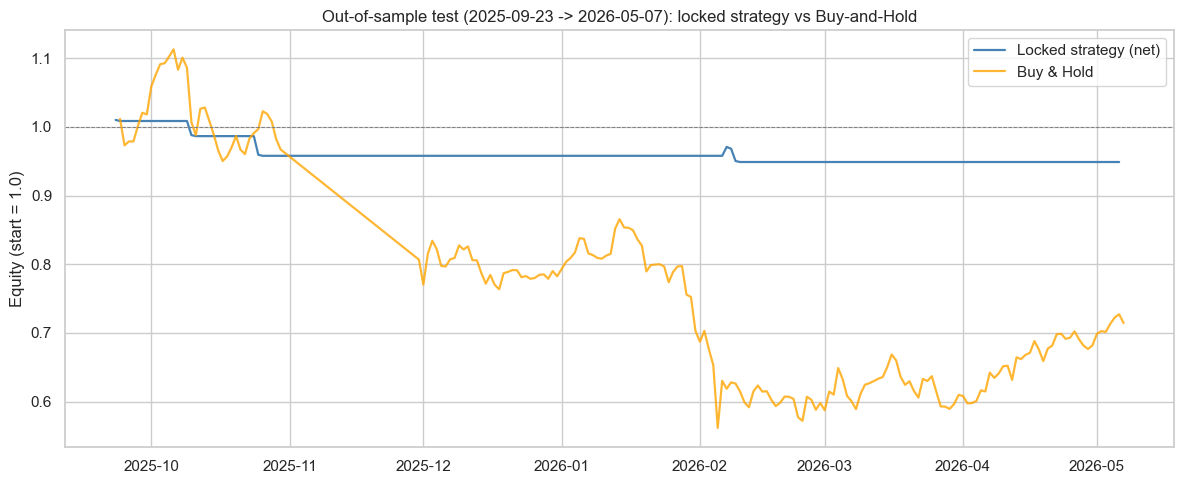
- Final Holdout (The Verdict): The winning configuration was deployed on a final, untouched data set spanning September 23, 2025, to May 7, 2026.
Analysis of Findings
The final verdict on the predictive power of whale alerts was "not confirmed." The locked strategy yielded a Sharpe ratio of -1.37 during the holdout period, with a 95% confidence interval ranging from -2.86 to +0.28. While the strategy did technically outperform a simple buy-and-hold approach in terms of total return, this was not due to predictive skill. The model remained in a "flat" position for 97% of the testing period, effectively avoiding a significant portion of the market’s decline. It did not capture alpha; it simply practiced defensive inaction.
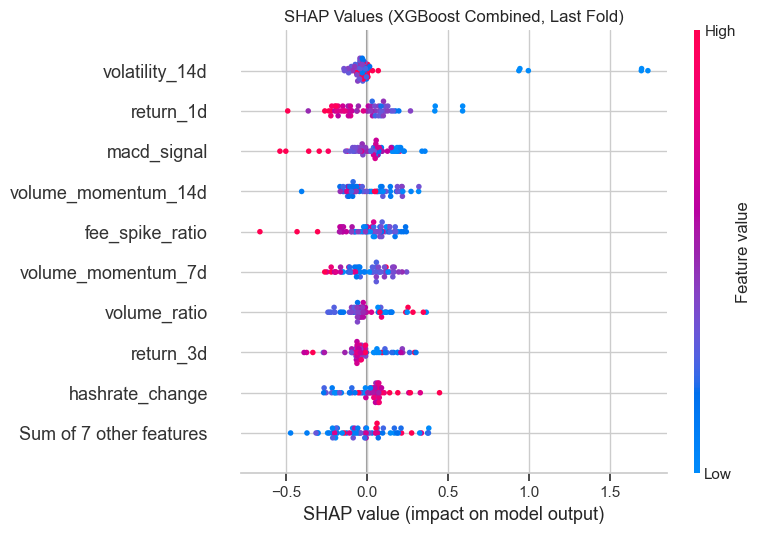
Furthermore, feature ablation tests revealed that while the models did incorporate on-chain and derivatives data, these inputs did not provide a statistically significant improvement over price-only models. SHAP (SHapley Additive exPlanations) analysis indicated that the models leaned most heavily on basic price features, such as 14-day volatility and previous-day returns, rather than the "whale" signals that the project was specifically designed to evaluate.
Broader Implications for Quantitative Finance
The failure of the whale-tracking strategy to generate alpha has profound implications for crypto-native quantitative research. It highlights the "efficiency trap"—the assumption that because blockchain data is public and transparent, it must necessarily contain exploitable information. The reality, as suggested by this research, is that markets tend to integrate information rapidly. If large-scale whale movements are visible to the public, the price impact is often priced in before a model can compute a signal and execute a trade.
This project serves as a masterclass in the necessity of scientific rigor in finance. In an industry where "alpha" is often claimed on the basis of poorly backtested strategies, the use of pre-registration, realistic cost modeling, and block bootstrap intervals provides a blueprint for how to separate signal from noise.
Limitations and Context
While the study’s conclusion is negative regarding the predictive power of current whale alert methodologies, the researcher noted several limitations. The test window was relatively short (197 days) and predominantly bearish, meaning the findings may not apply to all market regimes. Additionally, the data used was network-wide; specific wallet-labeling—a capability of advanced, paid on-chain analytics platforms—might potentially yield different results. However, the study remains a powerful rebuttal to the popular notion that raw, publicly available blockchain movements are a "shortcut" to profitable trading.

Conclusion
The data confirms that for the average trader, or even a sophisticated algorithmic system, whale alerts as currently defined do not constitute a reliable foundation for a profitable trading strategy. The project effectively demonstrates that when transaction costs are applied and selection bias is mitigated, the apparent edge of whale-tracking evaporates.
For institutional and retail traders alike, this serves as a reminder that transparency does not equal simplicity. The pursuit of alpha requires more than just monitoring public data feeds; it requires a disciplined, skeptical approach to research that prioritizes the elimination of biases over the excitement of finding a "holy grail" indicator. As the crypto market matures, the move away from anecdotal "whale watching" toward more robust, multi-factor quantitative models appears to be the only path toward sustainable performance.
Disclaimer: The information provided is for educational and informational purposes only. Cryptocurrency trading involves a high level of risk, and the results presented in this project are based on specific parameters and historical data, which do not guarantee future performance. The author and the institutions involved disclaim any liability for financial decisions made based on this analysis.
Related posts: