HaasOnline Launches Smart Trade on TradeServer Cloud to Revolutionize Manual Crypto Trading Strategies

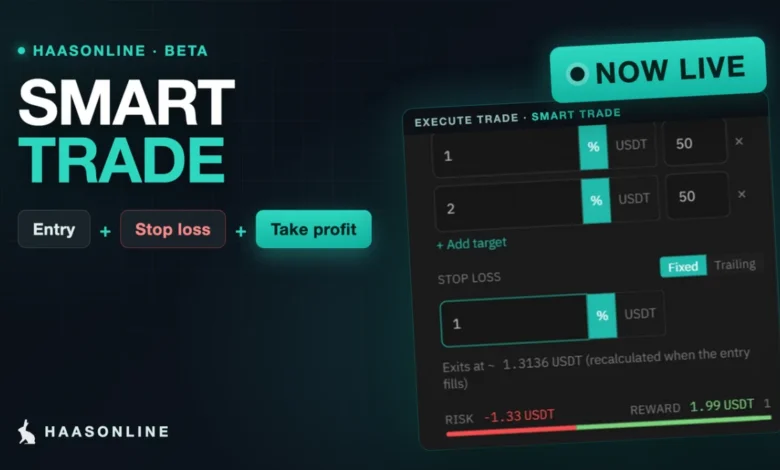
The landscape of cryptocurrency trading has long been bifurcated between two distinct camps: the automated, algorithm-driven bot users and the manual traders who rely on intuition, market sentiment, and real-time analysis. Bridging this divide, HaasOnline has officially launched its "Smart Trade" feature on the TradeServer Cloud platform. Currently in its beta phase, this new functionality allows manual traders to attach sophisticated take-profit and stop-loss parameters directly to their orders, effectively automating the exit strategy of a trade without requiring the user to develop complex scripts or deploy traditional trading bots.
This integration represents a significant shift in how retail and professional traders interact with exchange-based order books. Historically, while bots provided the necessary infrastructure to manage risk through automated exits, manual traders were often forced to monitor their positions constantly, leaving them vulnerable to "emotional trading"—the tendency to widen stop losses or prematurely exit positions due to market volatility. By embedding risk management directly into the order entry process, HaasOnline aims to provide a layer of institutional-grade discipline to the individual trader.
The Technical Evolution of Manual Trading
The introduction of Smart Trade follows a broader trend in the fintech sector toward "hybrid trading" solutions. While automated trading remains the core value proposition of HaasOnline, the company recognized a substantial user base that prefers the control of manual entry but lacks the automated oversight necessary for consistent risk management.
Smart Trade operates by decoupling the exit strategy from the exchange’s native order book in most instances. When a user initiates a trade via the "Execute Trade" panel, they specify an entry point, a take-profit target, and a stop-loss threshold. Once the trade is live, the HaasOnline TradeServer Cloud continuously monitors market data. When the price hits a pre-defined level, the server automatically issues a market order to close the position.
This approach offers several technical advantages. First, it allows traders to manage positions they may have opened on an external exchange interface. If a trader opens a position on Binance or Kraken, they can import the trade data into the HaasOnline interface and assign a Smart Trade "wrapper" to it. The system then takes over the monitoring duties, effectively retrofitting a manual position with automated protection.
Chronology and Development Roadmap
The development of Smart Trade was prompted by feedback from the HaasOnline user community, which reported a disconnect between their high-level strategy planning and their ability to execute that plan during periods of high volatility.
- Phase One (Conceptualization): Development began in late 2023, focusing on the need to integrate stop-loss and take-profit functionality that does not rely on complex HaasScript configurations.
- Phase Two (Integration): Early 2024 saw the integration of the "Order Overview" dashboard, allowing users to visualize their PnL (Profit and Loss) and position health in real-time.
- Phase Three (Beta Launch): The current release marks the transition to a public beta on the TradeServer Cloud, enabling users to test the functionality across multiple spot markets simultaneously.
Analytical Perspective: Implications for Market Discipline
The primary implication of Smart Trade is the mitigation of "cognitive load" for the trader. In high-frequency cryptocurrency environments, the speed at which prices move often exceeds human reaction times. By pre-programming exits, traders are effectively creating a "failsafe" that operates regardless of market conditions or human hesitation.
From an analytical standpoint, this tool serves as a bridge for traders transitioning from manual execution to automated systems. It provides a safer sandbox for users to test their exit strategies. According to industry data, the most common cause of significant capital loss for retail traders is the failure to adhere to a predefined stop-loss. By removing the manual intervention requirement at the moment of the exit, Smart Trade enforces a strict adherence to risk management parameters.
Furthermore, the "Lots" feature, which allows for up to 20 concurrent Smart Trades on a single spot market, indicates that the platform is catering to more complex strategies. A user can, for instance, maintain a long-term "hold" position while simultaneously running a short-term "swing" trade on the same asset. This granularity was previously only available to users with extensive programming knowledge of the platform’s proprietary script language.
Operational Mechanics and Exchange Interaction
It is critical for users to understand the operational architecture of Smart Trade. Because the exits are managed by HaasOnline’s servers rather than the exchange itself, there are inherent requirements for the system to function correctly.
- Connectivity: The TradeServer Cloud must maintain an active connection to the exchange API. If the connection is severed, the "watchdog" mechanism may be delayed.
- Order Execution: Because the exit is triggered by a market order, slippage remains a factor. During periods of extreme liquidity crunches or flash crashes, the price at which the order is filled may deviate from the target price set by the user.
- Latency: The system relies on the polling speed of the API and the internal processing time of the cloud server. While these are optimized for low latency, they remain subject to the infrastructure limitations of the underlying exchange.
HaasOnline has emphasized that this feature is not an investment advisory tool. The responsibility for setting accurate, risk-adjusted levels remains with the trader. The visual aids provided on the Marketview chart—where users can drag and drop entry, target, and stop lines—are intended to reduce the margin of error in placing these levels.
Market Context and Broader Industry Trends
The launch occurs at a time when the volatility of the crypto market is attracting a new wave of institutional and retail capital. As platforms compete to offer the most robust "all-in-one" experience, the ability to combine manual control with automated safety measures has become a competitive differentiator.
Competitors in the space have largely focused on either "copy-trading" or "fully automated grid bots." By targeting the "manual-plus-automation" niche, HaasOnline is addressing a specific pain point: the desire for traders to remain in the driver’s seat while offloading the high-stress tasks of monitoring and executing exits.
How to Get Started
For users currently utilizing the TradeServer Cloud, the Smart Trade interface is accessible via the dollar sign icon ($) in the application’s top navigation bar. The platform requires that users define their account, market pair, and position direction before activating the Smart Trade toggle.
HaasOnline has also released a comprehensive suite of documentation to support the beta launch. For those unfamiliar with the platform, the company is currently offering a seven-day trial. This is particularly relevant for those looking to test the functionality in a "paper trading" environment, where users can simulate trades with virtual capital to observe how the Smart Trade logic interacts with historical market data and real-time fluctuations.
Conclusion and Risk Disclosure
As with any tool involving automated execution, the risks associated with Smart Trade are not negligible. Cryptocurrency markets are inherently volatile, and automated systems, regardless of their sophistication, cannot predict market anomalies or black-swan events. The reliance on API connectivity and market-order execution means that traders should remain vigilant.
HaasOnline’s commitment to providing these tools reflects a growing maturity in the crypto-trading ecosystem. By democratizing access to professional-grade exit strategies, the company is empowering individual traders to operate with a higher degree of consistency. As the beta progresses, the platform is expected to gather data on user efficacy, potentially leading to further refinements in how manual trades are managed and protected in the volatile digital asset market. Investors are reminded that while software can assist in the implementation of a strategy, the underlying risk of capital loss remains a fundamental component of the trading process.