Why Retiring During a Stock Market Downturn Might Actually Be the Ultimate Financial Advantage

As technology-heavy public equities face severe corrections, investors are once again grappling with the psychological and financial toll of market volatility. While the S&P 500 has not formally crossed the definitive threshold into an official bear market, a significant number of individual high-growth equities have already experienced drawdowns exceeding 20 percent. For portfolios heavily weighted in the technology sector, index-level classifications offer little comfort against substantial paper losses.
Yet, historical market data and financial analysts suggest that economic downturns, while painful in the short term, are a normal and recurring feature of long-term capital accumulation. Understanding the mechanics of market corrections, the realities of sequence of returns risk, and the psychological framework required to navigate financial turbulence can transform how retirees and long-term investors approach periods of economic contraction.
The Illusion of the Wealth Effect and Consumer Behavior
For extended periods, rising equity markets function as a powerful psychological buffer against broader macroeconomic pressures. When brokerage accounts record steady annual gains, the financial sting of persistent inflation—manifested in elevated energy costs, higher housing prices, expensive higher education, and escalating healthcare expenditures—is notably mitigated. Investment portfolios outperforming the rate of inflation create a robust "wealth effect," numbing consumers to the rising cost of everyday goods and services.
However, this tolerance for high prices evaporates rapidly the moment investment portfolios sustain consistent losses. When the wealth effect vanishes, consumer sentiment shifts abruptly. Discretionary spending contracts as households defer major purchases, reduce dining out, and delay automobile replacements. Consequently, corporate profitability faces downward pressure, prompting businesses to accelerate cost-cutting measures and workforce reductions to preserve operating margins. This self-reinforcing cycle frequently precedes official economic recessions declared by economists long after consumers have felt the pinch.
For professionals anticipating labor market shifts, proactive career management—such as negotiating strategic severance packages prior to widespread corporate layoffs—often yields more favorable exit terms than being included in mass workforce reductions.
Sequence of Returns Risk and the Realities for Retirees
For newly retired individuals, the primary threat during a market downturn is sequence of returns risk. This refers to the vulnerability of sustaining substantial portfolio losses early in retirement while simultaneously executing regular withdrawals to fund living expenses. If severe drawdowns occur during the initial years of retirement without adequate cash buffers, a portfolio’s long-term viability can be permanently compromised, occasionally forcing retirees back into the labor market.

Retirees heavily dependent on portfolio withdrawals generally face higher psychological pressure during bear markets than active wage earners, as they lack a primary employment paycheck to cushion asset depreciation. Despite these risks, financial historians note that portfolios capable of surviving a correction or bear market ultimately benefit from post-crisis recoveries. The fundamental alternative—continuing to work indefinitely without proportional financial rewards—underscores the necessity of robust financial planning prior to exiting the workforce.
Financial planners recommend maintaining a conservative cash buffer equivalent to one to two years of living expenses, allowing retirees to avoid liquidating depressed equities during the depths of a market cycle.
Historical Context: Frequency and Duration of Market Declines
Examining historical data offers vital perspective on the expected frequency and duration of market downturns. According to historical analyses from Capital Group spanning data from 1954 through 2025, market corrections—defined as a decline of 10 percent or more in the S&P 500—occur on average roughly once every 18 months. Meanwhile, full bear markets, characterized by drops of 20 percent or more, materialize approximately once every six years.
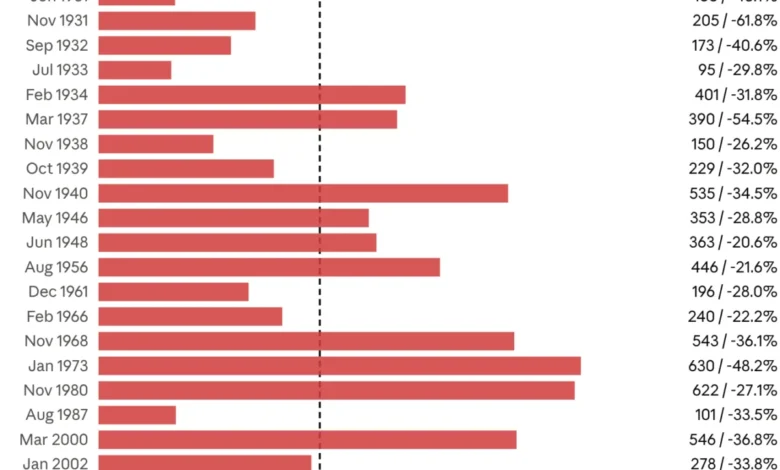
Further data from Hartford Funds, incorporating Ned Davis Research metrics dating back to 1928, identifies 27 distinct bear markets. On average, historical bear markets have witnessed stocks falling by roughly 35 percent over an average duration of 289 days—approximately 9.6 months—from peak to market trough. While outlier events, such as the prolonged bear markets of 1973 and 1980, endured for more than 600 days, the statistical norm points to a relatively swift path to recovery.
Historical S&P 500 Market Decline Metrics
| Market Decline | Frequency of Occurrence | Average Peak-to-Trough Duration |
|---|---|---|
| 5% or more | Approximately twice a year | 46 days (1.5 months) |
| 10% or more (Correction) | Once every 18 months | 133 days (4.4 months) |
| 15% or more | Once every 3 years | 247 days (8 months) |
| 20% or more (Bear Market) | Once every 6 years | 402 days (13 months) |
Source: Capital Group, S&P 500 data from 1954 through 2025.
Crucially, historical precedent demonstrates that every S&P 500 market correction since 1929 has ultimately been followed by a complete recovery. Data indicates that the average market return during the first twelve months following a cyclical market bottom reaches approximately 52 percent. Furthermore, studies show that a significant percentage of the S&P 500’s strongest single-day returns over the past two decades occurred directly during bear markets, illustrating the financial perils of panic selling and missing the subsequent market rebound.
Reassessing Return on Effort and Professional Burnout
Economic downturns frequently trigger an existential question for active workers: whether the intensity of their professional effort yields commensurate rewards. Financial analysts utilize the concept of "Return on Effort" (ROE) to evaluate the efficiency of labor input relative to financial output.

During expansive bull markets, working excessive hours rarely alters individual financial outcomes unless compensation is directly tied to performance metrics like sales commissions. Conversely, during a bear market, increasing labor output to compensate for stagnant revenue or corporate restructuring yields diminishing returns. Employers operating under compressed profit margins are rarely positioned to distribute generous wage increases, regardless of individual workload expansion.
Consequently, rational economic actors frequently scale back discretionary professional exertion during downturns, prioritizing personal well-being, health, and family life. By definition, retirees and individuals who have successfully achieved financial independence experience the highest possible Return on Effort, as their primary income generation is decoupled from corporate labor markets.
Structural Silver Linings of a Market Downturn
While widespread equity depreciation causes short-term anxiety, economic downturns introduce several systemic advantages for disciplined investors, consumers, and families:
- Deflation of Asset and Service Costs: As macroeconomic demand cools, pricing pressures ease across travel, hospitality, and real estate sectors. Retirees possessing flexible schedules can leverage off-peak pricing, while prospective homebuyers encounter reduced bidding competition.
- Discounted Asset Accumulation: Investors with robust cash reserves and steady passive income streams acquire equities at significantly lower valuations. Regular contributions to retirement accounts systematically purchase larger share volumes, enhancing long-term compounding potential.
- Intergenerational Wealth Transfer: Market corrections provide an ideal environment for establishing and funding investment portfolios for younger generations. A multi-decade time horizon allows juvenile accounts to absorb near-term volatility, transforming a temporary market drop into a minor historical footnote by the time beneficiaries reach maturity.
- Tax Optimization Strategies: Depressed valuations facilitate efficient tax-loss harvesting to offset future capital gains. Furthermore, executing Roth IRA conversions during market troughs minimizes tax liabilities on underlying share transfers, allowing subsequent market recoveries to compound entirely tax-free.
- Mitigation of White-Collar Disruption: Recent corrections in high-flying artificial intelligence equities suggest that technological adoption rates and valuations are facing realistic market checks, alleviating immediate fears of instantaneous white-collar job obsolescence.
- Enhanced Investor Resilience: Sustaining and surviving periodic market cycles instills long-term discipline, replacing speculative overconfidence with measured, risk-adjusted investment strategies.
Strategic Timing: Retiring in a Bear Market Versus a Bull Market
Conventional wisdom frequently cautions against retiring during a market downturn due to sequence of returns risk. However, financial planners increasingly argue that retiring successfully while the broader market is down 20 percent or more serves as a powerful stress test of a personal financial plan.
Retiring during a bear market ensures that an individual’s lifestyle and withdrawal rates are calibrated against depressed asset values rather than inflated bull market peaks. When the inevitable market recovery materializes, it provides an immediate structural tailwind to the retiree’s portfolio rather than an impending vulnerability. Conversely, individuals who retire at the absolute peak of a multi-year bull market face immediate exposure to sharp asset depreciation while simultaneously initiating regular withdrawals.
Ultimately, market volatility remains entirely outside individual control. By focusing on asset allocation discipline, maintaining prudent cash reserves, and aligning lifestyle expenditures with realistic long-term projections, investors can successfully navigate market cycles and preserve capital across generations.