Why The Cost of Living in America Correlates Directly With Climate and Weather Quality

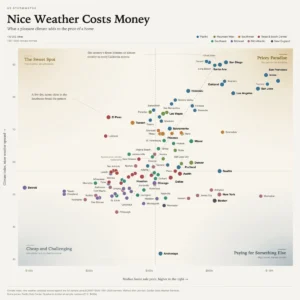
The spatial distribution of wealth, housing markets, and human migration patterns across the United States has long puzzled economists and urban planners. While traditional economic models attribute high real estate values primarily to job density, wages, and local tax structures, emerging geographical and demographic analyses suggest another powerful driver: climate. Recent housing data mapped across 110 major American cities indicates a profound correlation between median home sale prices and local weather indices, fundamentally altering how policymakers and residents understand the true cost of paradise.
The Economic Intersection of Climate and Real Estate
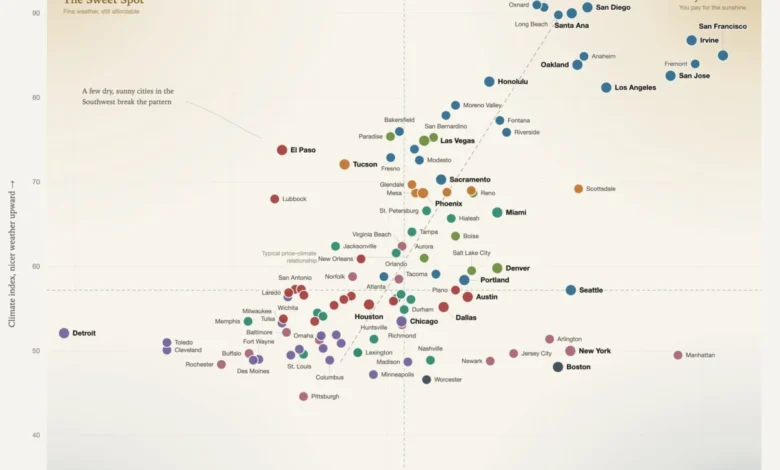
To evaluate how geography impacts consumer expenditure, researchers frequently construct climate indices using decades of meteorological data—incorporating variables such as ambient temperature, humidity, sunshine hours, and precipitation normals. When these indices are plotted against median home sale prices derived from real estate tracking platforms like Redfin, a distinct upward trend emerges. Cities boasting year-round moderate temperatures and high sunshine counts consistently cluster at the upper end of the housing market spectrum.
This relationship challenges the traditional notion that housing premiums in regions like coastal California or South Florida are entirely speculative bubbles. Instead, macroeconomic analysts argue that these markets reflect a rational consumer premium. Unlike manufactured goods or commercial services, stable, comfortable weather 365 days a year is an inelastic commodity that cannot be artificially produced or rapidly expanded through infrastructure development.
Geographic Stratification: The Four Housing Quadrants
A comprehensive breakdown of the 110-city dataset reveals four distinct quadrants categorized by housing affordability and climate quality, each presenting unique socio-economic trade-offs for American workers and retirees.
The Premium Coastal Tier: High Cost, Ideal Climate
Occupying the upper-right quadrant are major metropolitan areas predominantly located in California—including San Francisco, San Diego, Los Angeles, San Jose, and Oakland—alongside select sun-belt outliers like Miami and Honolulu. These regions command the nation’s highest median home prices, frequently exceeding $1 million to $2 million.

However, urban analysts note that housing in these markets serves multiple functions simultaneously. Beyond basic shelter, residents are purchasing access to outdoor recreation, improved mental and physical health outcomes, and proximity to high-density job markets. Real estate economists point out that these regions combine the "weather premium" with the "income premium," hosting the nation’s highest concentrations of venture capital, corporate headquarters, and high-paying technology and financial sectors. Furthermore, geographic constraints—bounded by oceans, mountain ranges, and strict zoning regulations—severely limit housing supply expansion, ensuring permanent scarcity.
The Value-Driven Southwest: Moderate Cost, Extreme Summers
Positioned in the upper-left quadrant are cities offering favorable climate indices at or below the national median home price, largely situated in the American Southwest. Municipalities such as Phoenix, Tucson, Las Vegas, El Paso, and Fresno provide abundant sunshine and pleasant winter conditions.
The primary economic friction in these markets is seasonal extremes, with severe summer temperatures requiring significant energy expenditures for air conditioning. Despite these challenges, population migration data shows consistent inflows into these regions. Families and retirees frequently trade two to three months of intense summer heat for significantly larger living spaces and lower overall cost-of-living metrics, often aided by favorable tax policies, such as Nevada’s zero state income tax.
The Industrial Heartland: Low Cost, Severe Winters
The lower-left quadrant encompasses the industrial Midwest and Rust Belt, featuring cities such as Detroit, Cleveland, Buffalo, St. Louis, Pittsburgh, and Minneapolis. These markets are characterized by highly affordable housing stock and challenging winter climates.
From a financial perspective, these cities offer exceptionally high rental yields compared to coastal metros, often generating gross rental yields of 7% to 8% compared to 3% in San Francisco. While property appreciation rates historically lag behind coastal counterparts, the lower cost of entry allows middle-income workers—such as educators, civil servants, and tradespeople—to achieve outright homeownership much earlier in life. Urban sociologists emphasize that these regions feature robust community infrastructure and stable local economies, though they struggle to attract the massive population influxes seen in southern states.
The Cultural Metros: High Cost, Demanding Climates
The lower-right quadrant captures major historical and financial hubs with higher-than-average housing costs and less favorable weather indices, including New York City, Boston, Chicago, Seattle, and Washington, D.C.
Residents in these metropolitan areas are not paying for climate; rather, they are paying for career density, institutional access, cultural infrastructure, and historical social networks. Economists observe that the concentration of specialized labor pools, world-class educational institutions, and public transit networks justifies the high cost of entry for ambitious career professionals, despite the logistical and financial burdens of harsh winters and high taxes.
Strategic Migration and Financial Implications
As remote work flexibility has matured, demographic shifts have accelerated discussions surrounding the optimal lifecycle of geographic arbitrage. Personal finance experts frequently advocate a phased approach to location strategy:
- The Wealth-Accumulation Phase: During early career stages, professionals are advised to prioritize opportunity density over comfort. Residing in high-cost, high-opportunity cities allows workers to accelerate income growth and build initial capital, even if it requires renting smaller spaces or enduring difficult weather.
- The Asset-Deployment Phase: Once a threshold of financial independence is achieved, individuals gain the optionality to relocate. Many high-net-worth individuals adopt geographic diversification strategies—often referred to in real estate circles as "renting luxury while buying utility." This involves leasing primary residences in desirable lifestyle markets while deploying capital into high-yield real estate assets in heartland or Sunbelt regions.
Broader Economic Impact and Future Outlook
The persistent demand for climate-favored real estate suggests that weather will remain a dominant variable in American demographic planning. As climate patterns shift and remote work decouples employment from specific physical offices, secondary and tertiary cities in the upper-left and upper-right quadrants are likely to see continued valuation pressures.
Urban planners emphasize that municipal policy must adapt to these migration trends by balancing environmental resilience, infrastructure scalability, and housing supply constraints. Ultimately, the choice of where to live in America remains a deeply personal financial calculation, balancing the quantifiable returns of career and cash flow against the intangible, yet priceless, dividends of health, climate, and quality of life.