The Co-Founder of Ransomware Remediation Firm RansomwareHelp Indicted in FBI Sting Over Decryption Fraud

Federal law enforcement authorities have unveiled a sweeping wire fraud indictment against the chief technology officer and co-founder of RansomwareHelp, a Florida-based digital security enterprise that operated for six years under the guise of an elite cryptographic rescue operation. Juan Ricardo Palacio Escobar, a 52-year-old resident of Miami and Medellin, Colombia, faces federal charges after an undercover Federal Bureau of Investigation (FBI) sting operation exposed that his firm possessed no proprietary decryption technology. Instead, investigators allege that Palacio routinely paid cybercriminal syndicates for decryption keys and subsequently billed victimized organizations massive markups for technical engineering work that was never performed.
The case, unsealed in Rhode Island district court, underscores an increasingly insidious trend within the cybersecurity landscape: predatory remediation firms that exploit the panic of compromised businesses. Rather than neutralizing threats through advanced algorithms, these fraudulent entities function as middlemen, surreptitiously paying threat actors while fabricating exorbitant invoices for non-existent forensic analysis.
The Facade of Proprietary Cryptography
Founded approximately six years ago, RansomwareHelp marketed itself as a premier sanctuary for organizations paralyzed by malicious encryption. The firm’s website prominently featured bold warnings urging victims not to yield to extortion, reassuring them that paying attackers was entirely unnecessary.
To reinforce this ethical stance, the company claimed to employ a formidable workforce of 80 specialists spanning cryptography, cybersecurity, forensic analysis, and reverse engineering, backed by a cumulative 28 years of industry experience. Promotional materials asserted that the enterprise utilized proprietary computational tools and custom algorithms capable of restoring 100 percent of locked servers, databases, and digital systems to their original operational state with a success rate exceeding 99 percent.
In reality, these claims were thoroughly fictitious. According to federal court documents, Palacio operated a streamlined brokerage scheme. When desperate enterprises approached the firm for help, Palacio allegedly contacted the ransomware operators directly, negotiated the lowest possible extortion fee, and then returned to the victim with a bloated invoice that disguised the extortion payment as labor-intensive computational engineering.

The Anatomy of an FBI Sting Operation
The unraveling of RansomwareHelp began when federal law enforcement agencies initiated a sophisticated sting operation targeting fraudulent remediation brokers. Operating under dual personas, undercover FBI agents posed simultaneously as a corporate victim of a ransomware attack and, separately, as a malicious threat actor group.
Investigators posing as a distressed company reached out to RansomwareHelp, providing a copy of a fabricated ransom note and explicitly stating their aversion to paying cybercriminals. True to form, representatives of the website reiterated their official policy against negotiating with extortionists.
Shortly thereafter, Palacio contacted the fictitious ransomware group—operated by the FBI—and requested a cost estimate for a decryption key. Special agents posing as hackers quoted a price of 0.2 Bitcoin, which equated to approximately $13,000 at the time. Less than 48 hours later, Palacio reportedly informed the undercover victim company that diagnostic assessments had concluded successfully and quoted a decryption fee of $13,260.
In an effort to maximize his illicit profit margin, Palacio covertly messaged the FBI’s fake ransomware group the following day, bargaining the extortion price down to roughly $4,000 in Bitcoin. An agreed-upon price of approximately $6,000 was eventually struck between Palacio and the undercover agents. Meanwhile, Palacio billed the fake victim firm a total of $16,010, which included an upfront $2,750 diagnostic charge alongside the inflated decryption fee, pocketing the difference without deploying any genuine proprietary decryption mechanisms.
Inside a Real-World Victim Encounter
The federal indictment aligns closely with independent accounts from legitimate cybersecurity professionals who investigated RansomwareHelp’s operational tactics in the wild. Paul Ihme, co-founder of the security firm Soteria, detailed a 20th-century-style corporate shakedown involving a small accounting firm struck by the LockBit ransomware strain in early 20th century—err, 2024.
According to Ihme, the victimized accounting firm retained RansomwareHelp after paying an initial diagnostic fee. The remediation company subsequently returned a staggering proposal totaling $438,880. The invoice claimed the exorbitant fee covered the "professional configuration of forensic servers," specialized programming hours to construct custom decryption algorithms, and eight distinct processing cycles dedicated to data recovery.

The proposal went so far as to assert that the company would utilize "510 preconfigured forensic servers of the maximum quantitative capacity located in different parts of the world" to execute brute-force cryptographic injections. Ihme noted that many of these technical assertions were patently absurd, citing examples where the company claimed it could break sophisticated encryption by referencing irrelevant password-hashing algorithms like SHA-256.
Furthermore, Ihme uncovered that RansomwareHelp routinely demanded unrestricted remote access to victim networks using AnyDesk remote desktop software. While framed as a diagnostic necessity, investigators concluded that a primary motive for securing this remote access was to purge native ransomware notes left behind by threat actors. By deleting these text files—which typically contained direct communication channels and darknet chat links—RansomwareHelp effectively blocked victims from independently contacting the hackers, thereby preserving their monopoly on the negotiation process.
The LockBit Negotiations Revealed
Forensic analysis of the infected accounting firm’s network later revealed that only a single copy of the original LockBit ransom note survived in a backup snapshot. When Soteria connected to the LockBit negotiation portal using the embedded user credentials, they discovered that an unauthorized party had already been actively corresponding with the extortionists for multiple days.
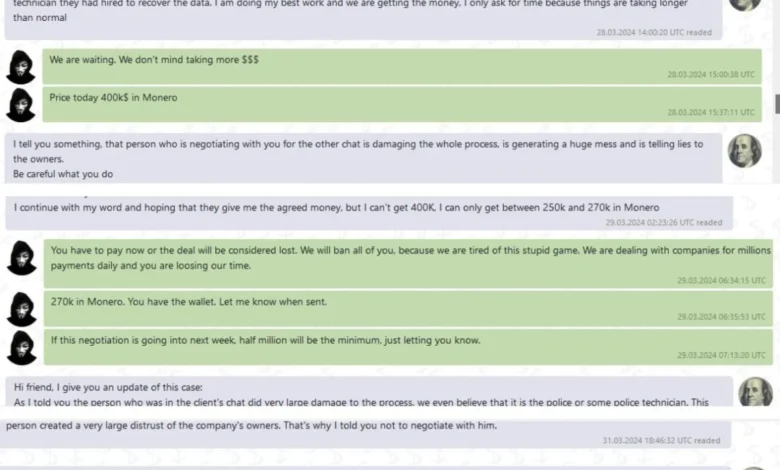
Chat logs obtained by investigators captured surreal interactions in which RansomwareHelp frantically pleaded with LockBit operatives not to disclose the ongoing negotiations to the victim organization. Simultaneously, RansomwareHelp attempted to bargain down the ransom while urging the threat actors to maintain their price point.
LockBit representatives quickly grew hostile toward the protracted negotiations, warning that the victim’s hesitation would trigger automatic price increases of $100,000 per day. In one intercepted message, RansomwareHelp complained to the cybercriminals: "I tell you something, that person who is negotiating with you for the other chat is damaging the whole process. Please do not change the price. I am doing my best to achieve it."
Realizing they were being exploited by their own remediation provider, the accounting firm severed ties with RansomwareHelp and retained Soteria. Under legitimate guidance, the firm successfully negotiated a settlement directly with the hackers for roughly half of what RansomwareHelp had originally planned to charge.

Broader Implications and a Wave of DOJ Prosecutions
The indictment of Juan Ricardo Palacio Escobar is far from an isolated incident. It represents a major escalation in a coordinated crackdown by the United States Department of Justice (DoJ) targeting compromised entities within the cybersecurity ecosystem that covertly collaborate with cybercriminals.
The enforcement landscape has seen a flurry of high-profile actions in recent months:
- October 2026: The DoJ charged Edward Dubrovsky, 54, an executive at Canadian cybersecurity firm Cybersteward, with cyber extortion and conspiracy.
- October 2026: Federal authorities charged Zohar Pinhasi, 50, CEO of Florida-based MonsterCloud, with wire fraud and conspiracy. Prosecutors allege Pinhasi secretly paid hackers $8 million behind his clients’ backs while billing those same customers $19 million for non-existent remediation efforts.
- July 2026: Angelo Martino, a 41-year-old ransomware negotiator from Land O’Lakes, Florida, was sentenced to 70 months in federal prison. Prosecutors proved that Martino conspired with the BlackCat/ALPHV ransomware collective by leaking confidential client negotiation strategies to help extortionists maximize payout demands.
Security experts emphasize that these prosecutions highlight a vulnerable blind spot for small-to-medium-sized businesses (SMBs). Lacking internal technical expertise and facing existential threats to their commercial survival, desperate executives frequently sign lucrative contracts with unverified vendors who promise miraculous, turnkey recoveries.
As federal agencies continue to dismantle fraudulent remediation networks, the cybersecurity community urges victimized organizations to vet incident response partners rigorously, verify credentials through accredited industry bodies, and maintain transparent communication channels with law enforcement during active extortion events.
Related posts: