Quantitative trading software provider Build Alpha has officially launched its November 2026 software update, introducing integration with the Model Context Protocol (MCP) and a dedicated Prop Firm Simulator. Founded by market maker and quantitative strategy developer David Bergstrom, Build Alpha aims to bridge the gap between algorithmic research and retail execution. This latest release equips quantitative traders with tools to control strategy generation workflows via external artificial intelligence agents while providing empirical risk metrics specifically tailored to proprietary trading firm challenges.
The integration of MCP—an open-standard protocol engineered by AI developers to connect large language models securely to external tools—marks a notable shift in how quants interact with research software. Rather than navigating complex graphical user interfaces manually, users of local clients such as Claude Desktop, Claude Code, or Codex can now issue natural language prompts to orchestrate complex strategy searches. According to company disclosures, the system operates under two distinct modalities: a GUI-prompting mode that dynamically configures interface settings based on conversational input, and a fully headless mode allowing automated agents to configure, run, filter, and export robust trading strategies without rendering the user interface.
This architecture fundamentally redefines the hierarchy between automated research tools and language models. While previous iterations, such as Build Alpha’s v3.1 LLM Orchestrator, positioned the AI in an advisory capacity during localized parameter tuning, the new MCP server places the AI agent in complete operational control. The software functions as a dedicated quantitative research engine called upon by the language model. Supported actions span the entire lifecycle of strategy development, including genetic searches, portfolio optimization, automated filtering, and code export.
Concurrently, the platform has rolled out its Prop Firm Simulator, a feature developed in response to surging demand from retail and institutional traders participating in funded-account programs. Historically, retail quant traders have evaluated strategies primarily through raw pass rates or standard metrics like Sharpe ratios and maximum drawdowns. However, proprietary trading firms enforce complex contractual rules regarding daily drawdowns, consistency scores, minimum trading days, and payout caps.
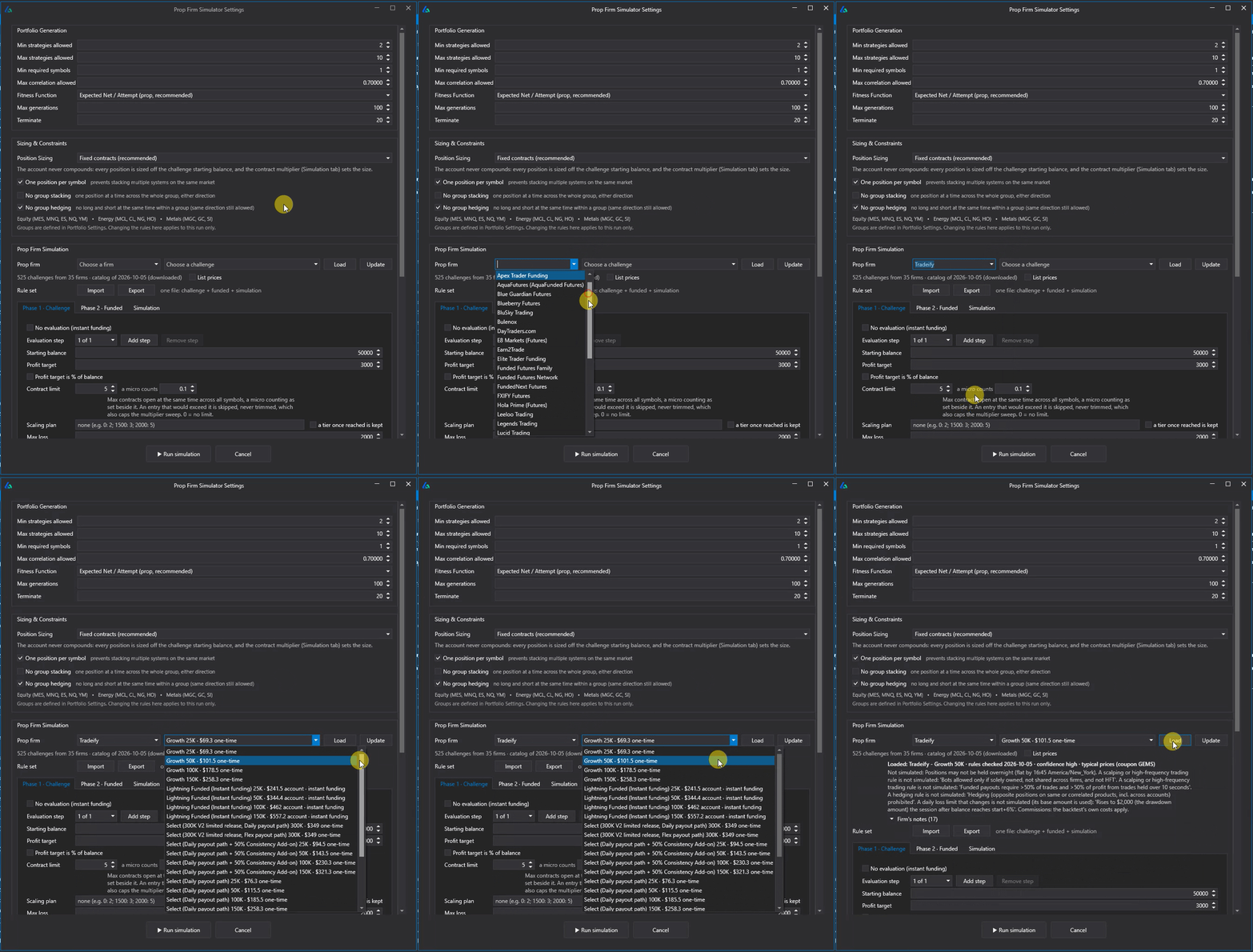
The Prop Firm Simulator directly addresses these hurdles by replaying historical candidate portfolios bar by bar through the explicit constraints of various prop firm challenges across multiple start dates. The engine evaluates not merely whether a strategy can pass an evaluation, but whether it generates sustainable profitability once funded. Through internal backtesting models, Build Alpha demonstrated that a high pass rate does not correlate directly with payout frequency; some portfolios with lower pass probabilities yielded significantly higher net returns due to faster payout triggers and favorable risk distribution. To quantify this, the simulator introduces a proprietary performance metric: Expected Net per Attempt. This metric calculates the expected monetary value of a single challenge purchase after accounting for all initial fees, failure costs, and operational restrictions.
Complementing the simulation engine is a built-in database comprising over 800 active futures prop firm challenges spanning 42 distinct firms. Maintained continuously via automated web-scanning AI agents, the repository allows users to instantly import challenge rules by selecting a firm and clicking load. Furthermore, a companion tool titled "Find Challenges" enables traders to input an established portfolio and cross-reference its performance across every challenge in the global database. This ranking system surfaces optimal capital allocation strategies, ensuring traders do not commit capital to firms whose structural rules mismatch their specific trading edges.
In addition to software automation and evaluation tools, the November 2026 release expands core infrastructure capabilities through a direct MetaTrader 5 (MT5) data downloader. By installing a one-click connector, users can import historical price data, point values, margin requirements, swap rates, and optional slippage or tick data directly into Build Alpha. This ensures that quantitative backtests utilize broker-specific execution characteristics. The update also delivers targeted code-export patches, resolving historical indexing discrepancies in Python scripts for Interactive Brokers, correcting bar timestamp alignments for Darwinex and other MT5 brokers, and eliminating rounding errors in alternative data comparisons—such as Commitment of Traders (COT) indices—within NinjaTrader 8 and MT5 code exports.
Industry observers note that these upgrades reflect a broader institutionalization of retail quantitative trading. By combining local AI agent control via MCP with algorithmic evaluation of proprietary trading firm constraints, developers are systematically removing manual friction from strategy generation. Build Alpha has additionally teased its upcoming development roadmap, confirming that a native live execution layer featuring streaming P&L and real-time position tracking will debut in the subsequent release. Existing license holders can access the November 2026 update immediately, while prospective users can review demonstration materials and licensing tiers directly through the platform’s official portal.