Bitcoin Surges Above $75,000 as Geopolitical De-escalation and Robust ETF Inflows Reignite Market Optimism.

Bitcoin has made a decisive return above the $75,000 mark, propelled by a confluence of easing geopolitical tensions in the Middle East and a sustained influx of capital into the burgeoning cryptocurrency industry, particularly through spot Bitcoin Exchange-Traded Funds (ETFs). This significant price recovery, which saw Bitcoin briefly touch an intraday high of $78,240 before stabilizing around $76,778, marks its highest level in 11 weeks and has sparked renewed debate among investors and analysts about the cryptocurrency’s potential trajectory towards the elusive six-figure milestone of $100,000.
The Catalytic Role of Geopolitical De-escalation
The recent bullish momentum for Bitcoin can be traced back to a series of diplomatic breakthroughs that began in early April, effectively de-escalating simmering tensions in a critical global region. A pivotal moment arrived with the announcement of a two-week temporary ceasefire agreement between the United States and Iran, mediated by Pakistan. This accord, reached mere hours before a deadline set by US President Trump, paved the way for formal peace talks scheduled to take place in Islamabad. Such diplomatic advancements are crucial as geopolitical instability typically fuels risk aversion, driving investors towards traditional safe-haven assets and away from more volatile holdings like cryptocurrencies. The initial positive sentiment was further bolstered by a 10-day ceasefire specifically related to the Israel-Lebanon front, which eased regional hostilities. Simultaneously, Iran’s declaration that the strategically vital Strait of Hormuz—a crucial chokepoint for global oil shipments—was open to commercial shipping, provided a significant boost to global market confidence. These developments collectively helped cool international oil prices, improved sentiment across equity markets, and fostered an environment conducive to renewed appetite for risk assets, including Bitcoin.
The Strait of Hormuz, linking the Persian Gulf with the Gulf of Oman and the Arabian Sea, is arguably the world’s most important oil transit choke point. Approximately 20% of the world’s total petroleum liquids consumption, or roughly 21 million barrels per day, passed through the Strait in 2023. Any disruption or threat to shipping in this narrow waterway immediately triggers spikes in oil prices and broader market uncertainty. Therefore, Iran’s explicit assurance of open passage was a powerful signal of reduced regional friction, directly contributing to the broader risk-on sentiment observed across global financial markets. This reduction in macro-level uncertainty provided the necessary tailwind for Bitcoin, allowing its inherent demand drivers to assert themselves more forcefully.
Institutional Inflows and Spot Bitcoin ETFs
Beyond geopolitical relief, the sustained demand from institutional investors, primarily channeled through Spot Bitcoin ETFs, has been a critical accelerator for Bitcoin’s ascent. The period coinciding with the geopolitical de-escalation saw an extraordinary surge in capital flowing into these investment vehicles. Major exchanges and market makers demonstrated a swift response to the shifting sentiment, executing substantial Bitcoin purchases. Binance notably acquired approximately 29,344 BTC, Coinbase added 20,756 BTC, Kraken secured 8,600 BTC, while other prominent players like Wintermute and Bybit also augmented their positions. These transactions collectively amounted to nearly $4.5 billion in Bitcoin, underscoring a significant institutional accumulation phase.
The performance of Spot Bitcoin ETFs, which launched earlier in the year, has been particularly noteworthy. These ETFs provide traditional investors with regulated access to Bitcoin without the complexities of direct ownership, custody, or security. This week alone, these investment products recorded robust demand, culminating in a staggering $663.91 million in inflows on Friday, pushing the weekly total to an impressive $996.38 million. Funds like BlackRock’s iShares Bitcoin Trust (IBIT), Fidelity Wise Origin Bitcoin Fund (FBTC), and Ark 21Shares Bitcoin ETF (ARKB) have consistently attracted significant capital, demonstrating growing institutional acceptance and integration of Bitcoin into mainstream investment portfolios. This steady influx of capital has been instrumental in helping Bitcoin reclaim and sustain levels that it had struggled to hold earlier in April, effectively absorbing selling pressure and providing a strong demand floor. The sustained positive net inflows into ETFs indicate that institutional conviction in Bitcoin as a legitimate asset class is strengthening, moving beyond initial speculative interest to more strategic long-term allocations.
Chronology of Key Events Leading to the Rally:
- Early April: Initial diplomatic discussions between the US and Iran intensify, mediated by Pakistan.
- April 10-12: Reports surface of a two-week temporary ceasefire agreement between the US and Iran, signaling a significant reduction in immediate conflict risk. Formal peace talks are scheduled.
- April 12-14: Iran declares the Strait of Hormuz open for commercial shipping, further easing concerns about global oil supply and maritime security. Simultaneously, a 10-day ceasefire is announced on the Israel-Lebanon front.
- April 14-16: Global markets react positively. Oil prices cool, and major equity indices show upward movement. Risk appetite begins to return.
- April 15-17: Major cryptocurrency exchanges and market makers (Binance, Coinbase, Kraken, Wintermute, Bybit) execute large-scale Bitcoin purchases, totaling approximately $4.5 billion, indicating a rapid institutional response to improving sentiment.
- April 17-19: Spot Bitcoin ETFs record strong demand, with weekly inflows nearing $1 billion, including a substantial single-day inflow.
- April 19-20: Bitcoin’s price breaks decisively above the $75,000 resistance level, reaching an intraday high of $78,240, fueled by both geopolitical relief and sustained institutional buying pressure.
Divergent Sentiment: Fear Amidst the Rally

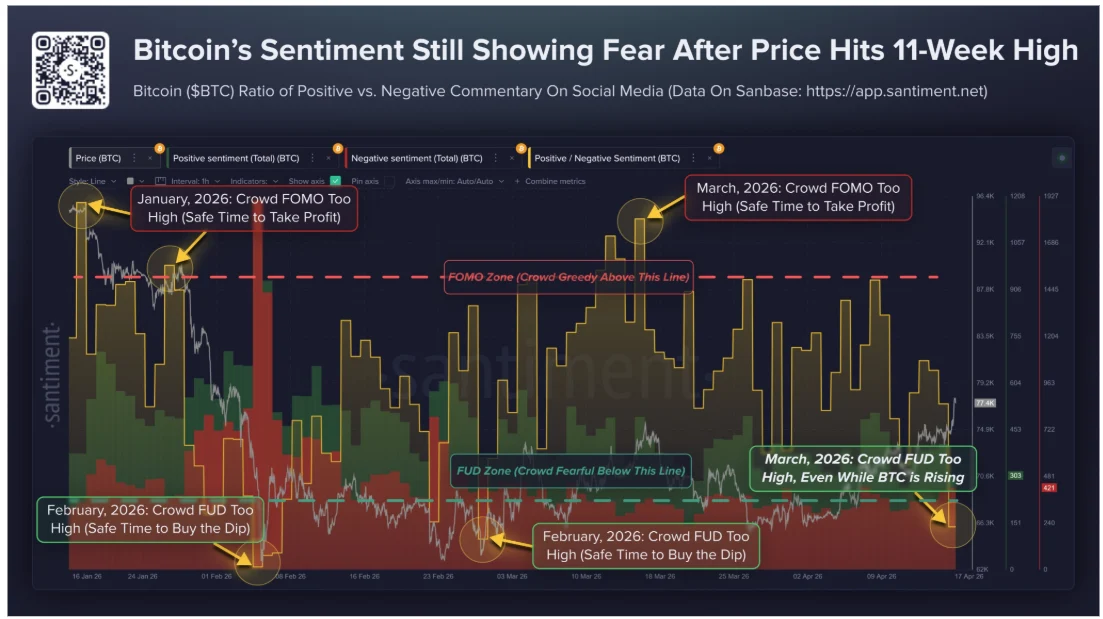
Despite Bitcoin trading at its highest level in 11 weeks, on-chain sentiment data presents a fascinating paradox. Data from Santiment, a leading on-chain analytics firm, suggests that the current rally is not being universally embraced by overwhelming optimism. Instead, bearish commentary continues to dominate social discussions across various platforms, with an observed ratio of roughly three negative comments for every two positive ones. This indicates a prevailing sense of skepticism, or even outright fear, among a significant portion of the market participant base.
This divergence between price action and public sentiment is a critical factor for analysis. Historically, market rallies that occur without a corresponding surge in "crowd optimism" often tend to be more sustainable. When prices rise amidst widespread skepticism, it suggests that the rally is not primarily driven by speculative fervor or retail FOMO (Fear Of Missing Out). Instead, it implies that stronger, more fundamental demand from institutional players or long-term holders is at play. In such an environment, there is less immediate selling pressure from overheated speculative positioning, as many potential sellers may still be on the sidelines, waiting for higher prices or a clearer bullish signal. This "wall of worry" dynamic suggests that the current ascent could have more room to run, as there isn’t an excess of overleveraged bullish bets that could quickly unwind and trigger a sharp correction.
Technical Outlook and the Road to $100,000
From a technical perspective, Bitcoin’s recent price action has shown encouraging signs. The break above $75,000 represents a significant psychological and technical hurdle. Furthermore, the price advance successfully crossed a descending trendline that had previously capped rallies since October of the preceding year (assuming current year is 2025, this refers to October 2024), when Bitcoin reached approximately $126,000 (a previous all-time high or significant peak). This trendline breakout suggests a shift in market structure, potentially signaling the end of a correctional or consolidation phase.
However, caution remains for some technical indicators. The 50-day Exponential Moving Average (EMA) is still positioned below the 200-day EMA, which is typically considered a bearish or neutral "death cross" signal in traditional technical analysis. While lagging, a sustained upward trend would eventually see the 50-day EMA cross above the 200-day EMA, forming a "golden cross" which is a strong bullish indicator. Traders are closely watching for this confirmation. Key resistance levels ahead include the recent intraday high of $78,240, followed by the $80,000 psychological barrier, and then the mid-$80,000 region. A clear break and consolidation above these levels would significantly bolster the case for a push towards $90,000 and eventually $100,000.
The path to a six-figure Bitcoin price will likely depend on more than just transient geopolitical relief. While the current momentum is strong, sustainability will require continued institutional accumulation, favorable macroeconomic conditions, and a potential shift in broader market sentiment. Sentiment trends, despite the current skepticism, suggest that many traders anticipate Bitcoin to encounter significant resistance and potentially stall around the mid-$80,000 region. Paradoxically, this widespread expectation of a slowdown could be a bullish signal. If the rally manages to push past these widely anticipated resistance points, it could trigger a "short squeeze" or ignite a fresh wave of buying from those who were previously hesitant, potentially propelling Bitcoin beyond $90,000 and towards $100,000 with greater force.
Broader Market Implications and Expert Perspectives
The renewed strength in Bitcoin has broader implications for the financial landscape. As a bellwether for the broader cryptocurrency market, Bitcoin’s rally tends to pull altcoins higher, indicating a healthy risk appetite across the digital asset space. The correlation between geopolitical stability, oil prices, equity markets, and Bitcoin’s performance highlights its increasing integration into the global macro narrative. Major financial institutions are increasingly viewing Bitcoin not just as a speculative asset, but as a potential hedge against inflation, a store of value, and a diversifier in a balanced portfolio, especially in times of geopolitical flux.
Analysts at leading financial institutions are cautiously optimistic. For instance, crypto strategists at JPMorgan have previously noted the growing impact of institutional flows on Bitcoin’s price discovery, suggesting that ETF demand will continue to be a dominant factor. Similarly, independent crypto analysts like those at Glassnode, while acknowledging the bullish price action, often urge caution, focusing on underlying network health and investor behavior to gauge the sustainability of rallies. The current environment, with strong institutional buying coupled with retail skepticism, presents a unique dynamic that could allow for a more prolonged and fundamental-driven uptrend, rather than a short-lived, speculative bubble.
The market is now poised at a critical juncture. The recent surge, fueled by a rare alignment of geopolitical de-escalation and robust institutional demand, has injected significant optimism. While the lingering bearish sentiment among some segments of the market might seem counterintuitive, it could ironically provide a stronger foundation for a sustained rally by preventing excessive leverage and speculative froth. The journey to $100,000 will undoubtedly be fraught with challenges and volatility, but with renewed confidence from institutional players and a clearer path in the global geopolitical landscape, Bitcoin appears well-positioned to test higher resistance levels in the coming weeks and months. The focus now shifts to whether these tailwinds are sufficient to overcome remaining technical hurdles and turn widespread skepticism into broader market conviction, ultimately paving the way for a new all-time high.