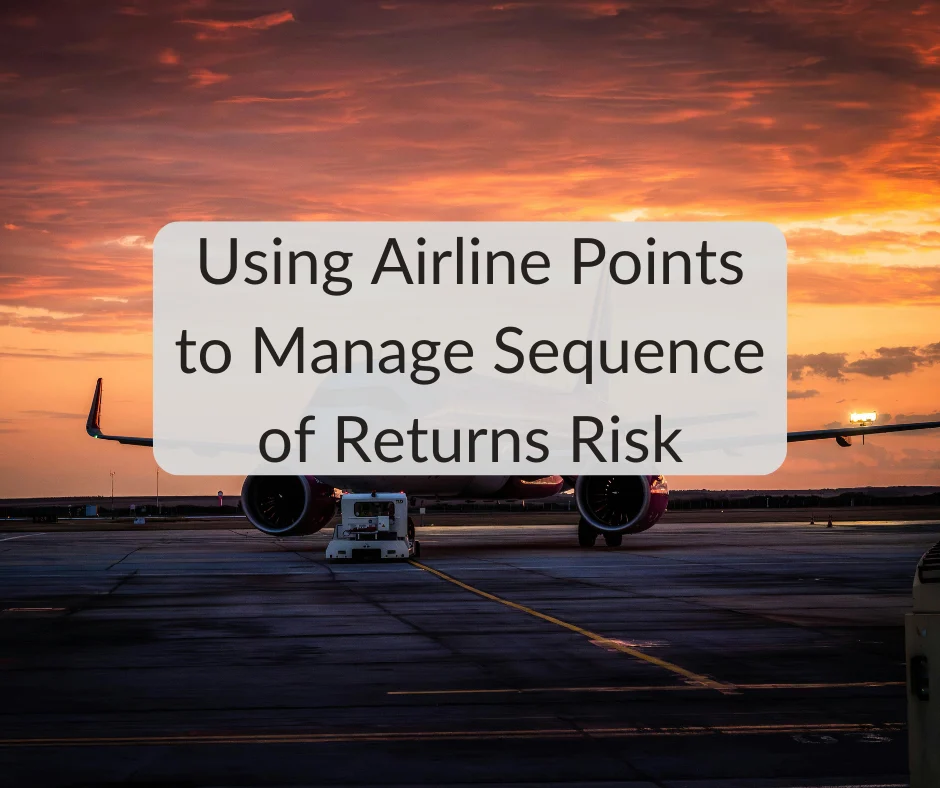
In the complex landscape of retirement planning, the "Sequence of Returns Risk," commonly referred to as SORR, remains one of the most formidable challenges for individuals transitioning from wealth accumulation to the withdrawal phase. While traditional financial strategies often focus on bond tents, cash cushions, or the Guyton-Klinger guardrails, a niche but increasingly discussed strategy involves the strategic accumulation and preservation of airline miles and credit card reward points as a non-correlated buffer against market volatility. This approach, though unconventional, addresses both the mathematical and behavioral hurdles of early retirement, particularly for those whose post-career goals include significant international travel.
The Mechanics of Sequence of Returns Risk
To understand the utility of airline points as a financial tool, one must first analyze the mechanics of SORR. This risk occurs when a retiree experiences poor investment returns in the first decade of their retirement. Because the retiree is simultaneously withdrawing funds for living expenses while the market is down, the portfolio’s principal is depleted more rapidly than if the losses had occurred later in life. This "sequencing" of negative returns can permanently impair a portfolio’s ability to recover, even if the long-term average return of the market remains positive.
According to the Trinity Study, which established the "4% Rule," a portfolio’s success is heavily dependent on the performance of assets during the first five to seven years of withdrawal. Financial advisors often recommend reducing equity exposure during this "Retirement Red Zone"—the five years before and after the retirement date—to mitigate this risk. The proposal to use airline points functions as a specialized "bucketing" strategy, where travel expenses are pre-funded with non-cash assets, thereby reducing the required cash withdrawal from a depressed portfolio during a market downturn.
The Evolution of Travel as a Primary Retirement Expense
For many high-earning professionals, travel is not merely a luxury but a core component of their retirement identity. Case data from retirees moving toward the Financial Independence, Retire Early (FIRE) milestone shows that travel can account for a significant portion of annual spending. For example, some households report travel expenditures ranging from $19,000 to $32,000 annually, representing upwards of 20% of their total budget.
The personal chronology of many such retirees reflects a delayed gratification model. In many instances, professionals in the medical, legal, or corporate sectors spend their early careers focused on academic prerequisites, residencies, and building practices. Travel often becomes a prioritized activity only in the "early attending" years or as retirement approaches. As these individuals plan for a transition—such as an international move or a commitment to visit distant family—the need for a robust travel budget becomes a fixed, rather than discretionary, requirement.
Strategic Accumulation: The "Points Tent" Strategy
The traditional advice from travel enthusiasts and "travel hackers" is to "earn and burn." This logic is based on the fact that airline miles are a depreciating currency; airlines frequently devalue their points by increasing the number of miles required for a specific flight. However, the "Points Tent" strategy proposes a different approach: hoarding points specifically during the final five years of one’s career to serve as a travel-specific emergency fund during the early years of retirement.
In a recent analysis of this strategy, a retired professional highlighted the accumulation of approximately one million Delta SkyMiles and 250,000 Chase Ultimate Rewards points as a strategic reserve. By utilizing high-tier credit cards and loyalty programs during their high-income years, they effectively "pre-paid" for several years of international travel.
The math behind this strategy becomes clear when comparing point usage to cash withdrawals in a bear market. For instance, an international flight costing $1,100 could be purchased for 82,000 miles plus minor fees. If a retiree pays cash for that flight while their portfolio is growing at a real rate of 6%, that $1,100 would have grown to approximately $1,472 over five years. Conversely, if the market drops by 20% in the year the flight is needed, selling stocks to fund the $1,100 ticket forces the retiree to lock in a loss. Using points instead allows the equity portion of the portfolio to remain untouched, providing it the "runway" needed to recover when market conditions improve.
Behavioral Finance and the Psychological Buffer
Beyond the mathematical benefits, the use of points to manage SORR addresses a critical behavioral component of retirement: the "fear of spending." Many retirees find it psychologically difficult to spend money on non-essential items when they see their portfolio balance declining. This often leads to a "frugality trap," where retirees cancel planned trips and experiences that were the very reason they sought financial independence.
By using airline points, the expense is perceived as "free" or "sunk," which bypasses the pain of selling assets at a loss. Financial planners note that maintaining a high quality of life during market downturns is essential for the long-term sustainability of a retirement plan. If a retiree can still fly to visit family or explore a new country using a points balance, they are less likely to experience the stress and regret that leads to abandonment of their financial plan.
Risks and Industry Devaluation Trends
Despite the benefits, hoarding points is not without significant risks. Unlike a brokerage account, airline points are not owned by the individual; they are the property of the issuing airline and can be revoked or devalued at any time without notice.
Data from the travel industry suggests that airline miles devalue at an average rate of 10% to 15% per year. For example, a flight that cost 60,000 miles five years ago might cost 100,000 miles today. This "mileage inflation" means that points are a poor long-term investment compared to equities. However, proponents of the SORR-points strategy argue that the correlation between the stock market and airline devaluations is low. If the stock market crashes, the airline does not necessarily devalue its points at the same moment. In fact, during economic downturns, airlines may occasionally offer "award sales" to stimulate travel, making points more valuable exactly when cash is most precious.
Expert Analysis and Broader Implications
Financial analysts remain divided on the efficacy of using loyalty points as a formal asset class. Some argue that the lack of liquidity and the risk of program changes make points too volatile to be considered a reliable part of a SORR mitigation strategy. Others suggest that for retirees with "fat FIRE" portfolios (those with high spending levels), the impact of points is negligible.
However, for the "middle-class millionaire" retiree, the impact is more pronounced. If travel constitutes $20,000 of a $100,000 annual budget, being able to cover that $20,000 with points for three consecutive years of a market downturn effectively reduces the withdrawal rate from 4% to 3.2%. This 0.8% reduction can be the difference between a portfolio that survives a 30-year retirement and one that is exhausted prematurely.
Conclusion: A Specialized Tool for a Specific Demographic
The strategy of using airline points to manage Sequence of Returns Risk is not a universal solution. It is most effective for a specific demographic: those in the "Retirement Red Zone" who have high travel aspirations and have accumulated significant rewards through professional expenses or strategic credit card usage.
While it does not replace the need for a diversified portfolio or a sensible withdrawal strategy, the "Points Tent" offers a unique fusion of behavioral psychology and tactical asset management. As the FIRE movement continues to evolve, the integration of non-traditional assets like loyalty points into formal retirement planning highlights a growing sophistication in how individuals protect their wealth and their lifestyle against the uncertainties of the global market. Whether this "crazy scheme" becomes a standard recommendation or remains a niche tactic, it underscores a fundamental truth of retirement: flexibility is the ultimate hedge against risk.