A Practical Framework for OpenVLA Fine-Tuning: Validating Vision-Language-Action Models via Parameter-Efficient Adaptation

The landscape of robotic artificial intelligence is currently undergoing a paradigm shift, moving away from specialized, task-specific controllers toward large-scale foundation models. At the forefront of this movement is OpenVLA, a 7-billion-parameter vision-language-action (VLA) model designed to bridge the gap between high-level semantic understanding and low-level robotic control. While the scale of such models often presents a barrier to entry for researchers with limited computational resources, new methodologies are emerging to make the fine-tuning of these massive systems more approachable. A recent technical demonstration has successfully established a reproducible, low-cost pipeline for adapting OpenVLA using Low-Rank Adaptation (LoRA) within a cloud-based environment, proving that sophisticated robotic training is no longer confined to massive industrial server farms.

The Emergence of Vision-Language-Action Models
To understand the significance of this reproducible fine-tuning path, one must first look at the architecture of OpenVLA. Introduced in mid-2024, OpenVLA is an open-source model trained on a staggering 970,000 real-world robot demonstrations. Unlike traditional Large Language Models (LLMs) that only process text, or Vision-Language Models (VLMs) that describe images, a VLA model like OpenVLA actively interacts with the physical world. It ingests two primary inputs: a visual feed from a robot’s workspace and a natural-language command, such as “place the bowl on the plate.”
The model’s output is not text, but a series of discrete action tokens. These tokens represent normalized seven-degree-of-freedom (7-DoF) end-effector commands. These commands dictate the robot’s movement in 3D space (x, y, z), its orientation (roll, pitch, yaw), and the state of its gripper. By predicting these actions in sequence, the model effectively "thinks" through the physical motions required to complete a complex task.

The Challenge of Embodiment Shift
While OpenVLA provides a robust foundation, roboticists frequently encounter the "embodiment shift" problem. This occurs when a pretrained model is deployed in an environment that differs from its training data—perhaps due to a new camera angle, a different gripper type, or unique objects in the workspace. In these scenarios, the model requires fine-tuning to align its existing knowledge with the new physical constraints.
Historically, fine-tuning a 7-billion-parameter model required significant VRAM and time, often making it inaccessible for small-scale experiments. The recent demonstration focuses on a "smoke test" approach: a short, verifiable training run designed to prove that the data pipeline, the hardware utilization, and the model updates are functioning correctly before a researcher commits to a full-scale, weeks-long training session.

Methodology: The Role of Low-Rank Adaptation (LoRA)
The primary tool used to democratize this training process is Low-Rank Adaptation (LoRA). In a standard full fine-tuning scenario, every one of the model’s 7 billion parameters would be updated, requiring massive amounts of memory to store gradients and optimizer states. LoRA circumvents this by freezing the majority of the pretrained weights and only training a small set of "adapter" matrices.
According to data from the OpenVLA project, LoRA can match the performance of full fine-tuning while updating as little as 1.4 percent of the total parameters. This efficiency is what allows the training to run on a single NVIDIA A100 GPU in a Google Colab environment. By utilizing a LoRA rank of 32, the experiment maintains a balance between model expressivity and computational thrift, producing a lightweight adapter checkpoint rather than a massive 15GB model file.

Chronology of a Reproducible Training Run
The demonstration follows a strict, step-by-step chronology designed to ensure that the results can be audited and replicated by third parties.
- Environment Configuration: The process begins by establishing a dual-environment setup in Google Colab. Because OpenVLA relies on specific, often older, versions of machine learning libraries, a dedicated virtual environment is created for training. A second environment is used for syncing data to Weights & Biases (W&B) to avoid dependency conflicts.
- Dataset Acquisition: The experiment utilizes the
libero_spatial_no_noopsdataset, part of the LIBERO benchmark for language-conditioned robot manipulation. This dataset is stored in the Robot Learning Dataset Standard (RLDS) format, which organizes robot demonstrations into episodes containing images, instructions, and actions. - The Training Execution: Using the official OpenVLA fine-tuning script, the model undergoes 100 steps of training. The parameters are set conservatively: a batch size of 2 and gradient accumulation steps of 8, resulting in an effective batch size of 16.
- Metric Logging and Verification: Throughout the 100 steps, system telemetry and training metrics are logged. The run concludes with a synchronization step that pushes all data to an external experiment tracker, providing an "audit trail" of the GPU’s work.
Analysis of Training Metrics and Evidence
The value of this 100-step run lies in the evidence it leaves behind. Rather than simply claiming success, the demonstration provides three critical metrics that confirm the model is learning:

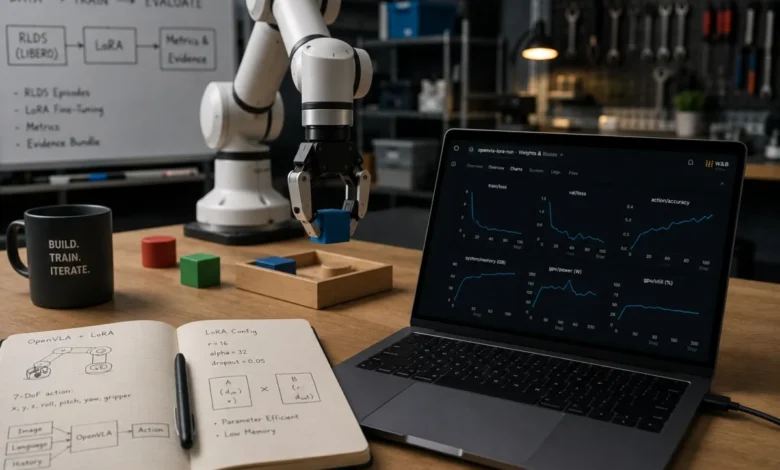
- Training Loss: This measure of supervised error dropped sharply within the first ten steps, stabilizing between 3.2 and 3.6. This decline confirms that the LoRA adapters are successfully absorbing the patterns present in the LIBERO dataset.
- L1 Action Loss: This metric tracks the absolute difference between the model’s predicted actions and the actual demonstrations. The run showed a decrease from 0.46 to approximately 0.22, indicating that the model’s physical predictions were becoming more accurate.
- Action-Token Accuracy: This represents the frequency with which the model’s discrete tokens matched the ground truth. Accuracy rose from a baseline of 0.09 to a peak of 0.35.
Crucially, the experiment also logged system telemetry. The NVIDIA A100 GPU maintained a power draw between 165 and 195 watts, with a utilization rate of roughly 40 percent. These figures are essential for verification; they prove that the notebook was performing genuine computational work rather than idling or encountering a silent failure.
Official Context and Industry Implications
The use of the LIBERO dataset is particularly relevant given its status in the robotics community. Released under the Creative Commons Attribution 4.0 International license, LIBERO focuses on "lifelong robot learning," challenging models to handle spatial relationships—such as placing one object relative to another. By proving that OpenVLA can be adapted to LIBERO spatial tasks in a simple Colab notebook, the experiment suggests that the barrier to "spatial intelligence" in robots is lowering.

Industry analysts suggest that the ability to run "verifiable smoke tests" is a critical step toward more transparent AI research. In an era where "black box" models are common, providing a clear path from dataset loading to hardware verification allows other researchers to build upon work with confidence. This approach aligns with the MIT-licensed nature of the OpenVLA codebase, which encourages open collaboration and commercial adaptation.
Broader Impact on Robotics Research
The implications of this reproducible path extend beyond a single model. It establishes a blueprint for how large-scale "Physical AI" can be tested. If a researcher can verify a training pipeline in 100 steps for a few dollars of cloud compute, they are much more likely to pursue innovative experiments that might otherwise seem too "fragile" or "expensive."

Furthermore, the success of LoRA in this context reinforces the trend toward parameter-efficient fine-tuning (PEFT). As models grow from 7 billion to 70 billion parameters and beyond, PEFT will likely become the standard method for task adaptation. The ability to swap small LoRA adapters—each tailored to a specific robot or a specific kitchen—allows for a modular approach to robotics. A single "brain" (OpenVLA) could theoretically use dozens of different "skill modules" (LoRA adapters) depending on the task at hand.
Conclusion: The Importance of the Audit Trail
The ultimate takeaway from this technical demonstration is the necessity of the experiment tracker as an audit trail. In robotics, where the gap between simulation and reality is notoriously difficult to bridge, having a reviewable record of training is paramount. The demonstration concludes that before asking whether a robot policy is "good" or "ready for deployment," researchers must first prove that the training run is real, reproducible, and measurable.

By providing a compact, 100-step baseline that is honest about its limitations, this framework offers a starting point for the next generation of roboticists. It proves that with the right tools—OpenVLA, LoRA, and standardized datasets—the future of intelligent robot control is within reach of anyone with a browser and a curiosity for the physical world. As these models continue to evolve, the emphasis on reproducibility will remain the cornerstone of reliable and scalable AI development.