Optimizing Distribution Networks through Unified Data and Strategic AI Integration: Lessons from Easy Metrics and Tyson Foods

The logistics and distribution landscape in the United States has reached a critical inflection point where the sheer scale of operations often outpaces the ability of leadership to maintain granular visibility. As global supply chains grow more volatile, the reliance on massive distribution networks has intensified, with the U.S. Bureau of Labor Statistics reporting that the warehousing and storage sector alone employs approximately 1.8 million workers. When considering the broader transportation and warehousing sector, that figure climbs to more than 6.5 million jobs nationwide. This immense scale means that even the most marginal inefficiencies—seconds lost per pick or slight misalignments in labor scheduling—can aggregate into multi-million-dollar losses across a national footprint.
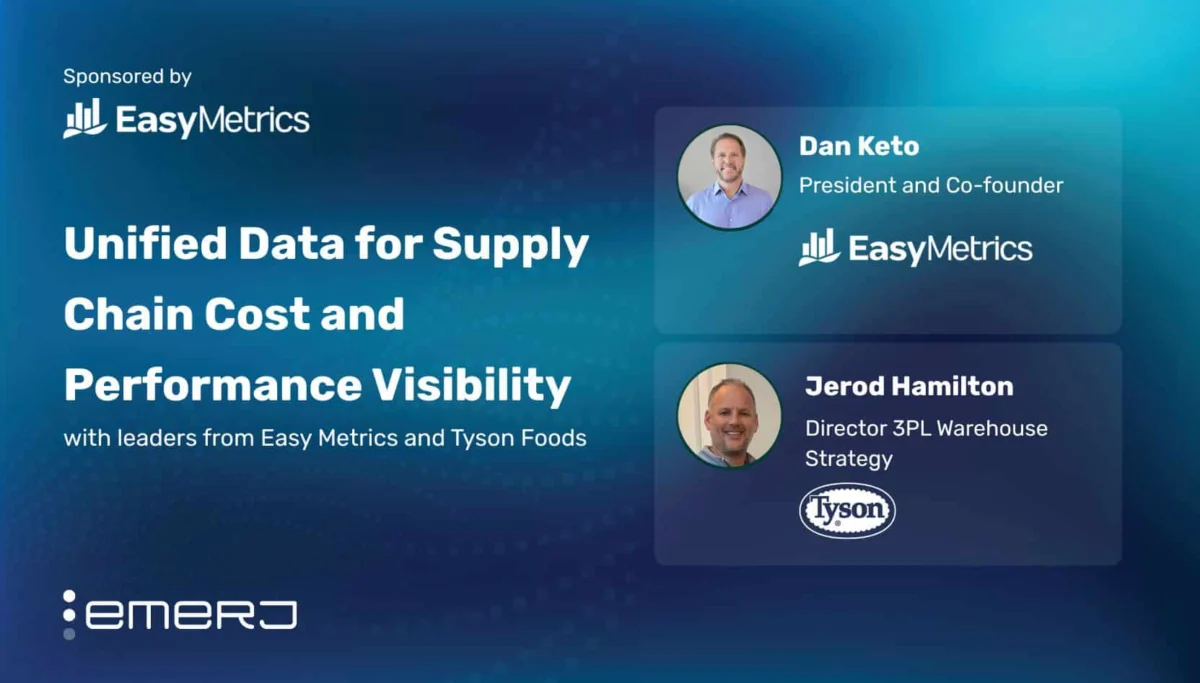
Despite the proliferation of digital tools, a persistent "visibility gap" continues to plague distribution and fulfillment leaders. Recent insights from industry experts Dan Keto, President and Co-founder of Easy Metrics, and Jerod Hamilton, Director of 3PL Warehouse Strategy at Tyson Foods, suggest that the primary obstacle to modernization is not a lack of data, but rather the fragmentation of that data across disparate, non-interoperable systems. This lack of a unified operational model prevents organizations from transitioning from reactive crisis management to proactive, data-driven decision-making.
The Infrastructure of Fragmentation and the Cost of Silos
The modern warehouse is a symphony of diverse technologies, yet these instruments rarely play from the same sheet music. Operational data is typically scattered across Warehouse Management Systems (WMS), labor management platforms, transportation management systems (TMS), and various financial models. These systems were often implemented at different times to solve specific departmental problems, resulting in a "siloed" architecture that resists reconciliation.
The Brookings Institution has documented that this lack of data interoperability is a primary driver of supply chain fragility. When data is fragmented, the detection of disruptions is delayed, and coordination failures between departments remain invisible until they manifest as increased operating costs or service failures. The OECD’s Measuring Productivity Manual further reinforces this, stating that accurate performance analysis is impossible without integrated data sources and consistent measurement frameworks—conditions that are increasingly difficult to sustain as operations scale.
For a leader in a large-scale distribution network, this fragmentation creates a fundamental accountability crisis. Executives are held responsible for throughput and cost-per-unit, yet they often lack a single, defensible view of where time, capacity, and margin are actually being consumed on the floor.
Chronology of the Shift Toward Data Unification
The evolution of warehouse management has moved through three distinct eras. In the late 20th century, the focus was on basic digitization—moving from paper-based tracking to early WMS platforms. The second era, spanning the last decade, saw the rapid adoption of automation and robotics to combat rising labor costs and the "Amazon effect" of expedited delivery expectations.
We have now entered the third era: the era of Operational Intelligence. In this current phase, the challenge is no longer about generating data or automating physical movement; it is about harmonizing the massive volumes of transactional data generated by robotics, conveyors, and human labor into a coherent narrative.
As Dan Keto of Easy Metrics noted during a recent industry discussion, the industry is currently "data rich but insight poor." The push for unification is driven by the realization that automation without integrated visibility often just moves the bottleneck from one part of the warehouse to another. For instance, a high-speed sorter might increase throughput in one zone, but if the loading dock data isn’t synchronized, the result is merely a more expensive pile of inventory waiting to be moved.
Strategic AI Sequencing: Foundation Before Innovation
One of the most significant risks currently facing distribution leaders is the premature deployment of Artificial Intelligence (AI). With the hype surrounding Generative AI and Large Language Models (LLMs), many organizations are attempting to layer AI over their existing, fragmented data structures. Keto warns that this approach is fundamentally flawed and financially unsustainable.
Warehouses generate billions of data points from equipment logs and transactional records. However, this raw data is often "noisy" and lacks the necessary context for AI to produce reliable outputs. Keto emphasizes that applying AI to unconditioned data leads to "hallucinations"—errors where the AI identifies patterns that do not exist or provides mathematically impossible recommendations.
Furthermore, there is a massive cost asymmetry involved. Running complex queries against unoptimized data structures can be exponentially more expensive in terms of compute power. To make AI financially viable at scale, organizations must first implement transformation layers and conditioning models. This ensures that the AI is operating on a "single version of the truth" that has been mathematically validated against the physical realities of the warehouse floor.
The Tyson Foods Perspective: Upstream Planning and Downstream Drag
While data unification is a technical challenge, Jerod Hamilton of Tyson Foods highlights the operational challenge of "upstream" synchronization. In a massive enterprise like Tyson, the warehouse is the ultimate destination for various planning streams, including supply planning, production planning, deployment planning, and sales forecasting.
The difficulty arises because these planning layers often operate on different cadences and within different software ecosystems. When a sales forecast changes but the production plan remains static, the warehouse is forced to absorb the resulting friction. This might manifest as "misplaced inventory"—pallets of product that have arrived but have no immediate shipping destination—which consumes valuable rack space and increases labor costs as workers move the product multiple times.
Hamilton describes these as "tiny misses" across dozens of workflows. Individually, a five-minute delay in a handoff between production and deployment seems negligible. However, when multiplied by thousands of pallets across a national network of 3PL (third-party logistics) and dedicated facilities, these misses represent significant "leakage" that erodes the company’s bottom line.
Measuring Network Economics Over Local KPIs
A recurring theme in the analysis of modern distribution is the danger of "local optimization." A department manager might be incentivized to reduce labor costs in their specific zone, but if that reduction slows down the overall flow of goods to the shipping dock, the company loses money on late-delivery penalties or lost sales.
Hamilton points to the example of automated storage and retrieval systems (ASRS). These systems often operate on static rules, placing "fast-moving" goods in the most accessible locations. However, in the food industry, a product’s velocity can change overnight due to seasonal shifts or promotional activities. If the ASRS does not ingest real-time demand signals, it will continue to treat a now-slow-moving product as a priority, adding unnecessary seconds to every subsequent pull of a truly fast-moving item. These hidden costs rarely appear in a single department’s KPI but are devastating to the overall network economics.
Keto adds that the lack of a unified taxonomy is a major hurdle. When the engineering team defines "efficiency" differently than the finance team or the operations team, the organization ends up "chasing contradictions." A unified data model acts as a common language, allowing all stakeholders to see how a decision in one area—such as a change in pallet configuration—impacts the total cost to serve.
Broader Implications and the Path Forward
The transition to unified, AI-ready data models is no longer an optional "innovation project"; it is a requirement for survival in a high-inflation, labor-constrained economy. As distribution networks become more complex, the "human-in-the-loop" model of management, where supervisors rely on intuition and spreadsheets, is reaching its limit.
The insights from Easy Metrics and Tyson Foods suggest a clear roadmap for the industry:
- Data Harmonization: Consolidate WMS, robotics, and labor data into a single operational model.
- Conditioning and Transformation: Ensure data is mathematically consistent and contextually aware before introducing advanced analytics.
- Cross-Functional Synchronization: Break down the walls between supply planning and warehouse execution to reduce the "absorption cost" of upstream errors.
- Network-Wide Accountability: Shift performance metrics away from siloed departmental goals toward total network margin.
As the logistics sector continues to evolve, the winners will be those who can see through the noise of their own data. By bridging the gap between operational complexity and decision visibility, leaders can transform their distribution networks from cost centers into strategic assets capable of navigating an increasingly unpredictable global market. The financial impact of these improvements is not just theoretical; in an industry that supports 6.5 million jobs, the ability to reclaim even 1% of operational efficiency represents a transformative economic opportunity.