The 2026 Market Paradox: Why Equities Are Thriving Amidst Macroeconomic Headwinds

The global financial landscape as of mid-September 2026 presents a distinct contradiction: while traditional macroeconomic indicators signal mounting pressure, the equity markets continue to demonstrate robust, double-digit growth. This divergence between deteriorating economic metrics—such as rising mortgage rates, elevated bond yields, and persistent inflation—and the performance of the S&P 500 has left analysts and institutional investors grappling with a new paradigm. As of September 15, 2026, the market is currently navigating a period where fundamentals appear detached from conventional interest-rate-sensitive expectations.
A Chronology of Economic Tightening
The narrative of 2026 has been defined by a steady climb in the cost of capital and consumer expenses. In January, the financial environment appeared relatively stable, but the subsequent nine months have seen a sharp, systematic tightening. Mortgage rates, which began the year near 6%, have steadily climbed to reach 7%, effectively cooling the housing market and increasing the cost of entry for prospective homeowners.
Simultaneously, the bond market has undergone a significant repricing. The 10-year Treasury yield, a benchmark for global borrowing costs, has surged from 4% at the start of the year to 5% today. This shift reflects a market adjustment to the realization that the "higher for longer" interest rate environment is not merely a policy forecast but a functional reality.
Inflation metrics have also defied initial hopes for a rapid decline. After recording a 2.4% inflation rate earlier this year, the latest data shows a rebound to 3.4%. This inflationary pressure is most visible at the energy pump, where oil prices have escalated from under $60 per barrel in January to over $100 per barrel as of mid-September. Consequently, the national average for gasoline has climbed from $2.90 per gallon to well over $4, further squeezing household budgets and testing consumer resilience.
The Earnings-Driven Rally
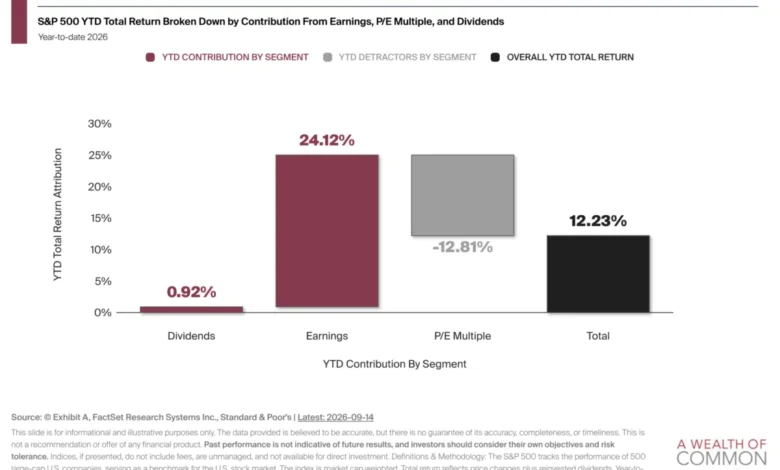
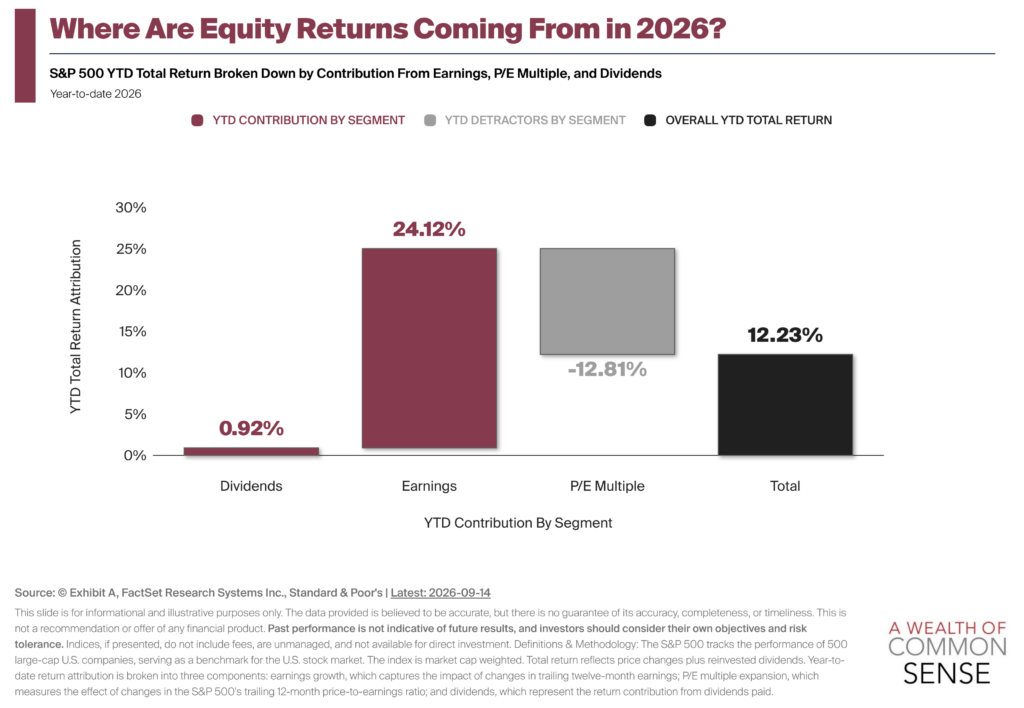
Despite these headwinds, the S&P 500 has maintained a double-digit return year-to-date. The most critical takeaway from the 2026 data is that this performance is not the result of speculative multiple expansion; rather, it is anchored in genuine, fundamental earnings growth.
Data attribution analysis reveals that corporations within the S&P 500 are reporting bottom-line results that significantly outpace the growth of their share prices. This creates a fascinating technical scenario: while the index price is rising, the valuation multiples—specifically the price-to-earnings (P/E) ratios—are actually contracting. In historical contexts, such a setup often precedes a market correction or a "soft landing" transition, yet the current environment remains dominated by the sheer scale of corporate profitability.
The Artificial Intelligence Catalyst
The primary engine behind this earnings strength is the unprecedented capital expenditure (CapEx) associated with the AI infrastructure buildout. Hyperscalers—the massive cloud infrastructure providers—have committed billions to the acquisition of high-end processing units and the construction of energy-intensive data centers.
This spending has created a "virtuous cycle" for the tech sector. The revenue generated by chipmakers and infrastructure providers flows directly into corporate earnings, which in turn justifies the continued investment in AI. However, this raises a central question for the investor community: Is this earnings growth sustainable, or is it a concentrated bubble fueled by the current AI arms race?
Market analysts remain divided on the durability of these returns. The current debate centers on three primary theories:
- Earnings Sustainability: Skeptics argue that the current growth is overly reliant on a single sector’s spending cycle. If AI adoption fails to translate into broader productivity gains for the general economy, the "hyperscaler" earnings streak may hit a ceiling.
- The Inflationary Drag: Continued inflation remains a threat to profit margins. While companies have successfully passed on costs to consumers thus far, sustained 3.4% inflation may eventually lead to a decline in discretionary spending.
- Valuation Compression: As bond yields remain elevated at 5%, the "discount rate" applied to future cash flows remains high. This forces investors to prioritize companies that can deliver immediate, tangible earnings growth over those promising long-term growth, a shift that is currently favoring established, cash-rich tech titans.
Broader Economic Implications
The resilience of the equity market in the face of these macroeconomic challenges has forced central bankers and institutional economists to reconsider their models. Traditionally, a 100-basis-point increase in the 10-year Treasury yield, coupled with a 100-basis-point increase in mortgage rates, would have triggered a broad contraction in corporate earnings.
The fact that the economy continues to "chug along" suggests that the corporate sector has become more efficient or that the AI-driven productivity shift is already providing a buffer against traditional interest rate sensitivity. However, this creates a policy conundrum: if the economy remains strong despite high rates, the Federal Reserve may feel compelled to maintain restrictive monetary policy for longer than the market currently anticipates.
Outlook and Investor Sentiment
As the market moves into the final quarter of 2026, the central theme remains a narrow focus on AI. The correlation between AI-related earnings reports and broader market sentiment is at an all-time high. Investors are effectively betting that the current technological transformation is a secular shift rather than a cyclical trend.
"We are witnessing a decoupling of asset prices from traditional macro-indicators," noted one senior strategist, "but that decoupling is inherently fragile."
The market’s current strength is undeniably impressive, but the lack of breadth—the tendency for only a handful of large-cap stocks to drive the index—remains a concern for market historians. A bull market that relies heavily on a single sector’s capital spending is prone to volatility should that spending cycle waver.
For the time being, the narrative is clear: as long as corporate earnings continue to rise faster than stock prices, the market finds a fundamental justification for its current valuation levels. The day that earnings growth stalls, however, the disconnect between the macro-economy and the stock market will likely face a sharp, and potentially painful, reconciliation. Until then, the markets are operating in a state of "AI-first" confidence, largely ignoring the warning signs emanating from the bond and energy markets.