Quantitative Analysis of Insider Purchase Filings: Evaluating Market Response and Informational Value

The U.S. Securities and Exchange Commission’s Form 4 filings have long served as a cornerstone for quantitative researchers seeking to understand the behavior of corporate insiders. Because these documents are public, highly structured, and governed by strict regulatory deadlines—requiring disclosure by the end of the second business day following a reportable transaction—they offer a unique window into the conviction of C-suite executives. However, the simplicity of a "one insider, one trade" narrative often masks a complex reality of joint filings, multi-tranche transactions, and varying security types. This article presents a comprehensive filing-date event study, analyzing C-suite purchase filings (Transaction Code P) submitted between January 1, 2022, and June 30, 2026, to determine whether such disclosures provide actionable signals for the broader market.
The scope of this research is vast, beginning with a raw dataset of 1,345,036 non-derivative transaction rows extracted from SEC records. Through a rigorous filtering process—designed to isolate meaningful events from routine administrative filings—the study reduces these to 11,957 component events. Following price validation, the removal of ambiguous data points, and issuer-day aggregation, the sample yields 7,406 distinct public signals. The results suggest that while these disclosures are associated with immediate, short-term market reactions, their long-term predictive power remains statistically tenuous.
The Evolution of Insider Trading Regulations
The regulatory framework surrounding Form 4 has evolved significantly in recent years, particularly with the implementation of enhanced disclosure requirements for Rule 10b5-1 trading plans. Since April 1, 2023, the SEC has mandated that filers explicitly indicate whether a transaction was executed under a pre-arranged 10b5-1 contract. This requirement has been a game-changer for data analysts, allowing for a clearer distinction between discretionary, information-driven purchases and those executed as part of a pre-determined schedule.
The study categorizes transactions based on the absence of such 10b5-1 flags, treating them as potentially discretionary. However, it is essential to acknowledge that this is an observational design. An officer might purchase shares following a precipitous price decline, during a corporate financing round, or in response to earnings news—all of which are invisible in standard structured fields. Consequently, while the study observes post-filing returns, it does not claim that these returns are the direct causal result of the filing itself, nor does it advocate for a specific trading strategy.
Anatomy of the Filing Funnel
To ensure statistical integrity, the research applies a strict "filing-only" funnel. The methodology excludes Form 4/A amendments to avoid the complexities of supersession, focusing instead on original filings. Furthermore, the study adopts a conservative policy regarding joint filings. Because the SEC’s flattened research tables do not always attribute individual transactions to specific owners in a joint filing, the researchers opted to drop all multi-owner accessions. While this reduces the total sample size, it prevents the artificial inflation of transaction counts that could skew the analysis.
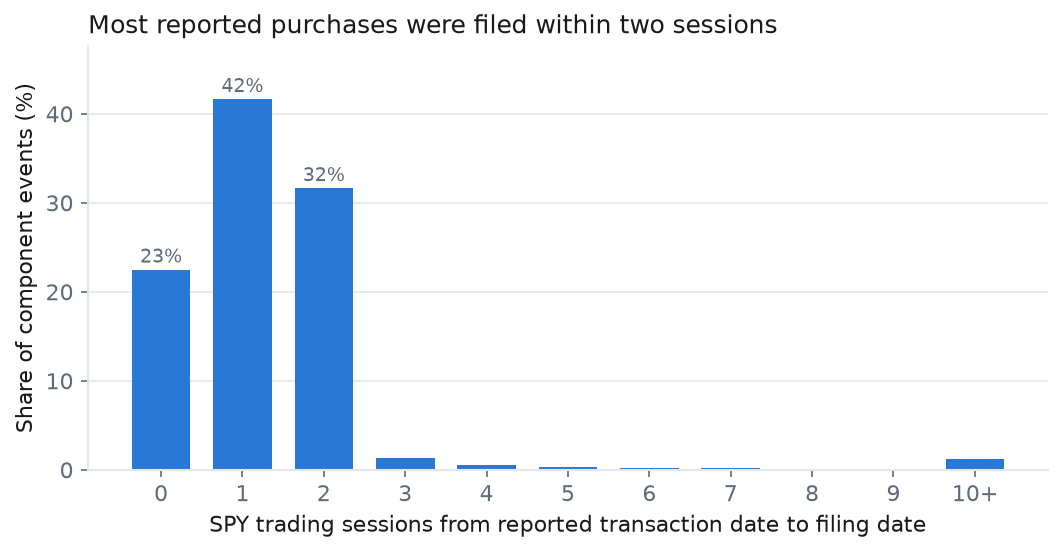
The following table summarizes the data reduction process, highlighting the transition from raw transaction rows to refined, usable events:
| Filter Stage | Surviving Rows/Events |
|---|---|
| Non-derivative transaction rows (All) | 1,345,036 |
| Original Form 4 filings (Excluding 4/A) | 1,312,250 |
| Code-P purchases (Acquired) | 114,505 |
| Officer-level purchases (C-Suite) | 30,004 |
| Non-10b5-1 plan trades | 28,957 |
| Validated component events | 11,957 |
This methodology reveals that a significant portion of raw insider activity is either noise, administrative in nature, or part of pre-arranged plans that do not carry the same informational signal as discretionary purchases.
Statistical Findings: The Short-Horizon Association
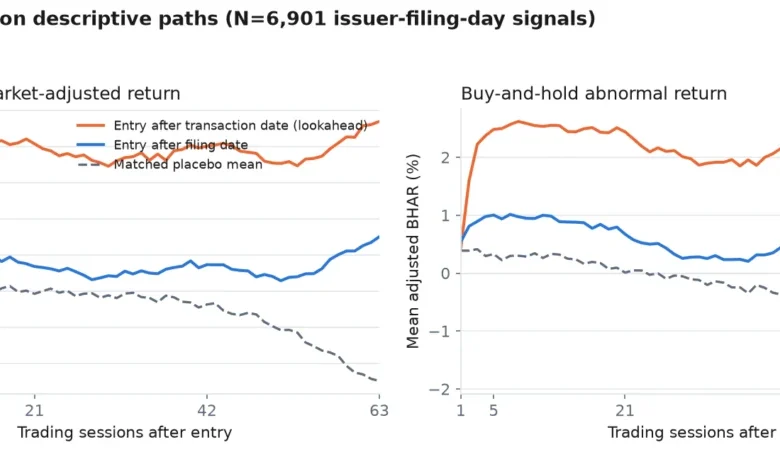
The primary performance metrics in this study rely on SPY-adjusted cumulative abnormal returns (CAR). The findings indicate a clear, albeit modest, market reaction in the immediate aftermath of a filing. For the next trading session, the mean adjusted CAR is +0.534%. Over a five-session window, this figure grows to +1.009%. The t-statistics for these periods—6.460 and 5.053, respectively—suggest that the market reaction is distinguishable from zero under two-way clustered covariance models.
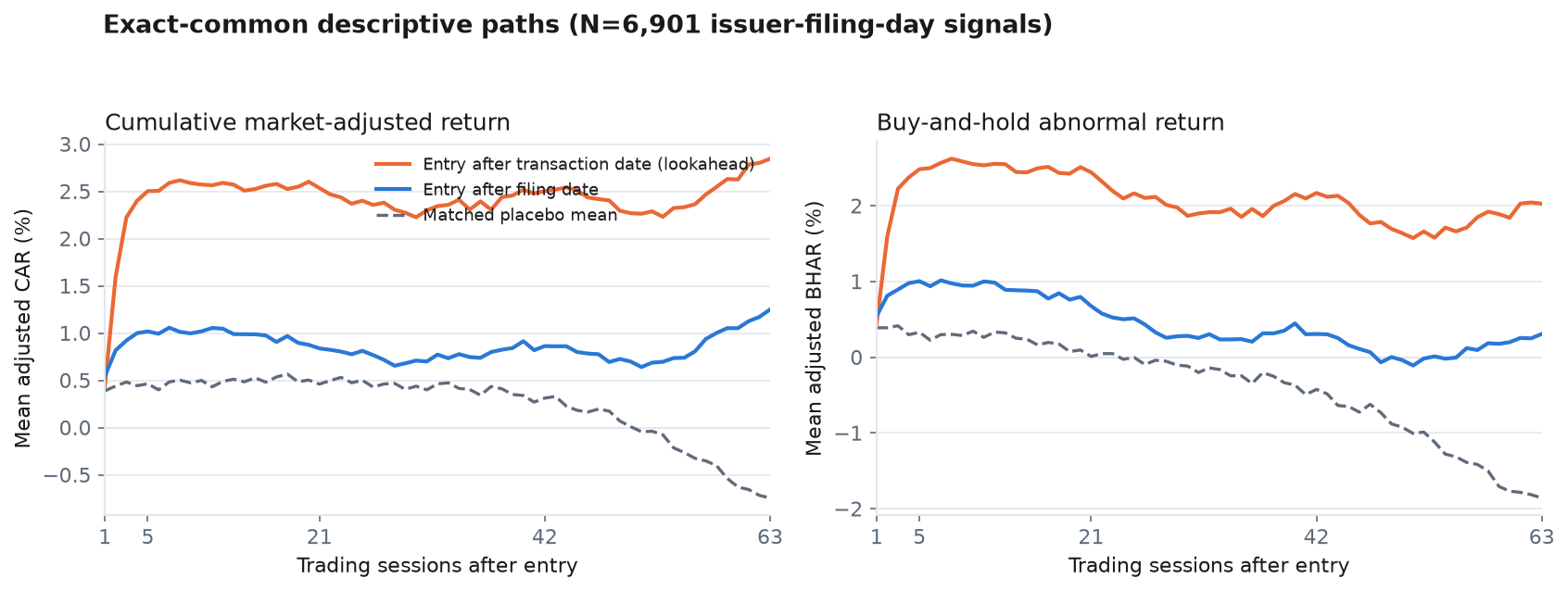
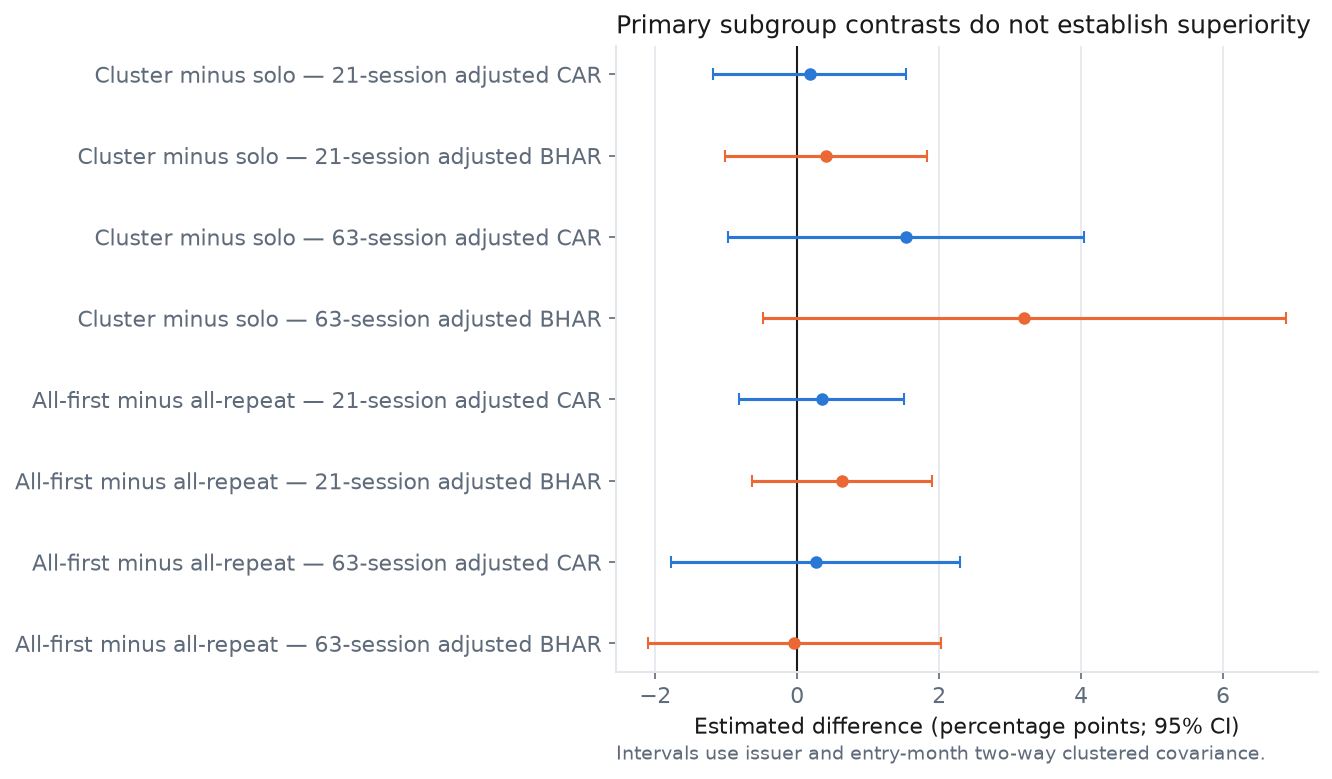
However, the "drift" often sought by momentum traders appears to dissipate as the time horizon extends. At 21 and 63 trading sessions, the adjusted CAR confidence intervals include zero, indicating that the initial market reaction is not sustained. Similarly, adjusted buy-and-hold abnormal returns (BHAR) for these longer horizons do not show consistent positive performance. These findings challenge the assumption that insider purchases are reliable predictors of long-term alpha.
Market Model Sensitivity and Placebo Testing
Critics of event studies often point to the choice of market model as a potential source of bias. This research addresses that concern by comparing primary adjusted estimators against a fitted market model. The market model produces larger estimates—suggesting a +6.560% return at 63 sessions—but this is largely a function of a negative pre-event alpha. Because a majority of these fitted alphas are negative, the market model mechanically inflates cumulative residuals over time. Therefore, the researchers categorize these results as a sensitivity check rather than a headline finding, emphasizing the robustness of the primary adjusted CAR metrics.
Furthermore, the study utilizes a matched-placebo control group to determine whether the observed returns are unique to the filing date. By building same-ticker candidate dates outside of a 63-session window around actual filings, the research team found that the "honest" signals did not significantly outperform the placebo samples. This suggests that market participants should be cautious when attributing positive returns solely to the act of an insider purchase, as broader market trends or stock-specific volatility may play a more significant role than previously assumed.
Implications for Market Participants
The findings carry significant implications for institutional and retail investors alike. Firstly, the data highlights that liquidity is a critical constraint. For many of the signals analyzed, the insider’s purchase represented a substantial percentage of the median daily dollar volume. This "disclosed footprint" acts as a warning: while an insider may have high conviction, the market’s ability to absorb such trades without significant slippage is limited.
Secondly, the distinction between filing-date entry and transaction-date entry is vital. Many academic studies suffer from "lookahead bias" by using the transaction date as the entry point, which ignores the time required for public dissemination. This study demonstrates that the returns associated with transaction-date entries are consistently higher precisely because they capture the pre-publication interval. For any investor relying on public data, the filing date—not the transaction date—is the only legitimate anchor for performance measurement.
Conclusion and Methodological Best Practices
The research underscores the necessity of transparency in financial data engineering. By maintaining a strict funnel, utilizing two-way clustered covariance, and rigorously validating corporate actions, the study provides a replicable framework for evaluating insider activity. The core takeaway is one of humility: while C-suite purchases are associated with a short-term bump in stock price, there is little evidence to support the idea that these signals translate into long-term outperformance.

For those interested in replicating these results, the companion code and data artifacts are available via the project’s GitHub repository, providing a transparent look at the data pipelines used to arrive at these conclusions. Ultimately, the study serves as a reminder that in the world of high-frequency and alternative data, the most valuable insights are often found not in the flashy returns, but in the rigorous, disciplined cleaning of the data itself.
As the regulatory environment continues to tighten and disclosure quality improves, future iterations of this study will likely yield even more precise insights into the relationship between executive behavior and market outcomes. For now, market participants should view insider purchase filings as a signal of immediate, short-term sentiment rather than a reliable indicator of long-term corporate trajectory. The gap between the insider’s private information and the public disclosure remains a challenging terrain, but through methodological rigor, the noise can be filtered to reveal the underlying market dynamics.
Related posts: