European Central Bank Launches Pontes Settlement System to Integrate Distributed-Ledger Technology Into European Financial Markets

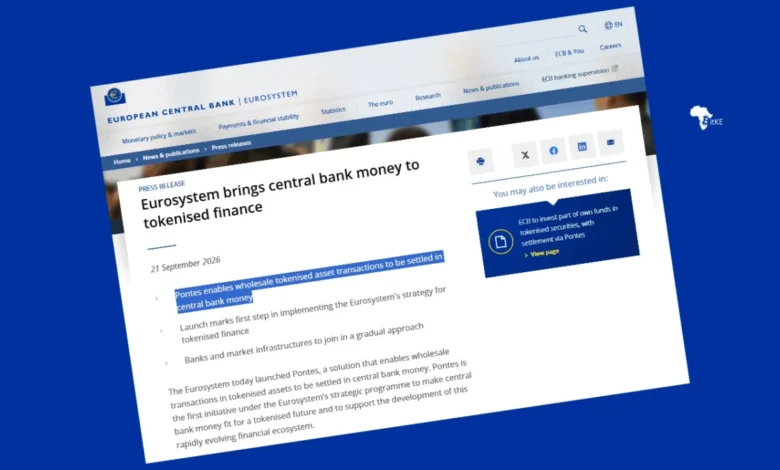
The European Central Bank (ECB) has officially launched Pontes, a groundbreaking settlement system designed to enable wholesale transactions in tokenized financial assets to be settled securely using central bank money. This major strategic milestone marks a significant step forward in the Eurosystem’s overarching plans to seamlessly integrate distributed-ledger technology (DLT) into the core of European financial markets.
By bridging traditional central bank money with modern on-chain assets, Pontes addresses a long-standing structural challenge within institutional finance: providing a risk-free, highly liquid settlement asset for blockchain-based financial instruments. As institutional adoption of tokenization accelerates globally, the introduction of Pontes positions the Eurozone at the forefront of digital asset infrastructure, aiming to modernize financial plumbing and enhance the resilience and efficiency of the region’s capital markets.
Background and Genesis of the Pontes Initiative
The conceptual foundation of Pontes was laid during rigorous exploratory trials conducted by the Eurosystem throughout 2024. During these trials, central banks, commercial lenders, and market infrastructure providers tested various technical solutions to determine how wholesale transactions involving assets recorded on-chain could be safely executed without introducing credit or liquidity risks.
A primary takeaway from these trials was the critical necessity of settling tokenized asset transactions using risk-free central bank money rather than commercial bank money or privately issued stablecoins. While private stablecoins and commercial bank tokenized deposits have gained traction in various sectors of the global digital economy, the ECB has consistently maintained that only central bank money can guarantee absolute finality, security, and systemic stability at the wholesale level.
This philosophy aligns with the ECB’s broader monetary stance, which views alternative digital settlement assets—such as certain stablecoins—as potentially inefficient or inadequate for strengthening the international role of the euro. Consequently, Pontes was engineered specifically to bridge the gap between traditional monetary sovereignty and the operational efficiencies promised by distributed-ledger technology.
Rollout Strategy, Phased Implementation, and Onboarding
The rollout of Pontes is structured as a phased implementation to ensure system stability, regulatory compliance, and seamless technical integration for participating financial institutions. In its initial phase, Pontes offers a robust core set of services tailored to foundational wholesale settlement needs.
Over the coming months and years, the Eurosystem plans to introduce additional features, expand system capabilities, and gradually extend operating hours to accommodate global trading demands. The ECB has projected that the system will reach full implementation by 2028, at which point it is expected to serve as a cornerstone for European DLT-based market infrastructure.
Despite being in its initial deployment phase, Pontes has already successfully onboarded a formidable group of pioneering commercial banks and market infrastructure operators. Among the inaugural participants are major financial heavyweights such as Deutsche Bank, Santander, Société Générale, DZ Bank, the European Investment Bank (EIB), and Clearstream.
The early participation of these institutions underscores the immense industry demand for standardized, risk-free on-chain settlement mechanisms. Additional financial institutions and market participants are expected to connect to the network in the coming months as the operational scope of the platform expands.
Leadership Perspectives and Strategic Vision
The launch of Pontes has drawn significant commentary from top-tier European policymakers, emphasizing the strategic importance of the initiative for the future of the European Union’s financial architecture.
ECB President Christine Lagarde highlighted the broader institutional goals driving the project, emphasizing the necessity of modernization in an increasingly digital global economy.

"The Eurosystem is working to enable a more integrated, innovative, and resilient European financial market in the digital age," stated Lagarde. "We will continue to make progress in close collaboration with the market."
Echoing these sentiments, Piero Cipollone, a member of the ECB’s Executive Board, underscored the unique value proposition that central bank money brings to the nascent digital asset ecosystem.
"Pontes brings the stability and trust of central bank money to the European tokenized finance ecosystem," Cipollone noted. "It will give an important advantage to help it scale."
Policymakers across Europe are acutely aware of the competitive pressures facing the continent’s financial markets. With prominent global banking leaders, such as JPMorgan Chase CEO Jamie Dimon, warning that Europe risks falling behind and facing global irrelevance if it fails to streamline and modernize its regulatory and technological frameworks, initiatives like Pontes are viewed as vital defensive and offensive measures to preserve the international competitiveness of the euro.
The Broader Eurosystem Strategy: The Appia Initiative and Tokenization Benefits
Pontes does not exist in a vacuum; it forms a critical component of the Eurosystem’s broader, multi-pronged strategy to adapt central bank money to the rapid evolution of tokenized financial markets.
Running parallel to Pontes is the "Appia" initiative, another key Eurosystem project tasked with developing a comprehensive blueprint for an integrated European ecosystem dedicated to distributed-ledger-based financial services. Much like Pontes, Appia is working toward a target operational window of 2028, aiming to harmonize disparate national efforts into a unified, cross-border digital financial market across the Eurozone.
The economic rationale behind these sweeping technological upgrades lies in the fundamental efficiencies promised by asset tokenization. According to ECB research and industry analyses, tokenization has the potential to fundamentally transform capital markets by collapsing traditionally siloed financial stages—such as issuance, trading, settlement, custody, and asset servicing—into streamlined, automated workflows.
By leveraging smart contracts, these processes can execute automatically upon the fulfillment of predefined conditions, drastically reducing administrative overhead, minimizing counterparty risk, and freeing up trapped liquidity. In traditional finance, settlement cycles can take multiple days (such as T+1 or T+2), tying up capital and exposing market participants to settlement risk. Tokenized settlements executed instantaneously using central bank money on platforms like Pontes have the potential to eliminate these friction points entirely.
Market Implications and Global Context
The launch of Pontes arrives at a pivotal juncture in the evolution of global digital finance. As central banks around the world grapple with the rise of decentralized finance (DeFi), tokenized funds, and private-sector digital currencies, the ECB is proactively staking out a leadership role in institutional DLT adoption.
While some jurisdictions and private financial institutions favor the dominance of regulated stablecoins or tokenized commercial bank deposits for on-chain settlements, the European approach doubles down on the sovereign anchor of central bank money. Industry experts remain divided on the ultimate trajectory of digital settlement assets. For instance, while some analysts and major U.S. banking institutions predict that regulated stablecoins will maintain dominance in tokenized funds due to existing commercial frameworks, others project that central bank-backed solutions and tokenized deposits will gradually capture institutional market share over the next five years.
By providing a secure, government-backed settlement rail for tokenized assets, the ECB is providing European financial institutions with the regulatory clarity and technical infrastructure required to experiment with and deploy blockchain-based financial products at scale.
As Pontes expands its operational capabilities toward its 2028 full-implementation target, its success will likely serve as a benchmark for central banks globally, demonstrating how traditional monetary authorities can successfully embrace distributed-ledger technology without sacrificing financial stability, trust, or systemic control.