The local economy and housing market have become immensely dependent on unsustainable AI magic-money.


San Francisco, long considered the global nerve center of technological innovation, is currently navigating a period of profound economic divergence. While industry giants like OpenAI and Anthropic—both headquartered within the city limits—continue to capture headlines with staggering valuation targets and aggressive recruitment drives, a deeper look at regional labor statistics reveals a bifurcated reality. For the majority of the professional workforce in Silicon Valley, the current economic climate is defined not by a tech renaissance, but by a persistent and painful contraction.
The disparity between the high-octane AI sector and the broader professional services landscape is striking. As companies chase a multi-trillion-dollar horizon, the sheer scale of the AI-driven hiring boom is statistically dwarfed by the structural decline in established sectors, including traditional information technology, engineering, and finance. This reliance on a narrow, high-wealth niche to prop up local consumption and housing prices has created a precarious economic foundation that risks instability if the current AI speculative bubble faces a correction.
A Chronology of the Shift: From Pandemic Peaks to Present Contraction
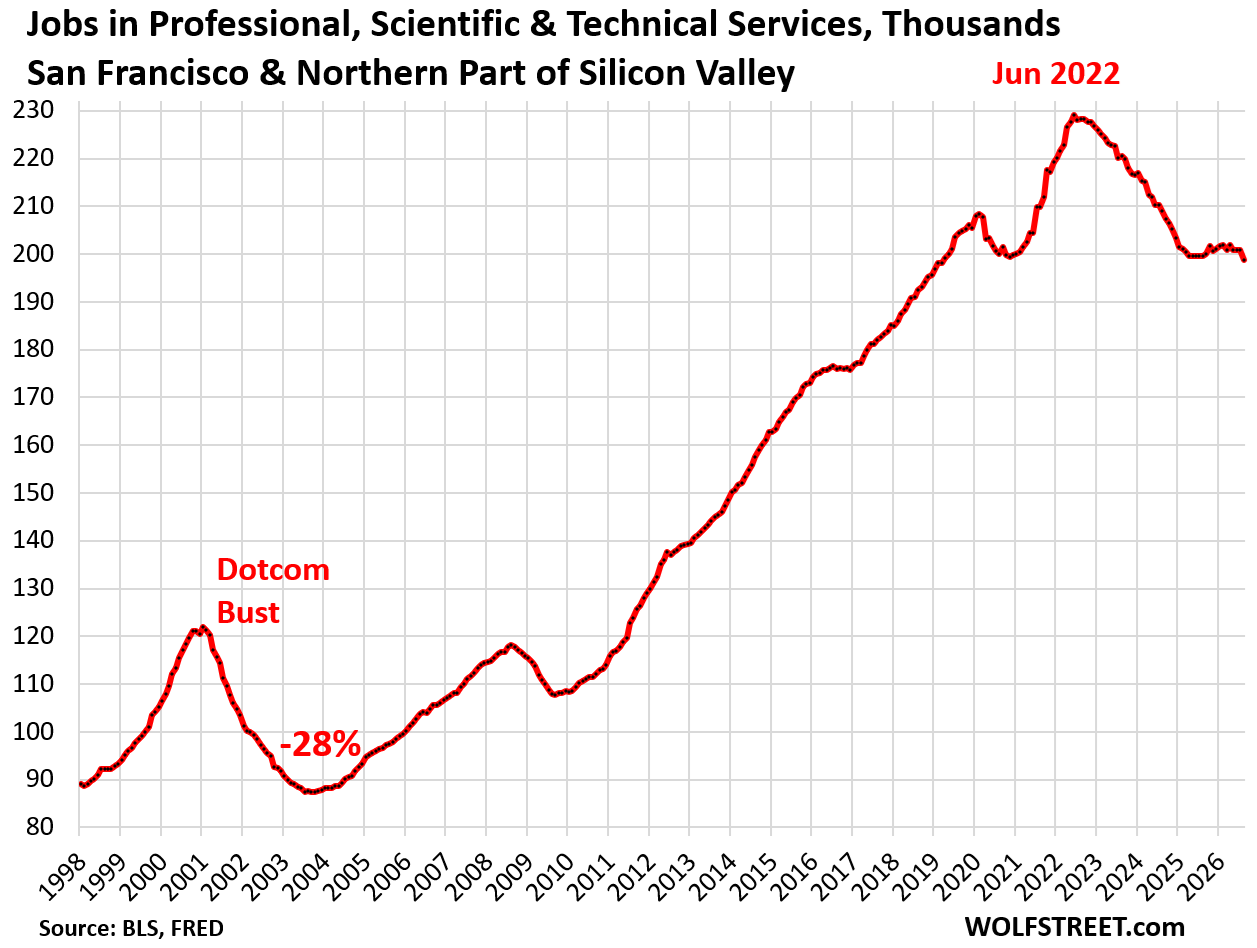
The trajectory of the San Francisco and San Mateo County labor market over the last five years offers a sobering look at how quickly the fortunes of a major metropolitan hub can shift. Following the 2020 pandemic-induced downturn, the region experienced a brief, robust recovery, fueled by low interest rates and a massive surge in demand for digital services.
By mid-2022, however, the momentum began to stall. The Federal Reserve’s pivot toward higher interest rates to combat inflation initiated a cooling period for the venture capital ecosystem, which serves as the lifeblood of Bay Area employment. Since the peak of June 2022, the region has witnessed a steady erosion of payrolls. The "Professional, Scientific, and Technical Services" sector, which includes engineering, legal, accounting, and consulting, has shed approximately 35,500 jobs—a decline of 13.2%—marking a return to employment levels not seen since March 2019.
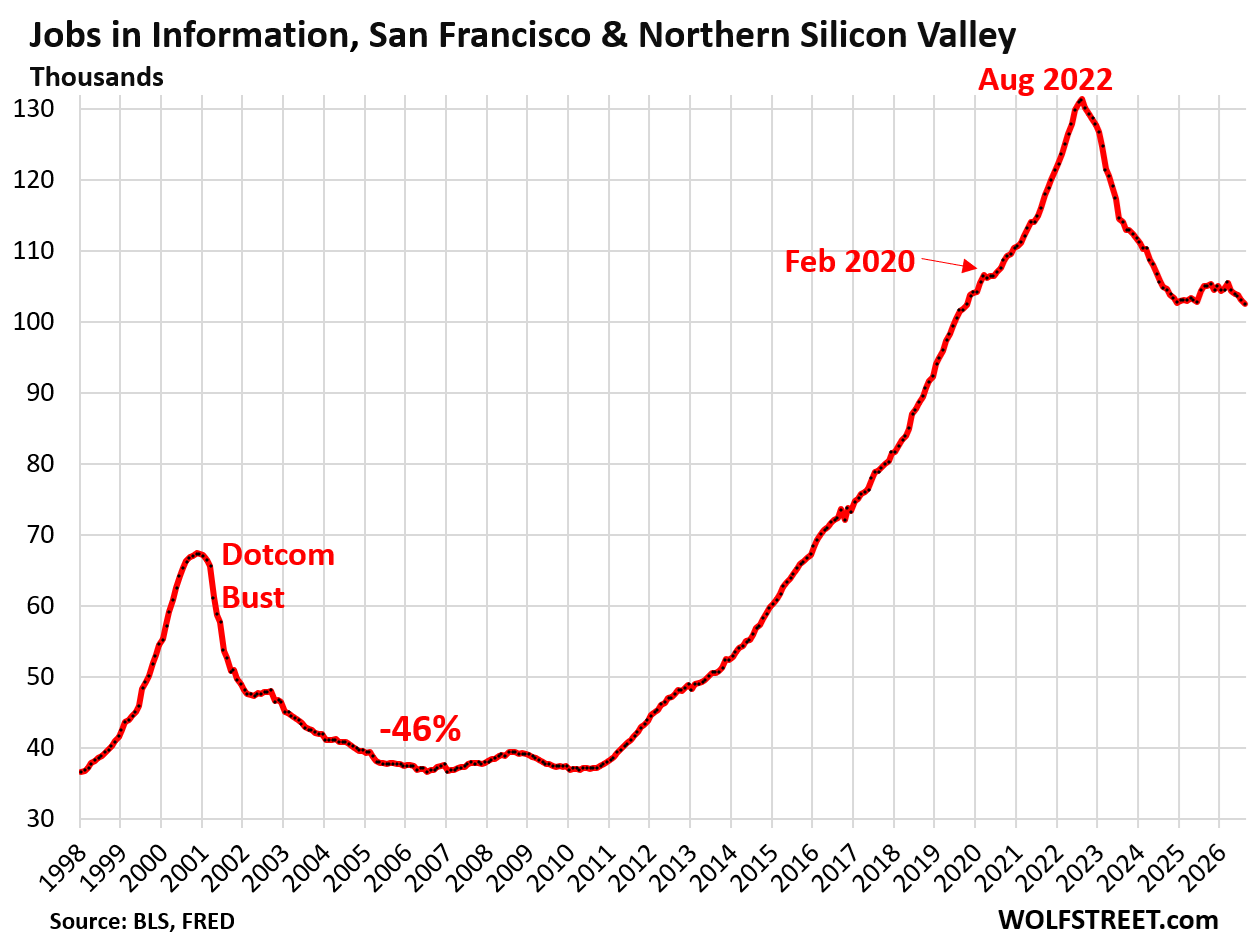
The "Information" sector, historically the engine of San Francisco’s economic prosperity, has suffered an even steeper decline. Since peaking in August 2022, this sector has lost 28,900 jobs, representing a 22% reduction in total payroll. These figures suggest that the pandemic-era expansion in tech-related roles has been effectively wiped out, with employment levels now regressing to late-2019 figures.
Sectoral Analysis: The Financial and Professional Bloodbath
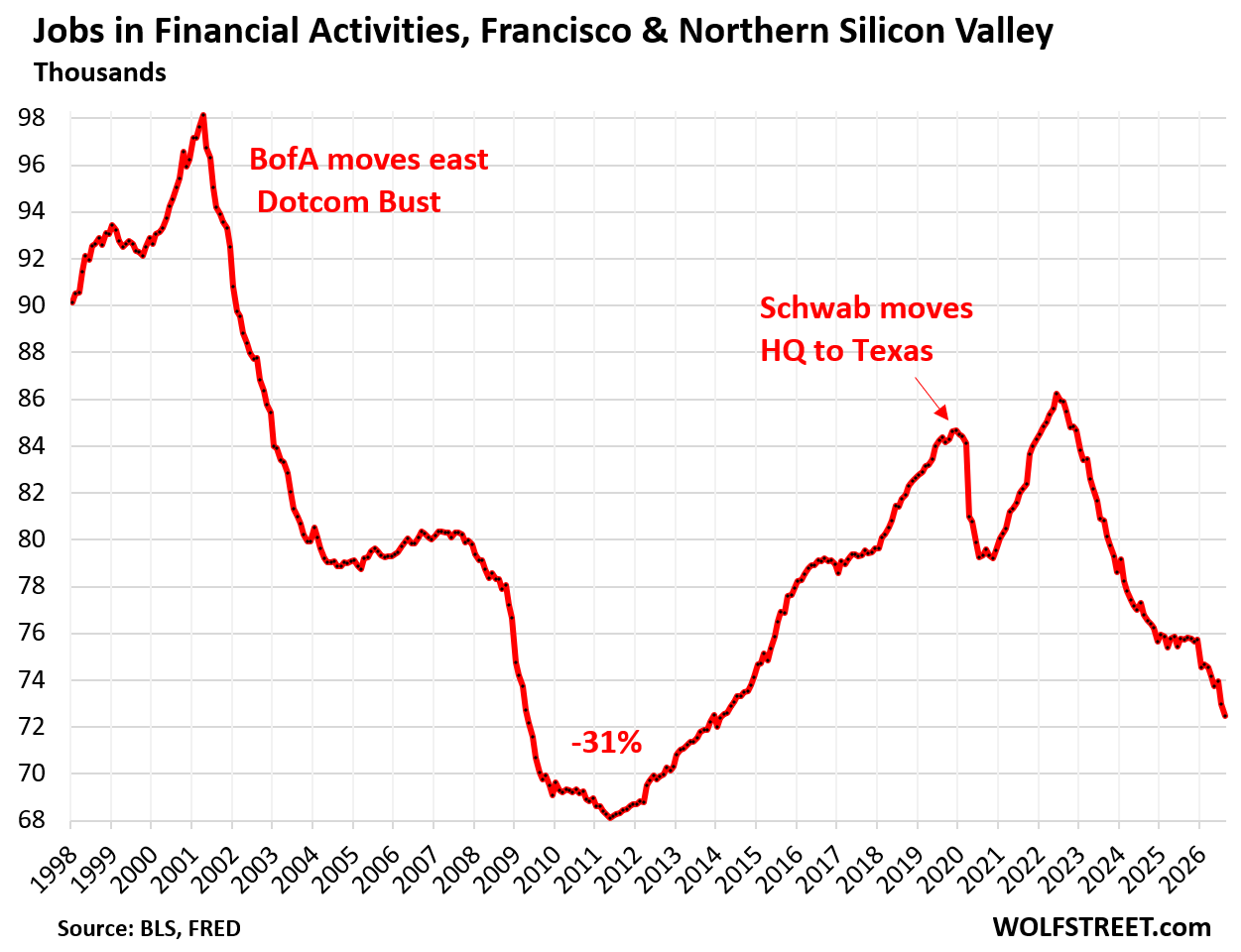
The contraction is not limited to software developers or data engineers. The "Financial Activities" sector, encompassing banking, insurance, and real estate services, has seen a consistent migration of talent and headquarters out of the Bay Area. Since 2019, major financial institutions—including Charles Schwab and the executive functions of Wells Fargo—have relocated significant portions of their operations to regions with lower costs of living and more favorable corporate tax environments.
As of August 2024, payrolls in the financial sector dropped to 72,500, the lowest level recorded since January 2014. This 16% decline from the 2022 peak reflects a structural realignment of the city’s financial base. When compared to the peak of 2001, the sector has seen a total contraction of 26%, suggesting that the current decline is part of a multi-decade trend of corporate decentralization that has only been exacerbated by the recent economic headwinds.
The Mirage of Growth: Healthcare and Leisure
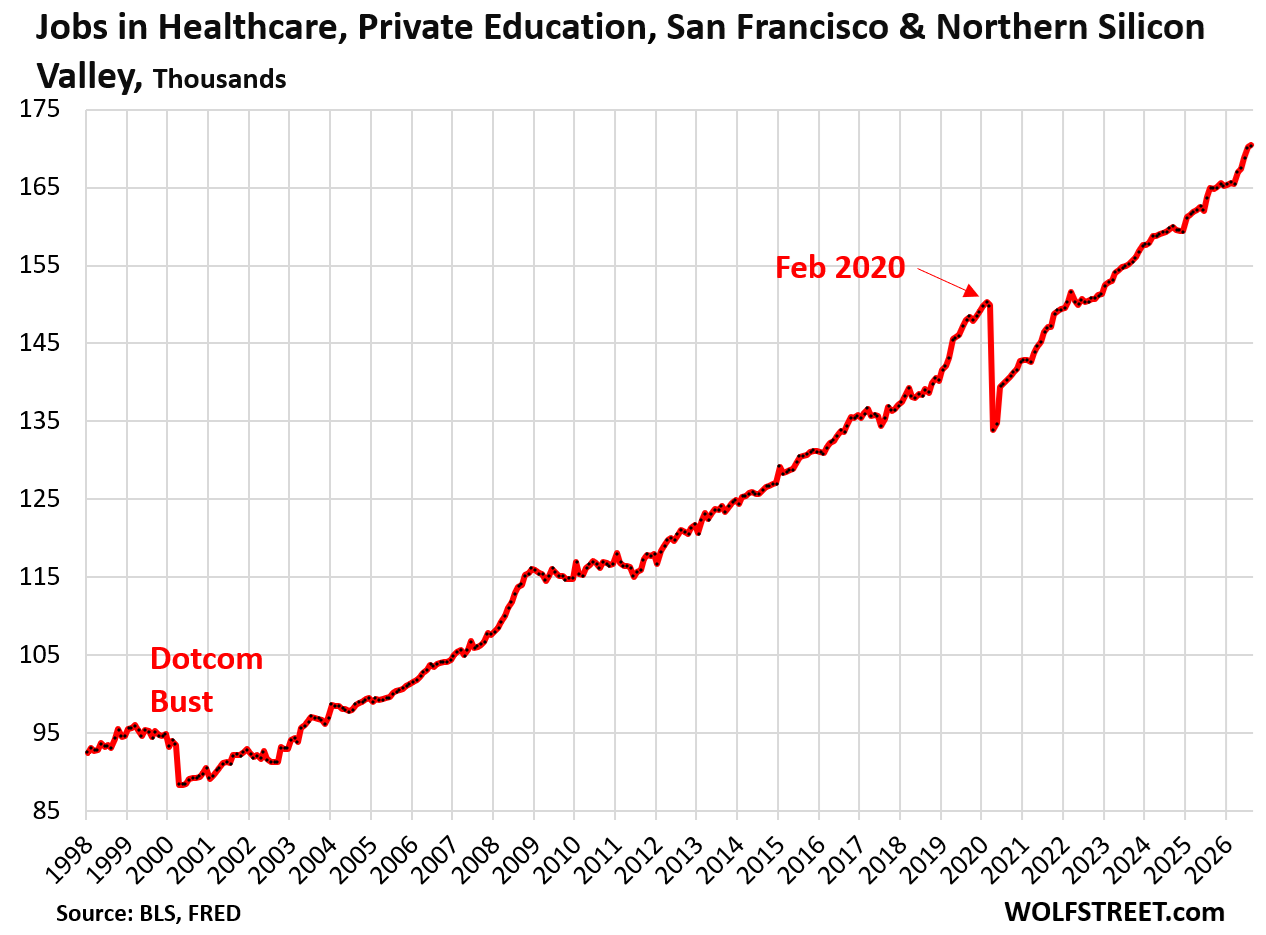
While the core drivers of the regional economy remain in a state of retrenchment, the only sectors demonstrating consistent growth are "Healthcare Services and Private Education" and "Leisure and Hospitality."

Healthcare services added 5,500 jobs over the past year, marking a 3.3% increase and reflecting the non-cyclical nature of medical demand. Similarly, the leisure and hospitality sector, which was decimated by the public health mandates of 2020, has seen a 5.4% year-over-year increase. However, this growth remains a recovery of lost ground rather than a true expansion; despite the recent uptick, leisure and hospitality payrolls remain approximately 9.5% below the February 2020 peak.
The reliance on these sectors to stabilize the local economy creates a paradox: while they provide essential services and low-to-mid-tier employment, they do not generate the tax revenue or the high-velocity capital required to sustain the current elevated cost of housing and the premium real estate market in the Bay Area.
Implications of the AI Wealth Concentration
The disconnect between the broader employment bloodbath and the localized success of AI firms is not merely a statistical anomaly; it has significant implications for the socioeconomic fabric of San Francisco. The AI sector, while highly profitable for a select few, currently employs a relatively small percentage of the total workforce. Yet, the massive stock-based compensation packages awarded to these employees create a "wealth effect" that sustains high-end real estate prices, luxury services, and a cost-of-living structure that remains disconnected from the median wage of the average worker.
Economic analysts point to this concentration of wealth as a potential risk factor. When an economy relies on the hyper-valuation of a single, nascent industry to support its housing and commercial rent markets, the entire region becomes hyper-sensitive to sector-specific volatility. Should the enthusiasm for AI investment wane—or should the promised productivity gains fail to materialize into sustained corporate earnings—the resulting contraction could be amplified by the already weakened state of the traditional professional services sector.
A Comparative Perspective: The Dotcom Bust
Historical context provides a frame of reference for the current crisis. During the Dotcom Bust, which spanned from 2000 to 2006, the Information sector in the San Francisco/San Mateo area lost 46% of its jobs. While the current 22% loss in the Information sector has not yet reached that extreme, it is nearly halfway there.
Unlike the 2000-2006 period, however, the current decline is occurring alongside a broader inflationary environment and a global shift toward remote work. The latter factor introduces a layer of complexity to the data: some of the jobs lost in these sectors may have been held by remote workers assigned to Bay Area offices but residing elsewhere. While this suggests that the local impact of the job losses might be slightly less severe than the aggregate numbers indicate, it also suggests that the region’s role as an in-person office hub is permanently diminished.
Official Responses and Future Outlook
The Bureau of Labor Statistics (BLS) data, which tracks employment based on business location, confirms that the region is experiencing a systemic labor migration. While government officials have frequently touted the growth of AI as a successor to the tech boom of the 2010s, there is little evidence to suggest that this sector will reach the scale of employment necessary to replace the tens of thousands of professional jobs lost in the engineering, finance, and information sectors.
As the city faces these mounting economic pressures, the focus is shifting toward the sustainability of the housing market. Real estate prices in San Francisco have historically tracked with job growth in high-salary sectors. With the current disconnect between job losses in traditional fields and the hyper-growth of AI-focused wealth, the market is effectively being supported by a thin veneer of speculative capital.
The path forward for the San Francisco economy will likely require a broader diversification of its industrial base. Relying on the "magic money" of the AI boom to paper over structural weaknesses in the labor market risks creating a city that is increasingly exclusive, where the cost of living is decoupled from the realities of the average labor market participant. Without a significant resurgence in the broader professional services sector, the region may continue to see a hollowing out of its middle class, leaving a landscape defined by an extreme wealth divide and an increasingly vulnerable economic foundation.