The rapid proliferation of large language models (LLMs) has transitioned from a research curiosity to a core industrial utility. While the challenge of achieving functional output from these models is largely considered a solved engineering problem, the secondary challenge—deploying these models with sufficient speed, cost-efficiency, and reliability—remains a critical bottleneck for modern enterprise infrastructure. As organizations scale their deployments, they frequently encounter a "performance wall" where latency spikes under load and operational costs escalate linearly with increased context lengths and user volume. Achieving production-grade LLM service requires a shift in focus from model training to the discipline of inference optimization, which aims to maximize throughput and minimize latency without necessitating architectural retraining.
The Mechanics of the Two-Phase Inference Lifecycle
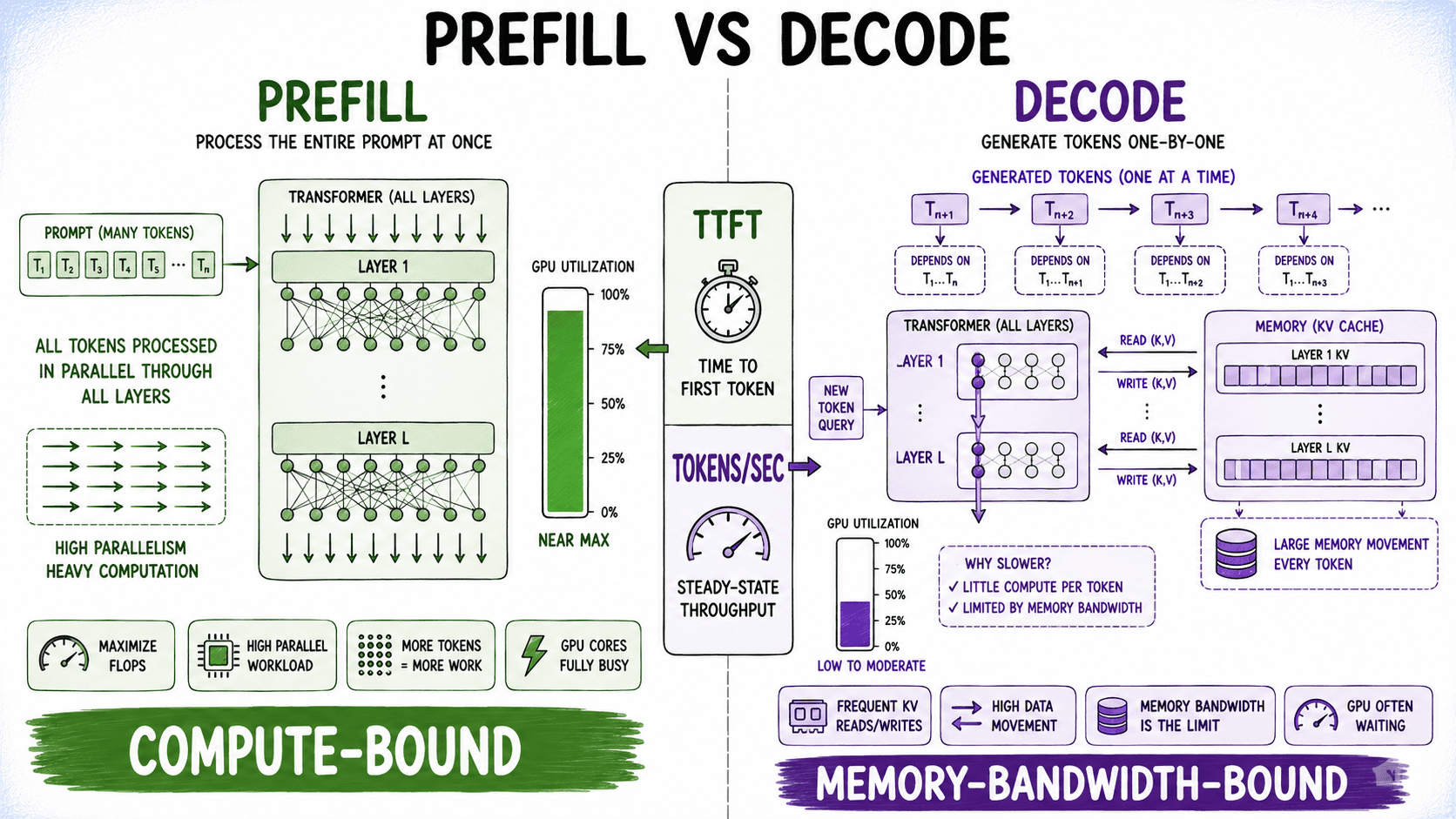
To understand the optimization landscape, one must first recognize that the lifecycle of an LLM request is bifurcated into two distinct operational phases: the prefill phase and the decode phase. Each possesses unique computational characteristics that dictate how hardware resources are consumed.
The prefill phase occurs immediately upon receiving a prompt. The model processes the entire input sequence simultaneously to calculate the intermediate key and value tensors—essentially the "memory" of the input—required to generate the first output token. Because this phase is highly parallelizable, it is classified as compute-bound, meaning the performance is limited primarily by the raw processing power of the GPU.
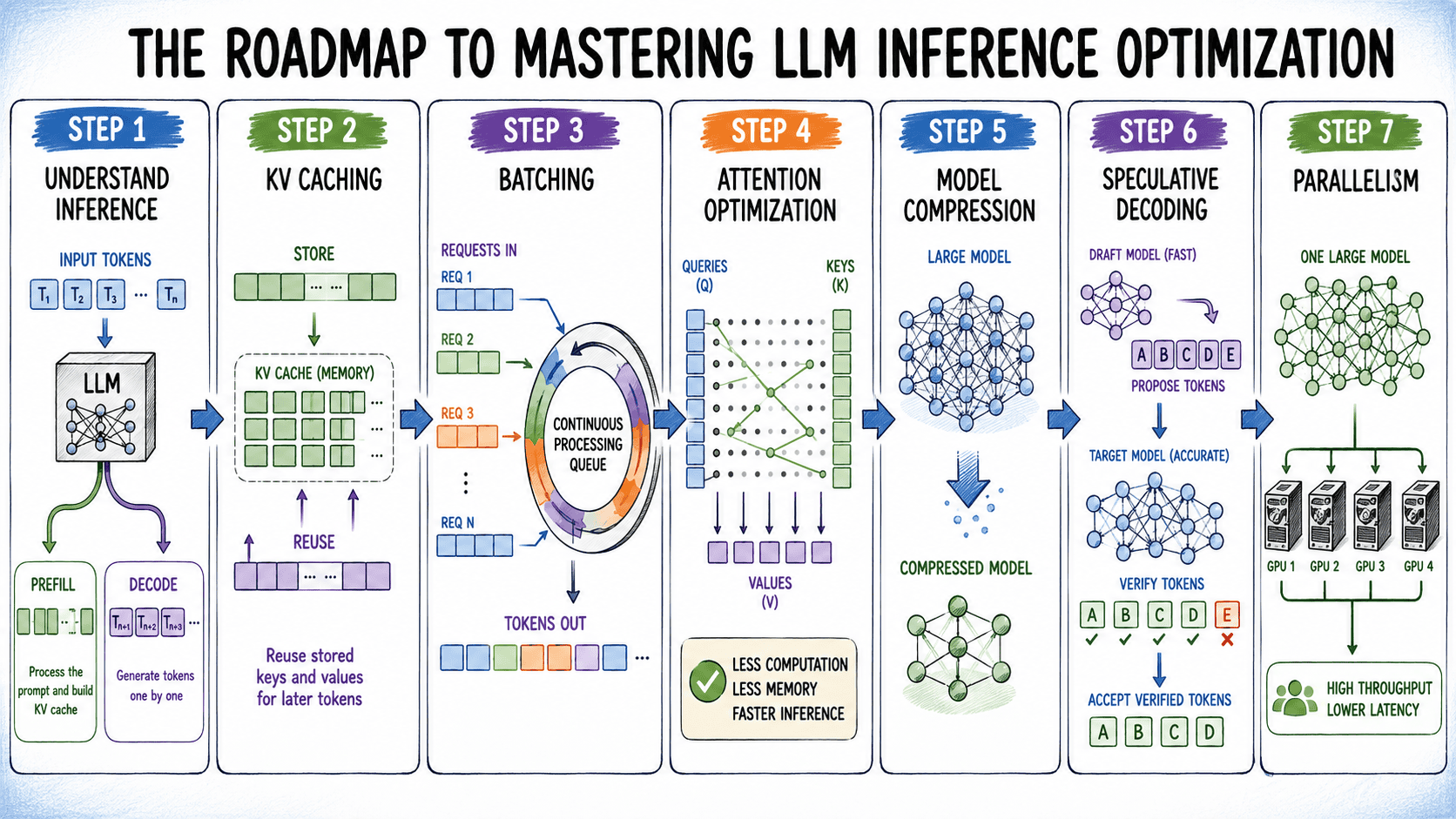
Conversely, the decode phase is inherently autoregressive. The model generates tokens one by one, with each new token dependent on the output of the previous one. This sequential constraint renders parallel generation within a single sequence impossible. Consequently, the bottleneck shifts from computation to memory bandwidth; the GPU spends the majority of its cycle time moving data from memory to the processor. According to industry performance data, in memory-bandwidth-bound operations, the speed of inference is governed by how efficiently the system can shuffle these large weight matrices. This fundamental difference explains why Time-to-First-Token (TTFT) and Tokens-per-Second (TPS) must be measured and optimized separately; an optimization that accelerates prefill may have negligible impact on the overall token generation rate.
Managing the Memory Overhead: KV Caching and PagedAttention
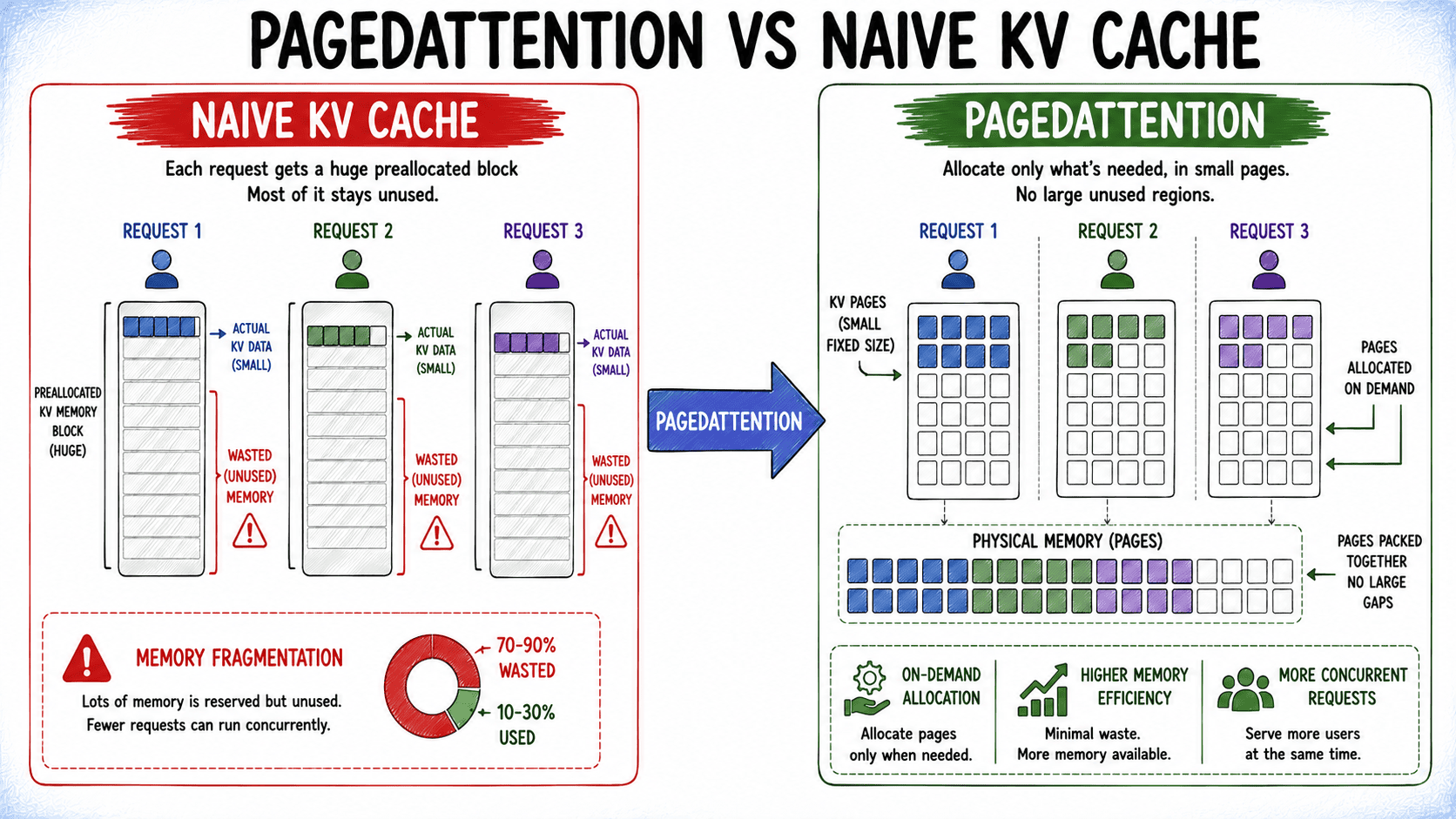
The most critical memory-intensive component in modern inference is the Key-Value (KV) cache. To avoid the redundant computation of previously processed tokens during the decode phase, systems cache the computed key and value states in GPU memory. While this significantly accelerates generation, it imposes a massive memory tax. For a 7B-parameter model utilizing 16-bit precision, the KV cache can consume several gigabytes of VRAM for a single request.
Traditional approaches to memory allocation were notoriously inefficient. By reserving contiguous blocks of memory based on the maximum possible sequence length, developers frequently suffered from massive internal fragmentation. The introduction of PagedAttention marked a major shift in the industry, drawing inspiration from virtual memory paging in operating systems. By partitioning the KV cache into non-contiguous, fixed-size blocks, PagedAttention allows for dynamic memory allocation. This breakthrough enables significantly higher batch sizes, effectively increasing the number of concurrent requests a single GPU can sustain. Complementing this, prefix caching—where common system prompts or documents are cached across multiple requests—has emerged as a standard practice for reducing redundant computation in RAG (Retrieval-Augmented Generation) architectures.
The Evolution of Scheduling: From Static to Continuous Batching
GPU utilization is the primary metric for operational efficiency. If a GPU sits idle, the capital expenditure associated with high-end hardware like the H100 or A100 is wasted. Static batching, the industry’s early attempt at optimization, involved grouping requests into fixed-size batches. This proved suboptimal because the entire batch is held hostage by the longest-running request.
The evolution toward continuous, or "in-flight," batching represents a milestone in production runtime architecture. In this model, the system does not wait for an entire batch to conclude. Instead, as soon as one sequence completes, the scheduler immediately inserts a new request into the vacated slot. This granular, real-time management ensures the GPU is constantly saturated, keeping throughput high despite the inherent variance in output length. Current industry-standard runtimes, such as vLLM and TensorRT-LLM, have adopted continuous batching as the default, underscoring its necessity for scalable, production-ready AI.
Architectural Optimizations: Attention and Compression
Beyond scheduling, structural optimizations at the model level have significantly lowered the cost of inference. Multi-Head Attention (MHA) has historically been the standard, but it is increasingly being supplanted by Multi-Query Attention (MQA) and Grouped-Query Attention (GQA). By sharing key and value heads across multiple query heads, these variants drastically reduce the volume of data transferred during the memory-bound decode phase.
Furthermore, FlashAttention has become an essential tool in the developer’s arsenal. By utilizing tiling to keep intermediate calculations within the faster on-chip SRAM of the GPU, FlashAttention eliminates the need for expensive round-trips to global memory. Because this is a drop-in optimization that requires no model retraining, it provides a high-leverage path to immediate performance gains.
Model compression remains the final frontier for resource-constrained environments. Quantization—the process of reducing the bit-precision of weights—has become a standard technique to shrink the memory footprint of models. Moving from 16-bit to 4-bit quantization can reduce VRAM requirements by as much as 75%, often with negligible impact on output quality. Combined with structured sparsity—a feature supported by modern NVIDIA architectures—and knowledge distillation, these techniques allow smaller, more efficient models to deliver performance parity with their larger, uncompressed counterparts.
Latency Mitigation and Future Scaling
For applications where latency is the defining constraint—such as real-time interactive agents—speculative decoding offers a pathway to bypass the autoregressive bottleneck. By using a small "draft" model to predict tokens and a larger model to verify them in parallel, developers can generate multiple tokens per forward pass. This creates an illusion of speed, as the system effectively processes several steps in the time it would normally take to compute one.
As models continue to grow, the industry is moving toward more sophisticated parallelism. Tensor parallelism distributes weight matrices across multiple devices, while pipeline parallelism breaks models into vertical layers. The emergence of prefill-decode disaggregation reflects the industry’s recognition that the two phases of inference require different hardware priorities. By separating these workloads, infrastructure teams can route prefill requests to high-compute clusters and decode requests to memory-optimized nodes, effectively decoupling the scaling of these two distinct processes.
Implications for Enterprise Deployment
The economic implications of these optimizations are profound. For a company running millions of inferences per day, the difference between a naive implementation and an optimized one is not merely marginal; it is the difference between an economically viable product and a prohibitive operating expense. By applying these layered strategies—from kernel-level attention optimizations to cluster-wide scheduling—organizations can reduce their reliance on expensive hardware and extend the reach of their AI services.
The path forward for LLM inference is clear: as models become more capable, the competitive advantage will increasingly belong to those who can master the underlying systems that serve them. Success in this field requires a rigorous, data-driven approach to profiling and a willingness to adopt hardware-aware optimizations that align with the specific constraints of the production environment. Through the strategic application of caching, batching, and compression, the high-performance, low-latency LLM of tomorrow is becoming the standard of today.