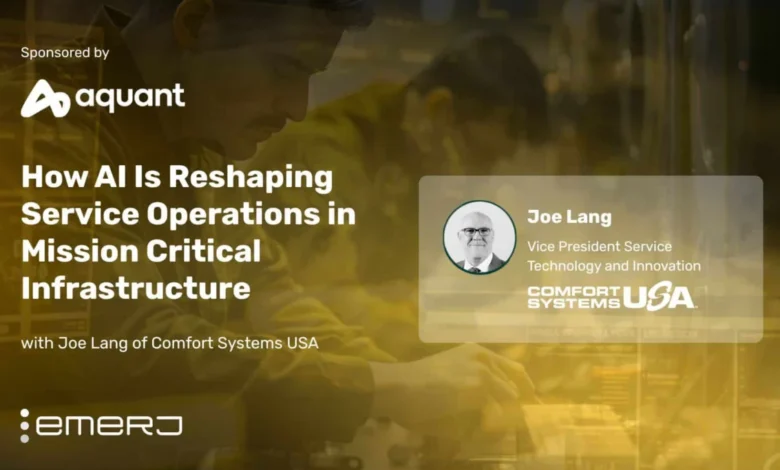
How AI Is Reshaping Service Operations in Mission Critical Infrastructure: Insights from Comfort Systems USA and Aquant

The global landscape of mission-critical infrastructure is currently grappling with a profound structural mismatch that threatens the stability of energy grids, data centers, and essential utility services. As uptime requirements tighten toward a standard of near-zero tolerance, the traditional maintenance models and the available technician workforce are failing to keep pace with the accelerating demand. This widening gap has necessitated a fundamental shift in how service organizations operate, moving away from reactive and schedule-based maintenance toward AI-driven prescriptive guidance.
The pressure is most visible at the "grid edge," where the rapid expansion of digital infrastructure is outstripping existing service capacities. According to analysis from the Electric Power Research Institute (EPRI), cited by the U.S. Department of Energy, data centers could consume up to 9 percent of total U.S. electricity generation by 2030. This represents more than a doubling of their 2023 share, placing unprecedented stress on the cooling and power systems managed by service organizations. When these systems fail, the financial consequences are staggering. The Institute for Supply Management (ISM) recently reported that unscheduled downtime now costs the world’s 500 largest companies approximately $1.4 trillion annually, a figure representing roughly 11 percent of their total revenue.
The Convergence of Labor Shortages and Data Fragmentation
The crisis in infrastructure maintenance is compounded by a demographic shift often referred to in industrial circles as the "Silver Tsunami." As a generation of highly experienced technicians reaches retirement age, the pipeline of new talent is insufficient to fill the void. The U.S. Bureau of Labor Statistics projects approximately 81,000 openings for electricians annually through 2034. The majority of these openings are driven by the need to replace workers who exit the labor force rather than by industry expansion, creating a massive "knowledge drain" within service organizations.
Beyond the labor shortage, technicians who remain in the field are often hampered by a lack of actionable information. The National Institute of Standards and Technology (NIST) has found that the inadequate interoperability of facility and equipment data costs U.S. capital-facilities owners and operators $10.6 billion annually during the operations and maintenance phase alone. This fragmentation means that even the most skilled technicians often arrive at a job site without comprehensive asset histories or manuals, leading to diagnostic guesswork and lower "first-time fix" rates.
In a recent episode of the AI in Business podcast, Yolandi de Weerdt was joined by Joe Lang, Vice President of Service Technology and Innovation at Comfort Systems USA, to discuss how artificial intelligence is being deployed to bridge these gaps. Comfort Systems USA, a leading provider of commercial HVAC, mechanical, and electrical services, has been at the forefront of integrating AI to stabilize service outcomes. Lang, an industry veteran with nearly two decades of leadership experience, argues that without "next-best maintenance guidance" powered by AI, technicians simply cannot close the operational gap alone.
Moving Toward Anomaly Detection and Condition-Based Maintenance
Traditional maintenance cycles are built on the assumption of predictable intervals—for example, servicing a chiller every six months or changing filters every quarter. However, Lang posits that equipment behavior often deviates significantly during the unmonitored periods between these scheduled visits. When these anomalies are left unaddressed, they progress into catastrophic failures.
"AI gives technicians a head start," Lang noted during the interview. "When the system flags a deviation, it’s often the earliest sign that something is drifting out of normal behavior. Acting at that moment prevents failure rather than reacting to it. It changes the rhythm of service work—teams stop chasing emergencies and start addressing issues before they become critical."
For Lang, anomaly detection is not merely a high-tech "bell and whistle" but the first essential discipline of modern service operations. Most enterprises already collect the necessary sensor data; the failure lies in the lack of rigor required to surface deviations early enough for intervention. By treating real-time equipment behavior as the "source of truth," organizations can transition to condition-based maintenance, where service is performed because the equipment requires it, not because a calendar says so.
To successfully adopt anomaly detection, Lang identifies several operational requirements:
- Logical Asset Grouping: Organizations must categorize assets into logical groups to establish baselines for "normal" behavior.
- Automated Alerting: Systems must be capable of surfacing deviations to service coordinators or technicians without manual oversight.
- Historical Contextualization: Anomalies must be compared against historical failure patterns to determine the urgency of the intervention.
The Shift from Predictive to Prescriptive Guidance
A critical distinction emerging in the industry is the shift from predictive maintenance to prescriptive guidance. While predictive maintenance forecasts when a failure might occur, prescriptive guidance recommends the specific "next-best action" to resolve a developing issue.
Lang highlights that technician performance often swings wildly when they encounter unfamiliar equipment or ambiguous symptoms. This variability is rarely a reflection of the technician’s inherent skill but rather an "information issue." When diagnostic evidence is buried in disconnected PDFs, legacy systems, or the siloed experience of senior staff, the technician is forced to start from scratch.
AI-driven prescriptive guidance stabilizes this variability by consolidating service histories, Original Equipment Manufacturer (OEM) documentation, and resolution patterns into a single, reasoned output. Before a technician even opens an equipment panel, the AI can surface the likely fault and the most effective steps for repair. This does not replace the technician’s judgment; instead, it removes the "first ten minutes of uncertainty" that often lead to incorrect diagnoses and wasted time.
Lang identifies several critical evidence sources that must be integrated to make prescriptive guidance effective:
- Sensor Data and Telemetry: Real-time feeds that indicate current operating conditions.
- Service Records: Historical data on what has broken in the past and how it was fixed.
- OEM Manuals and Schematics: Technical documentation that provides the engineering baseline for the equipment.
- Technician Notes: Unstructured data from previous visits that may contain clues about recurring issues.
To make these sources usable, Lang stresses the necessity of a structured data environment where an AI model can reason over the information and deliver it to the field in real time.
Operational Transformation: Modifying the Plane While Flying
One of the most significant hurdles to AI adoption in service organizations is the "implementation gap." Many companies treat the transition to AI-enabled operations as a part-time initiative or a side project for the IT department. Lang argues that this is the primary reason why modernization efforts stall.
"This is where you’ll modify the plane while you’re flying it," Lang explained. "You’ve got to modify it so it can continue to fly and land and take off again. You absolutely have to resource this correctly when you start down this path."
Successful transformation requires dedicated ownership and a commitment to data hygiene. Organizations often spend years assembling data infrastructure but fail to produce measurable results because the project was never staffed with the necessary expertise or authority to change workflows. Lang suggests that for maintenance workflow changes to take root, organizations must:
- Assign Dedicated Leadership: AI initiatives should be led by those who understand both the technology and the field-service reality.
- Focus on Data Structuring: Modernization begins with organizing assets into logical groups and centralizing manuals and service histories.
- Reskill the Workforce: Technicians must be trained not just on the equipment, but on how to interact with and trust the AI-driven guidance tools.
Broader Implications for the Industrial Sector
The implications of this shift extend far beyond individual service companies. As the U.S. and global economies become increasingly dependent on "always-on" infrastructure, the ability to maintain that infrastructure efficiently becomes a matter of national economic security. The transition to AI-enabled service operations represents a move toward a more resilient industrial base.
By reducing the reliance on "tribal knowledge" and replacing it with a centralized, AI-augmented intelligence, companies can mitigate the impact of the labor shortage. Furthermore, the reduction in unnecessary maintenance—such as replacing functioning parts simply because of a schedule—contributes to greater sustainability and lower operational costs.
In conclusion, the insights provided by Joe Lang and the ongoing work at Comfort Systems USA, in partnership with AI leaders like Aquant, suggest a clear roadmap for the future. The organizations that thrive will be those that move beyond the "emergency response" mindset and embrace a data-driven, prescriptive approach to maintenance. In the high-stakes world of mission-critical infrastructure, AI is no longer an optional luxury; it is the essential tool for keeping the lights on and the data flowing.