Redefining Algorithmic Risk Management through Large Language Model Integration in Quantitative Trading

The integration of Large Language Models (LLMs) into quantitative finance has reached a critical juncture, shifting from speculative attempts at market prediction to sophisticated, rule-based risk management. Historically, algorithmic strategies that tasked LLMs with predicting next-day directional returns for liquid assets like Apple (AAPL) have largely failed, as even the most advanced statistical and machine learning models struggle to overcome the efficient market hypothesis in large-cap equities. A recent research initiative spearheaded by José Carlos Gonzáles Tanaka challenges this paradigm by pivoting away from return forecasting in favor of regime-aware risk assessment. By utilizing DeepSeek to interpret historical market states and establish policy-based exposure, this methodology offers a new blueprint for automated trading that prioritizes capital preservation over speculative gains.
The Shift from Prediction to Risk Management
The fundamental challenge in modern algorithmic trading is not a lack of data, but a surfeit of noise. Traditional quantitative models often rely on blunt thresholds to trigger trade executions, which can lead to over-sensitivity during volatile market regimes. The current approach, documented in recent quantitative finance discourse, posits that an LLM’s true utility lies in its ability to synthesize qualitative context from historical data.
Instead of asking a model to determine whether a stock will rise or fall, the strategy tasks the LLM with a nuanced classification problem: given specific market conditions—such as rolling volatility, mean returns, and Sharpe-like metrics—what is the appropriate level of exposure? By framing the model as a risk manager rather than a market forecaster, the strategy maintains a position between 50% and 100% long, effectively creating a regime-sensitive, long-only exposure model that avoids the binary traps of traditional automated systems.
Chronology of Strategy Development and Implementation
The development cycle for this strategy follows a rigorous walk-forward optimization framework, which is essential for ensuring that backtesting results remain valid out-of-sample (OOS).
- Data Normalization (January 1990 – 2026): The strategy begins with high-fidelity OHLCV data. To ensure accuracy, the implementation utilizes automated split adjustments, which are critical for preventing artificial price spikes that would otherwise corrupt rolling volatility and trend-score calculations.
- Feature Engineering and Discretization (Ongoing): The model processes seven distinct signals, which are then bucketed into 12 discrete, human-readable market states. This discretization allows the LLM to apply its world-knowledge to categorize market "moods" (e.g., trending versus range-bound) with greater accuracy than purely mathematical models.
- Monthly Policy Generation (2023 – Present): Each month, the LLM analyzes the preceding three years of data to output a policy table. This table dictates the exposure strategy for the upcoming period, ensuring that the model’s risk-off or risk-on stance remains current with the evolving market environment.
- Guardrail Integration: To mitigate the risks of "black swan" events or unprecedented market volatility, the strategy employs hard guardrails—including volatility stops, drawdown limits, and forced re-entry mechanisms—that operate independently of the LLM’s qualitative decisions.
Supporting Data and Performance Metrics
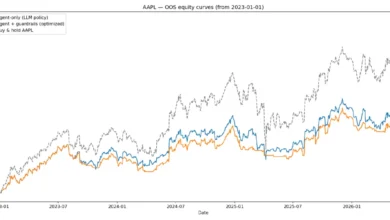
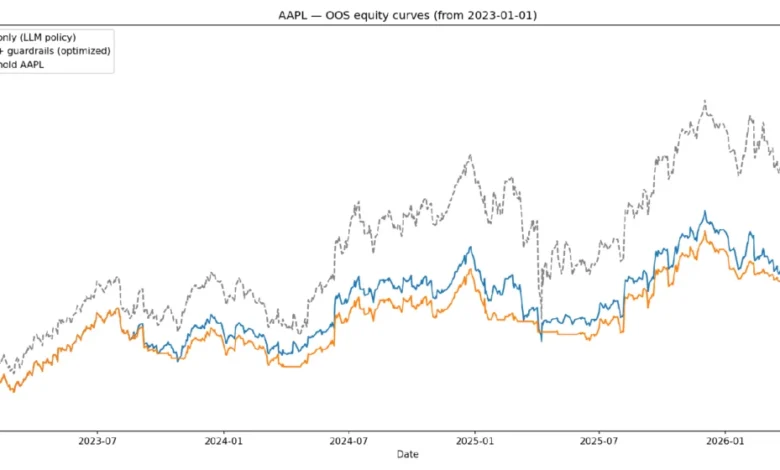
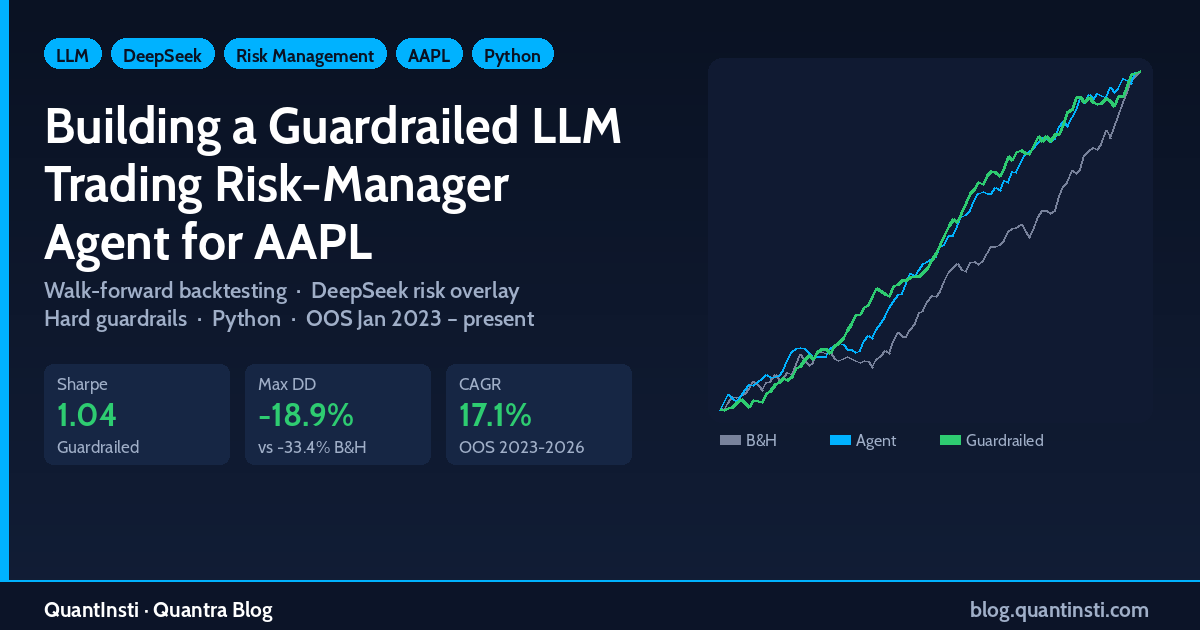
The efficacy of this strategy is best observed through its performance on AAPL data from January 2023 to the present. While a simple buy-and-hold strategy yielded a Compound Annual Growth Rate (CAGR) of 27.1%, it also carried significantly higher risk. In contrast, the LLM-integrated strategy, when paired with hard guardrails, achieved a CAGR of approximately 12.8%.
Crucially, the risk-adjusted returns tell a different story. The guardrailed strategy effectively reduced the maximum drawdown from 22% (or higher in some configurations) to 18%. By trimming exposure during periods of high volatility and negative momentum, the system demonstrated a clear ability to protect capital. The divergence between the "Agent-only" and "Agent + Guardrails" equity curves highlights that while the LLM provides nuanced management, the mechanical guardrails serve as the final line of defense during periods of market stress.
The Technical Challenge of Guardrail Deadlocks
A significant contribution of this research is the identification and resolution of the "guardrail deadlock." In many standard trading models, a drawdown stop triggers a move to zero exposure (flat). If the market remains stagnant or continues to decline, the equity curve remains frozen. Because the drawdown calculation is based on peak equity, the strategy may find itself unable to re-enter the market, effectively locking the portfolio into a flat position indefinitely.
The implementation of a MAX_FLAT_DAYS parameter serves as a programmatic circuit breaker. By forcing a re-entry after a set period—regardless of the current equity drawdown—the strategy ensures that the portfolio remains liquid and active, preventing the systemic paralysis that often plagues automated drawdown-prevention systems.
Broader Implications for Quantitative Trading
The implications of this strategy extend beyond the specific case of AAPL. The framework demonstrates that LLMs can act as effective "orchestrators" in a multi-layered trading environment. By offloading the qualitative interpretation of market regimes to an LLM, while keeping the execution of trades and the enforcement of safety guardrails in robust, deterministic code, developers can create systems that are both intelligent and disciplined.
Furthermore, the strategy’s reliance on a monthly walk-forward loop underscores the necessity of constant adaptation. As markets shift from low-volatility regimes to periods of high stress, the ability to re-optimize guardrail thresholds—such as volatility stops and drawdown limits—is paramount. This synergy between human-designed rules and AI-driven policy suggests that the future of quantitative trading lies in hybrid architectures rather than pure-play black-box models.
Expert Analysis and Future Research Directions
Industry experts suggest that the next phase of this development will likely involve "multi-horizon momentum" and "earnings blackout" filters. By incorporating macro-regime indicators, such as the S&P 500’s relationship to its 200-day moving average, practitioners can provide the LLM with a broader context of market health. This top-down approach, combined with the current bottom-up regime analysis, could significantly improve the strategy’s ability to navigate broad market corrections.
Moreover, the use of fractional Kelly-sizing and continuous exposure output—rather than discrete 50% or 100% steps—represents a logical progression for fine-tuning the system. However, as the strategy becomes more complex, the burden of validation increases. The necessity of rigorous, out-of-sample testing remains the gold standard for ensuring that these models provide genuine alpha rather than mere curve-fitted noise.
Conclusion
The framework introduced here serves as a practical, transparent, and honest approach to LLM-assisted trading. By admitting the limitations of predictive modeling and focusing instead on risk modulation, this strategy provides a robust alternative to high-risk speculative trading. As the financial industry continues to grapple with the integration of generative AI, the methodology of using LLMs to navigate market states—while relying on hard, objective guardrails for safety—offers a sustainable path forward. Future iterations will undoubtedly refine the granularity of state features and the sophistication of the risk-assessment prompts, but the foundational principle remains: an AI’s greatest value in finance is not in guessing the future, but in managing the risks of the present.