Event Conditioned Intraday Trading Signals: Transforming Market Context into Systematic Edge

Algorithmic trading has long relied on instantaneous market indicators to capture short-term price movements, yet traditional tools frequently struggle to capture the broader narrative of a trading session. Recognizing the limitations of standard indicator libraries, quantitative trading platforms are increasingly shifting toward event-conditioned signals. By isolating specific intraday occurrences—such as closing strength during the final hour of trade, opening range breakouts, or midday volume-weighted average price (VWAP) positioning—systematic traders can establish robust contextual rules that dictate trades in entirely separate windows of the session.
The mechanics behind event-conditioned strategies rely on temporal separation. Rather than describing the immediate bar upon which a trader sits, an event-conditioned rule evaluates what has already transpired at a distinct milestone and carries that informational payload forward. This methodological shift allows researchers to frame complex conditional hypotheses that traditional technical metrics fail to express cleanly.
The Mechanics of Event-Conditioned Logic
At the core of modern event-aware feature engineering is the capacity to anchor specific price points or market readings to defined chronological markers. Utilizing custom logical frameworks, such as Build Alpha’s proprietary Value When function, quantitative analysts can capture variables like the opening bell’s price or the market close without manual intervention.
The function evaluates two primary inputs: a specified condition and a target value. Whenever the governing condition evaluates as true, the system captures and stores the designated metric. Across subsequent bars, the function preserves the most recently captured value until the condition is met anew. For instance, capturing the exact opening price at 09:30 EST or recording the closing value at 16:00 EST provides immutable benchmarks that can be referenced hours later in the trading session.
This capability addresses a longstanding structural challenge in financial engineering: how to efficiently test whether morning market sentiment reliably bleeds into afternoon volatility or whether late-day institutional positioning forecasts the opening trajectory of the following session. By separating the diagnostic event from the execution window, developers create cleaner testing environments that minimize data leakage and reduce curve-fitting vulnerabilities.
Five Core Intraday Event Setups
To understand how event-conditioned logic operates in practice, quantitative researchers often categorize strategies into distinct structural setups. Assuming standard US equity index hours in Eastern Time, several primary configurations illustrate the versatility of event-aware modeling.
Setup 1: Yesterday’s Last Hour Strength and First-Hour Follow-Through
One classic inquiry in index futures and equity trading is whether late-day institutional accumulation carries over into the next morning’s open. By storing the closing price of the prior session at 16:00 and comparing it to the final print at 17:00, traders can determine whether yesterday finished on an upward trajectory. Because these values are locked prior to the subsequent session’s open, a rule can be established to buy at 09:30 and exit at 10:30 whenever yesterday’s final hour closed higher.
Setup 2: Opening Range Direction and Afternoon Momentum
Rather than focusing exclusively on overnight data, market participants frequently evaluate the opening range—typically established between 09:30 and 10:00—to gauge directional bias. By storing the opening price and the 10:00 close, a comparative rule can assess whether the opening range finished higher. If verified, the strategy can execute a long position during the final hour of the session, capitalizing on potential end-of-day marking or institutional rebalancing.
Setup 3: Midday VWAP Positioning
The volume-weighted average price serves as a primary institutional benchmark for fair value during a trading session. Determining whether price is holding above or below VWAP at midday (12:00 EST) provides a transparent read on which market participants control the session. Storing the distance between the midday close and the VWAP allows systems to condition afternoon trades, such as buying the final hour when midday price action successfully sustains itself above the benchmark.
Setup 4: Volatility Expansion Filters via Opening Ranges
Beyond standalone directional triggers, event conditions excel as filters for classic volatility breakouts. For example, an opening range breakout (ORB) strategy can be refined by comparing today’s opening range width to yesterday’s final-hour range. If the morning session demonstrates greater volatility and energy than the prior afternoon closed with, the breakout filter activates, permitting trades that might otherwise be filtered out during quiet, low-conviction market regimes.
Setup 5: Normalizing Ranges Against Full-Day Volatility
Scaling opening range parameters relative to the prior day’s entire trading range provides another robust filter. If an opening range constitutes an abnormally large percentage of yesterday’s full daily range, it often signals an expanding volatility regime where a breakout has sufficient room to trend. By setting an optimizable threshold, traders can restrict breakout executions strictly to environments characterized by significant structural expansion.
Data Integrity and Chronological Precision
Implementing event-conditioned signals requires strict attention to underlying data structures. Market data vendors vary significantly in how they timestamp bars, with some recording timestamps at the opening of a period and others marking them at the close. Ensuring that a designated timestamp—such as 15:00—accurately reflects the conclusion of that specific bar is essential to prevent look-ahead bias.
Furthermore, utilizing extended-hours data is critical for capturing overnight and premarket developments. While standard equities data limited to regular trading hours will truncate pre-market price action, futures data encompassing a 24-hour cycle allows event-conditioned algorithms to evaluate overnight macroeconomic releases, international market closes, and pre-market liquidity shifts seamlessly.
Advanced Integration and Signal Pooling
While individual event-conditioned rules offer valuable insights, their true utility emerges when integrated into a broader signal pool. Modern algorithmic platforms allow quantitative researchers to combine event-based filters with technical indicators, volume profiles, sentiment metrics, and macroeconomic data.
Through automated genetic algorithms, thousands of strategy variations can be tested simultaneously to determine which combinations exhibit genuine predictive power. For instance, traders can stack multiple independent event reads—such as requiring both an upward-trending prior last hour and an expanding opening range—while applying a broader regime filter, such as ensuring the daily price remains above its 200-day moving average. Event conditions are equally effective when deployed as dynamic exit signals, allowing systematic models to liquidate positions early if late-day price action demonstrates sudden weakness or deteriorating body-to-range ratios.
Validation, Robustness, and Avoiding Curve-Fitting
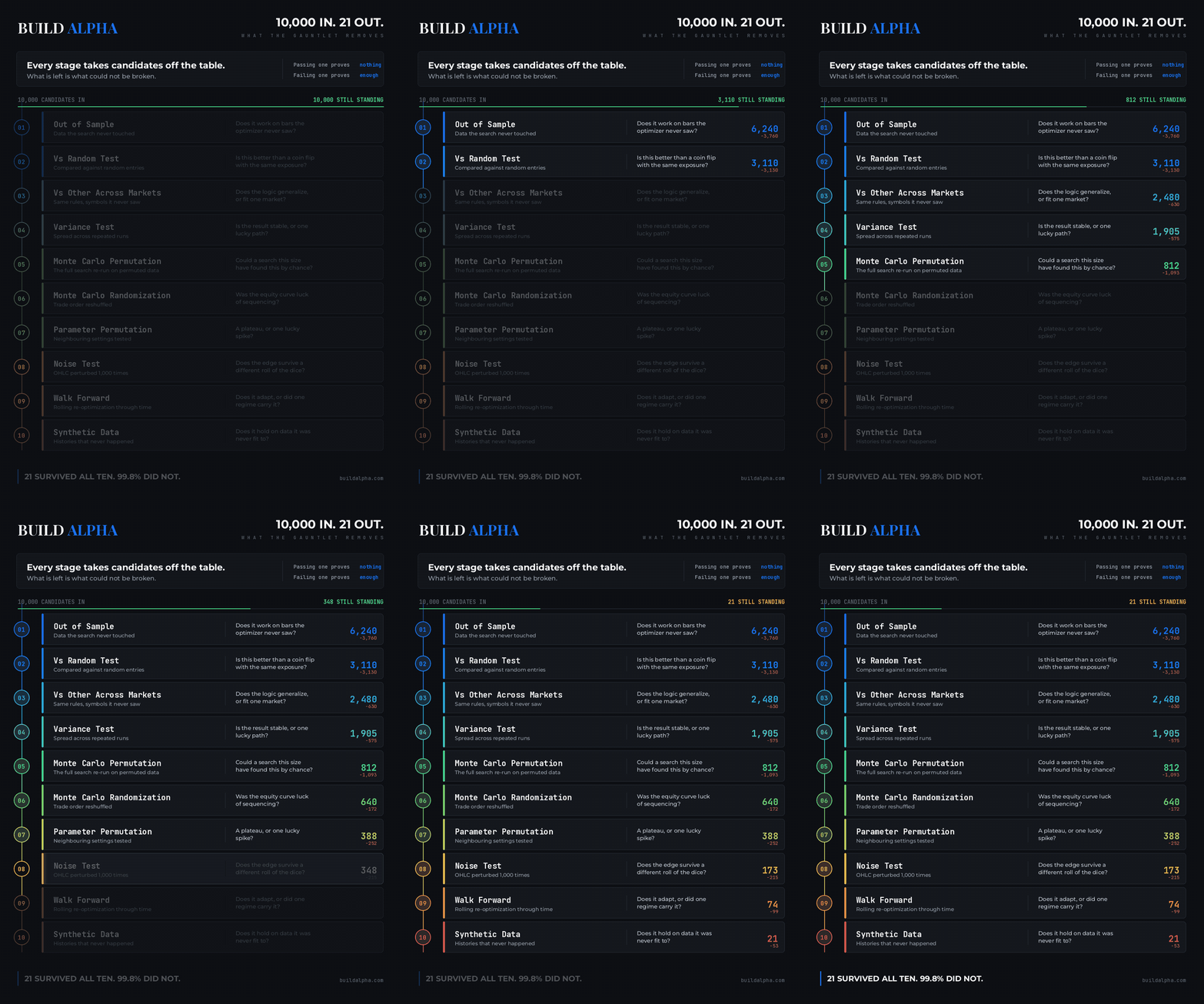
The flexibility to optimize time parameters, window lengths, and threshold percentages introduces significant risk regarding curve-fitting and over-optimization. Testing numerous variations inevitably uncovers historical parameters that appear exceptionally profitable purely by chance.
To combat this search-space vulnerability, rigorous validation protocols are mandatory. A robust event-conditioned signal must demonstrate stability across a plateau of nearby times and thresholds rather than relying on a single isolated peak in performance. Quantitative developers utilize parameter permutation tests, noise tests, and out-of-sample walk-forward analysis to ensure that identified edges persist across diverse market regimes. Strategies that survive this validation gauntlet demonstrate that capturing intraday context successfully translates into a sustainable, systematic trading edge.