Bank of Canada Prepares First Rate Hike in a Year as Energy Shocks and Resilient Growth Revive Inflation Pressures

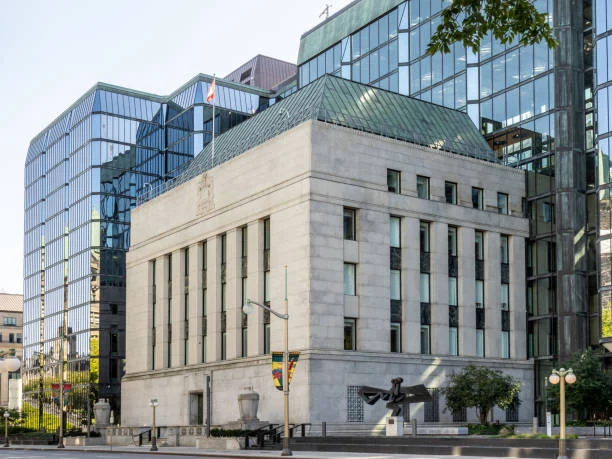
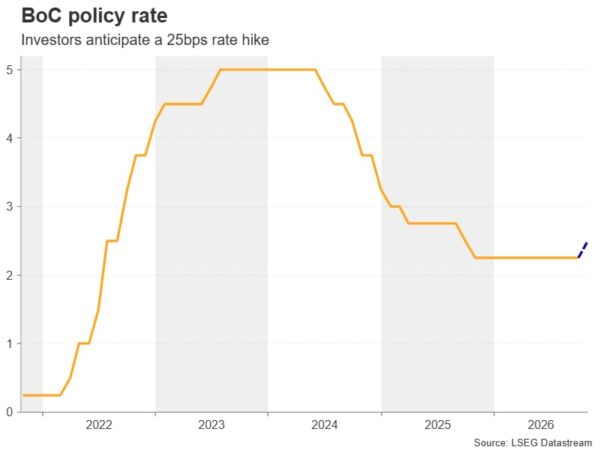
The Bank of Canada is widely expected to implement its first interest rate increase in a full year, with financial markets and economists forecasting a 25-basis-point lift to bring the benchmark overnight rate to 2.50%. This anticipated pivot follows a prolonged period of policy stability, during which the central bank maintained rates at 2.25% following a targeted quarter-point reduction in October 2025. The shift underscores a broader international monetary trend, as central banks globally recalibrate toward tighter policy stances to combat persistent inflation risks largely stoked by surging global energy prices. Reuters polling indicates that a decisive majority of economists support the probability of a hike, while overnight index swaps price in roughly an 80% likelihood of the policy adjustment occurring at the upcoming monetary policy meeting.
Chronology of Policy Shifts and Market Repricing
The journey toward this week’s anticipated policy tightening represents a dramatic departure from market sentiment just months prior. Throughout late 2025 and the early quarters of 2026, consensus expectations pointed toward an extended period of monetary policy stagnation, with financial markets betting that the Bank of Canada would keep borrowing costs unchanged through the entirety of 2026. However, economic indicators and central bank communications over the late summer and early autumn forced a rapid repricing of interest rate trajectories.
The turning point materialized when Bank of Canada Governor Tiff Macklem delivered public remarks signaling that upcoming macroeconomic projections in the central bank’s Monetary Policy Report would likely incorporate upward revisions to inflation forecasts. This hawkish pivot was validated by subsequent business and consumer surveys conducted by the central bank, which revealed creeping inflation expectations among domestic enterprises and households. Consequently, interest rate swaps began reflecting not only an October rate increase but also strong probabilities for an additional quarter-point hike by the end of March 2027, completely dismantling earlier assumptions of a prolonged policy pause.
Energy Markets and the Roots of Resurgent Inflation
At the heart of the central bank’s policy reassessment is the relentless appreciation of global energy commodities. Brent crude prices experienced a violent upward trajectory, briefly breaching the significant threshold of $117 per barrel during the month. This energy shock, heavily fueled by escalating geopolitical tensions and supply disruptions in the Middle East, has directly impacted domestic pricing structures and threatened to undo years of hard-won progress in subduing consumer price growth.
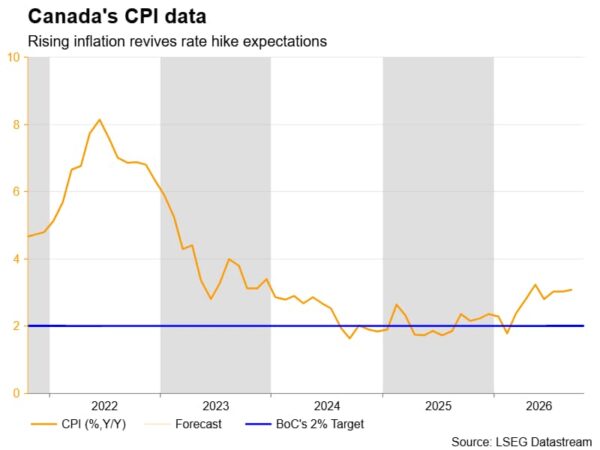
Canada’s headline consumer price index (CPI) for September accelerated to 3.1%, lifting inflation above the upper boundary of the Bank of Canada’s official 1% to 3% target corridor. While a substantial portion of this acceleration is directly attributable to volatile energy components—such as petroleum, gasoline, and home heating fuels—underlying core inflation metrics have remained comparatively stable.
Nevertheless, central bank officials face a complex transmission mechanism. Elevated fuel costs inevitably cascade through supply chains, driving up transportation expenditures, production overheads, and operating expenses across virtually every sector of the economy. These pressures elevate the tangible risk of second-round effects, wherein businesses pass rising costs onto consumers and workers demand higher compensation to offset the cost-of-living squeeze. The Bank of Canada’s recent Business Outlook Survey confirmed that firms are increasingly adjusting their pricing behavior and inflation expectations upward, establishing a more persistent inflation psychology that monetary policymakers feel compelled to preempt.
Economic Resilience and Trade Dynamics
The rationale for monetary tightening is further reinforced by surprising resilience in broader economic activity, which has repeatedly defied expectations of a sharper slowdown. Gross Domestic Product (GDP) growth for the second quarter printed at a robust 3.3% on an annualized basis, outperforming forecasts and demonstrating underlying domestic momentum. Furthermore, international trade channels have shown remarkable adaptability; despite ongoing trade frictions and the breakdown of comprehensive bilateral trade negotiations with the United States, Canadian export volumes managed a steady recovery.
Consumer demand has likewise remained a vital pillar of economic expansion. Retail sales expanded by 1.2% in August, supported by strong labor market carryover from earlier quarters, while preliminary tracking for September pointed to an additional 0.7% increase in retail turnover. Economic models and consensus tracking now project third-quarter GDP growth to register at approximately 2.0%, providing the central bank with sufficient economic cushion to absorb a tighter borrowing environment without inducing an immediate recession.
Labor Market Softening and Competing Pressures
Despite the headline strength in output and consumer spending, underlying vulnerabilities within the domestic economy present a nuanced picture for policymakers. The Canadian labor market has exhibited noticeable signs of deceleration, providing a counterweight to persistent inflation readings.
Employment figures contracted significantly in September, with the economy shedding 68,300 jobs—marking the second consecutive month of net employment declines. The national unemployment rate has drifted higher as a result. Concurrently, wage growth has moderated substantially, easing to an annualized pace of roughly 2.3%, down sharply from the 3.3% rate recorded a year prior. This cooling in wage pressures indicates that the acute labor-market tightness characteristic of the post-pandemic inflationary surge has largely dissipated, removing one major domestic driver of wage-push inflation.
Furthermore, structural headwinds continue to weigh on long-term business sentiment. According to central bank business surveys, corporate leadership remains intensely preoccupied with the potential economic fallout from ongoing tariff disputes and protectionist trade measures, which are expected to dampen capital expenditure and hiring ambitions over the medium term. Consensus forecasts compiled by Reuters suggest that national GDP growth will moderate to a sluggish 1.0% throughout 2026 before staging a modest recovery toward 1.7% by 2027.
Foreign Exchange Implications and the USDCAD Outlook
The shifting monetary policy landscape has direct implications for foreign exchange markets, particularly the valuation of the Canadian dollar against its American counterpart. The Canadian currency has found solid technical support in recent weeks, buoyed concurrently by elevated crude oil quotations and the aggressive repricing of Bank of Canada interest rate expectations.
This domestic policy adjustment has visibly impacted cross-border yield differentials, notably narrowing the two-year yield spread between Canadian government bonds and US Treasuries. By compressing this yield advantage traditionally held by US fixed-income assets, the Canadian dollar has been shielded from deeper depreciation pressures.
However, the future trajectory of the USDCAD exchange pair will heavily depend on the forward guidance issued by Governor Macklem and the policy committee following the rate decision. While the US Federal Reserve is widely anticipated to maintain its current policy rate during its concurrent meeting, underlying US inflation metrics remain persistently elevated, leaving financial markets priced for a divergence in the future paths of both central banks.
Market consensus currently assumes that the Bank of Canada will adopt a measured approach, likely delivering only a limited series of additional hikes following the October adjustment. Consequently, a standard 25-basis-point increase is largely absorbed by current market valuations and will not inherently force a dramatic convergence in North American interest rate structures.
Foreign exchange strategists emphasize that market participants will scrutinize the central bank’s updated economic projections and verbal commentary for explicit signals regarding cumulative tightening. Should the Bank of Canada accompany its rate hike with upwardly revised inflation forecasts and a clear willingness to extend its tightening cycle into early 2027, yield spreads could compress further. Such a hawkish outcome would likely catalyze downward momentum in USDCAD, potentially breaching psychological support at 1.4000 and driving the pair toward the 200-day simple moving average near 1.3880.
Conversely, if the central bank pairs its policy move with a cautious, data-dependent narrative that emphasizes emerging labor market slack and trade uncertainties, financial markets may rapidly pivot back toward the relative monetary restrictiveness of the United States. In that scenario, USDCAD could stage a robust rebound toward the 1.4100 handle, with potential extensions testing the eighteen-month cyclical high near 1.4230 as investors re-embrace US dollar yield supremacy.