US Consumer Confidence Suffers Sharp September Decline Amid Growing Labor Market Strain and Sticky Inflation Concerns

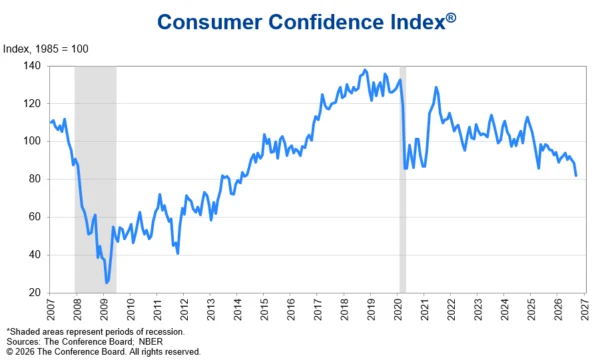
U.S. consumer confidence deteriorated significantly in September, driven down by mounting concerns over the trajectory of the labor market, persistent inflation pressures, and an increasingly pessimistic outlook for household finances. According to the latest data released by The Conference Board, the headline Consumer Confidence Index fell sharply from a downwardly revised 88.6 in August to 81.9 in September. This latest reading underscores a broadening sense of economic unease among American households, reflecting a combination of softening growth sentiment and sticky price expectations that complicate the broader macroeconomic landscape.
The downturn in September was comprehensive, affecting both key sub-indices tracked by the organization. The Present Situation Index—which measures consumers’ assessment of current business and labor market conditions—dropped from 117.2 to 109.3. Concurrently, the Expectations Index, which gauges consumers’ short-term outlook for income, business, and labor conditions over the next six months, slid from 69.5 to 63.6. This decline in the expectations metric marks the third consecutive monthly drop, signaling that households are increasingly bracing for a more challenging economic environment as the year progresses.
Survey data, compiled from responses collected between September 1 and September 23, revealed a notable shift in sentiment regarding current economic health. For the first time since September 2024, assessments of current business conditions turned negative on balance. Consumers expressed growing apprehension not only about the immediate state of the economy but also about their personal financial prospects and business conditions looking out over the next two quarters.
Labor Market Softening and Widening Employment Pressures
At the heart of the consumer malaise is a tangible cooling in the U.S. labor market. For months, strong employment metrics had served as a primary bulwark supporting consumer confidence despite high costs of living. However, the September survey results point to a distinct deceleration in hiring sentiment and a rise in employment anxiety.
The proportion of respondents reporting that jobs were currently "plentiful" decreased from 24.5 percent to 23.6 percent. Conversely, the share of consumers stating that jobs were "hard to get" ticked upward from 20.3 percent to 21.9 percent. As a result, the closely watched labor-market differential—the percentage of consumers viewing jobs as plentiful minus those viewing them as hard to get—narrowed dramatically from 4.2 percentage points to a scant 1.7 percentage points, pointing to a near-even split in employment perceptions.

Forward-looking labor indicators reinforced this cautious narrative. Expectations for future job availability deteriorated as the percentage of consumers anticipating an increase in jobs fell from 14.8 percent to 14.0 percent. Simultaneously, the share of respondents expecting job availability to decrease rose from 26.1 percent to 28.4 percent.
This anxiety extended directly into personal financial expectations. Anticipation of higher household incomes softened, with the share of consumers expecting their incomes to grow dropping from 19.0 percent to 17.9 percent. In contrast, those anticipating a decline in their household income increased from 13.5 percent to 15.4 percent. These shifting dynamics illustrate a growing vulnerability among households, who feel squeezed by both a less certain employment landscape and stagnant wage expectations.
Persistent Inflation Anxieties and Higher Interest Rate Expectations
Perhaps most concerning for economic policymakers is that the softening in consumer confidence and labor market sentiment was paired not with easing price pressures, but with a resurgence in inflation concerns. Rather than feeling relief from price growth, consumers reported an escalation in their near-term inflation expectations during September.
The survey revealed that average 12-month inflation expectations climbed from 5.8 percent to 6.1 percent. Meanwhile, median inflation expectations over the same timeframe increased from 4.8 percent to 5.1 percent. Consumers increasingly pointed to the high cost of everyday goods and services, alongside persistently elevated oil and gasoline prices, as primary drivers of their financial stress.
This renewed focus on inflation translated directly into monetary policy expectations. The share of consumers anticipating higher interest rates over the course of the coming year jumped sharply to 68.4 percent. The resulting economic environment presents an uncomfortable mixture for analysts and central bankers alike: slower growth and weaker labor sentiment coinciding with firmer, more stubborn inflation expectations.
Comprehensive Economic Data Summary
The table below outlines the key metrics from The Conference Board’s September consumer confidence survey, comparing current readings against the previous month:
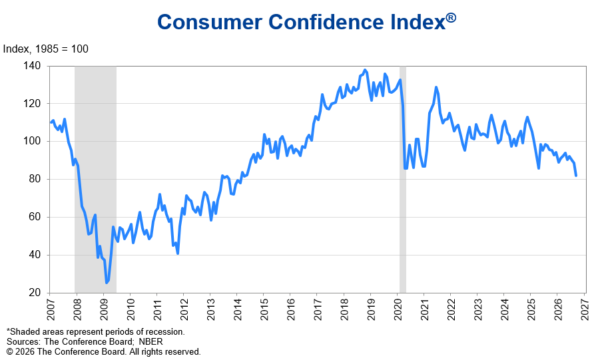
| Indicator | Previous (August) | Current (September) |
|---|---|---|
| Consumer Confidence Index | 88.6 | 81.9 |
| Present Situation Index | 117.2 | 109.3 |
| Expectations Index | 69.5 | 63.6 |
| Jobs “plentiful” (%) | 24.5% | 23.6% |
| Jobs “hard to get” (%) | 20.3% | 21.9% |
| Labor-market differential (%) | 4.2% | 1.7% |
| Average 12-month inflation expectations (%) | 5.8% | 6.1% |
| Median 12-month inflation expectations (%) | 4.8% | 5.1% |
Context, Chronology, and Market Implications
The Conference Board’s Consumer Confidence Index has historically served as a critical barometer for household spending trends, which account for the vast majority of U.S. economic activity. The steady erosion observed over the past three months suggests that American consumers are increasingly exhausting the financial buffers built up over prior years, weighed down by cumulative price increases and cooling job security.
The chronology of the September survey captures a period marked by shifting financial market conditions, fluctuating energy commodities, and ongoing debate regarding the trajectory of federal monetary policy. With the preliminary data cutoff established on September 23, the responses reflect real-time consumer reactions to late-summer economic developments. The convergence of a narrowing labor market differential and elevated inflation expectations signals that consumers are feeling pinched from both sides: earning potential is perceived as flattening, while the purchasing power of the dollar continues to be eroded by high living costs.
Market analysts and economists reviewing the September data note that this combination of waning confidence and sticky inflation expectations could pose headwinds for upcoming retail seasons, particularly if households pull back on discretionary expenditures. Furthermore, the persistent belief among nearly 70 percent of consumers that interest rates will continue to climb underscores the reality that borrowing costs remain a dominant fixture in the public consciousness, heavily influencing major purchase decisions for housing and automobiles.
As the broader economy navigates the final quarter of the year, the Federal Reserve and private-sector forecasters will closely monitor subsequent consumer confidence releases to determine whether the September retreat represents a temporary dip or the onset of a more pronounced slowdown in consumer-driven economic expansion.