Choosing a Chunking Strategy for Your LLM Apps: A Decision-Tree Approach

The Mechanics of RAG and the Chunking Dilemma
Retrieval-augmented generation functions by bridging the gap between a model’s static training data and a company’s proprietary, real-time knowledge base. However, standard LLM context windows, while growing, remain finite. Furthermore, embedding models—the engines that translate text into vector representations for similarity search—perform optimally when the input text is dense with semantic meaning.
When a document is split incorrectly, the system suffers from "semantic fracturing." If a chunk cuts mid-sentence or separates a subject from its predicate, the vector representation becomes noisy, leading to degraded retrieval accuracy. Research from industry leaders in vector databases suggests that improper chunking accounts for roughly 40% of retrieval failures in RAG pipelines. Consequently, the choice of strategy is not merely a configuration setting; it is a critical component of the data engineering pipeline.
A Chronological Evolution of Chunking Strategies
The history of chunking in the era of LLMs has evolved rapidly alongside the capability of embedding models. Early implementations relied on primitive fixed-size splitting, a holdover from traditional search engine indexing.
- The Era of Fixed-Size Chunking (2020-2022): In the nascent stages of transformer-based search, developers prioritized computational speed. By simply counting tokens and applying a sliding window overlap, engineers ensured that no segment exceeded the maximum input length of models like early BERT variants.
- The Rise of Structural Awareness (2023): As RAG systems matured, the limitations of fixed-size windows became apparent. Developers began implementing document-based chunking, which leveraged Markdown headers, HTML tags, and code syntax to keep related information clusters together.
- The Semantic Turn (2024-Present): Currently, the industry is shifting toward "context-aware" strategies. Techniques like semantic chunking—which uses embedding distance to detect topic shifts—and agentic chunking—which uses small models to dynamically determine the best split—represent the cutting edge of current engineering practices.
Evaluating Strategies Through a Decision-Tree Framework
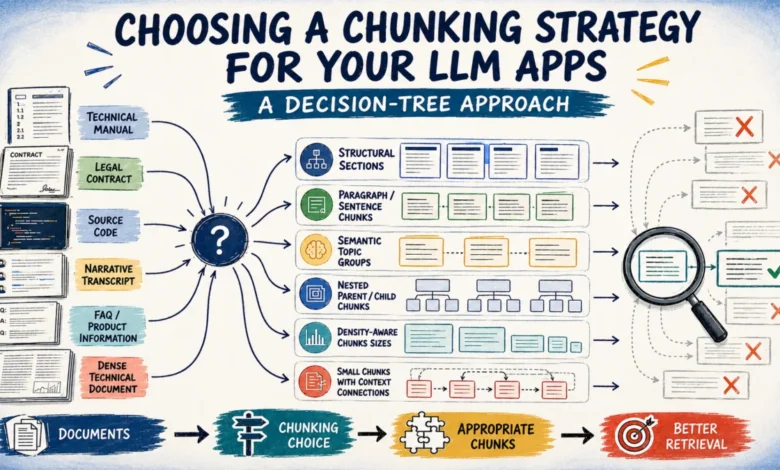
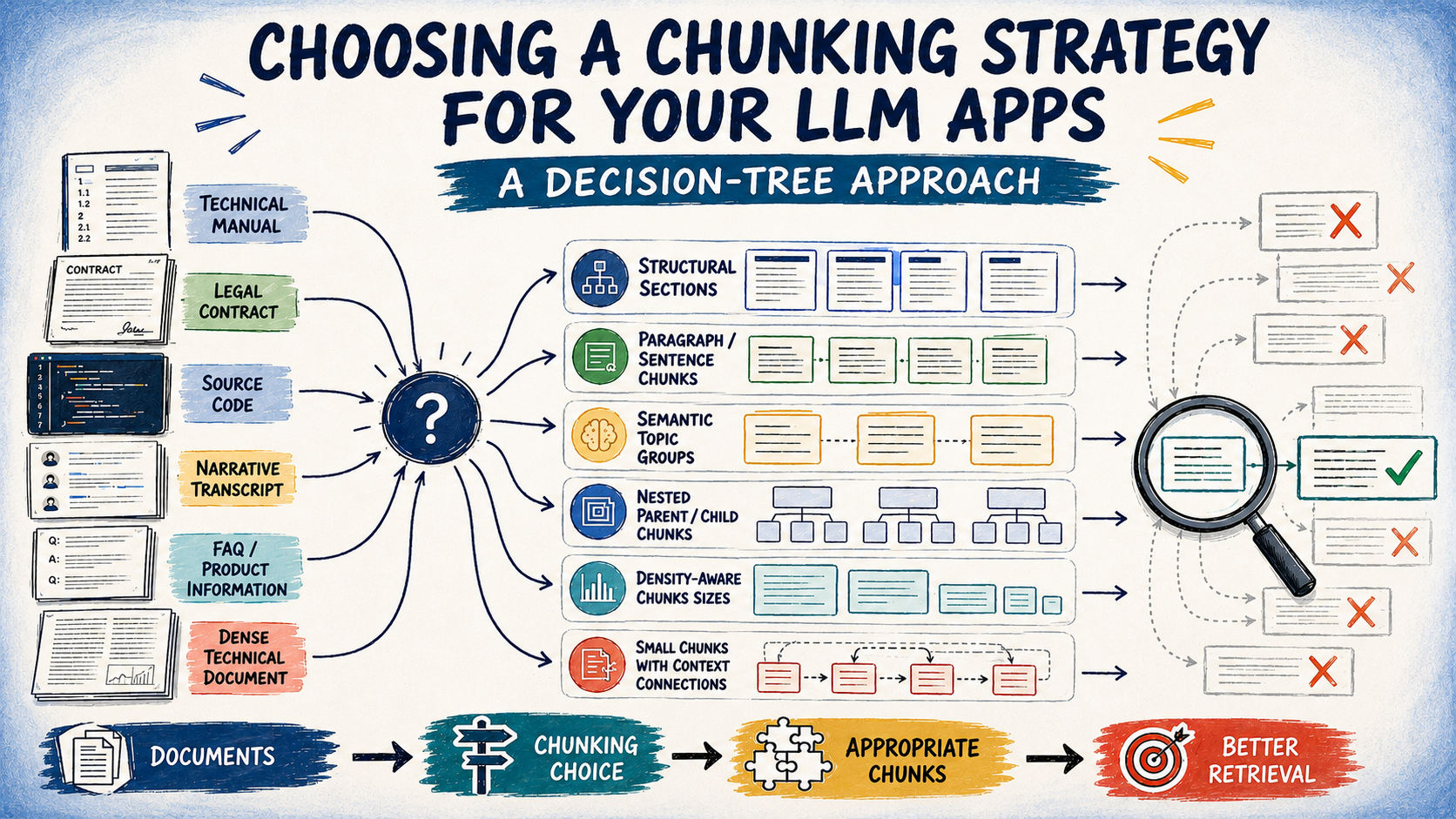
Selecting the right approach requires a systematic, objective assessment of the document corpus. By applying a decision-tree model, developers can mitigate the risk of over-engineering their solutions.
Step 1: The Necessity Assessment
The most common mistake is premature optimization. For repositories consisting of FAQs, short technical bulletins, or atomic configuration files, chunking is often counterproductive. If a document is inherently cohesive, the most effective strategy is to forgo splitting entirely. This avoids the risk of fragmenting the context and ensures the model receives the complete semantic unit.
Step 2: Structural Integrity
For longer documents, the existence of metadata is the next primary filter. If a document adheres to a strict schema—such as a JSON file, a structured technical manual with hierarchical headers, or a codebase—document-based chunking should be the default. By parsing based on the document’s own inherent structure, the system preserves logical relationships that arbitrary character counts would destroy.
Step 3: Contextual Dependencies
In complex datasets like legal contracts or research papers, a single chunk often relies on information found elsewhere. For instance, a "Definitions" section at the start of a document provides the keys to interpreting the entire text. In these cases, "late chunking" has emerged as a superior solution. By embedding the document as a whole using long-context models and then deriving the specific chunks, the system retains a global "semantic trace" of the document within every individual segment.
Step 4: Information Density and Granularity
When dealing with mixed media—such as a document that contains both sparse headers and dense, paragraph-heavy prose—static rules fail. Adaptive chunking provides a solution by dynamically adjusting segment sizes based on the density of the information. Similarly, hierarchical chunking serves as a dual-layer strategy, where small chunks are indexed for precision and larger "parent" chunks are indexed for broad thematic understanding.
Comparative Analysis of Performance Metrics
To determine which strategy provides the best return on investment, engineering teams should measure performance across three metrics: Latency, Compute Cost, and Retrieval Recall (the percentage of relevant documents successfully retrieved).
| Strategy | Latency Impact | Compute Cost | Ideal Use Case |
|---|---|---|---|
| Fixed-Size | Minimal | Low | Rapid prototyping/Speed-critical apps |
| Recursive | Low | Low | General-purpose, uniform document sets |
| Semantic | Moderate | Medium | Unstructured documents with shifting topics |
| LLM-Based | High | High | High-stakes, high-accuracy requirements |
| Agentic | High | Variable | Heterogeneous data collections |
Technical Pitfalls and Remediation
Even with a well-selected strategy, operational drift can occur. A common issue is "semantic drift," where the similarity threshold in semantic chunking is set too loosely, causing the system to group unrelated topics into a single chunk. Industry best practices dictate a "monitor-and-tune" cycle: if retrieval quality dips, the first step should be an analysis of the "chunk-to-query" ratio. If chunks are consistently returning irrelevant information, the system likely requires a tightening of the segmentation threshold or a transition to LLM-based boundary identification.
Furthermore, teams should avoid the trap of "strategy proliferation." It is rarely efficient to implement five different chunking methods for five different document types if the results are marginal. Simplification is often the most effective form of optimization.
Broader Implications for AI Infrastructure
The standardization of chunking strategies reflects a broader trend in the AI industry: the move away from "black box" model performance toward "data-centric" engineering. The effectiveness of a RAG system is increasingly seen as a function of the quality of the data pipeline rather than just the underlying LLM architecture.
As businesses continue to scale their AI initiatives, the ability to automate the selection of these strategies—using agentic frameworks to analyze the document before processing—will likely become a standard feature of enterprise RAG platforms. By treating chunking as a dynamic, intelligent process rather than a static pre-processing task, organizations can significantly improve the accuracy, reliability, and cost-efficiency of their generative AI deployments.
Ultimately, the goal of any chunking strategy is to minimize the distance between a user’s query and the specific segment of knowledge that provides the correct answer. By rigorously applying a decision-tree approach, developers ensure that their systems are built on a foundation of structural, semantic, and logical integrity, setting the stage for more capable and responsive AI applications.