Multilingual Text Classification with Scikit-LLM and Multilingual Embeddings

The Evolution of Multilingual NLP
Historically, machine learning practitioners faced a binary choice when dealing with cross-lingual datasets. The first option was machine translation, which necessitated using external APIs—often costly and prone to latency issues—to convert all incoming data into a single "pivot" language, such as English. While effective, this process frequently stripped away cultural nuances and idiomatic expressions that are critical for accurate sentiment analysis. The second option involved training N models for N languages. As a product expanded into new markets, the operational complexity grew exponentially, leading to higher cloud computing costs and significant technical debt.
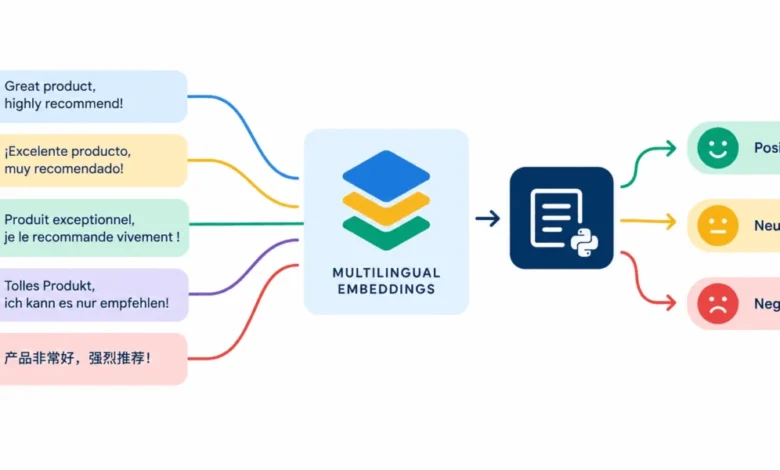
The advent of "barrier-free" multilingual embeddings has rendered these strategies largely obsolete. These embeddings, generated by models trained on massive, cross-lingual corpora, map disparate languages into a common vector space. In this high-dimensional landscape, the semantic distance between an English phrase and its Spanish, French, or Japanese equivalent is minimized. Consequently, a single downstream classifier can interpret the intent of the text regardless of the original language, allowing for a "write once, deploy everywhere" architecture.
Implementation and Technical Architecture
To demonstrate this, developers are increasingly turning to the BGE-M3 model, an open-source powerhouse that excels in multilingual information retrieval and embedding generation. Integrating this model into a production-grade workflow typically involves the Scikit-LLM library, which bridges the gap between sophisticated LLMs and the intuitive, standardized API of Scikit-learn.
The initial setup begins with the deployment of a local inference server, such as Ollama. By running the server locally, developers bypass the security and financial constraints of proprietary API endpoints. The process follows a clear technical sequence:
- Dependency Management: Installing necessary libraries including
scikit-llm,datasets, andscikit-learn. - Infrastructure Initialization: Spawning an Ollama background process to manage the BGE-M3 instance.
- Configuration: Directing the Scikit-LLM configuration module to the local server, utilizing a dummy key for authentication purposes.
Once the environment is primed, the pipeline is constructed using a Pipeline object. This structure typically contains two distinct stages: the GPTVectorizer for transforming raw text into high-dimensional vectors, and a LogisticRegression model that serves as the final classifier. This marriage of advanced neural embeddings and traditional, lightweight statistical models offers an optimal balance between performance and computational efficiency.
Empirical Analysis of Multilingual Classification
To assess the efficacy of this approach, researchers often utilize datasets such as the Amazon Multi-language Reviews. In a representative test involving 2,000 samples balanced between English and Spanish, the system demonstrated remarkable agility. After shuffling the data to ensure class diversity—ranging from one-star to five-star ratings—the model processed the input through the BGE-M3 vectorizer.
The results of such experiments reveal a nuanced reality: while the model performs exceptionally well at the extremes of the spectrum—correctly identifying highly positive or highly negative sentiment—it encounters more friction with intermediate ratings. This is common in sentiment analysis, where nuances between "three-star" and "four-star" reviews are often subjective and ambiguous. However, the macro-average performance suggests that the model effectively bridges the language gap, achieving a level of predictive accuracy that would previously have required the maintenance of two separate, language-specific models.
Industry Implications and Strategic Benefits
The shift toward unified multilingual models has profound implications for global enterprises. For companies operating in multiple jurisdictions, the ability to deploy a single classification engine reduces the time-to-market for new regional features. Instead of waiting for a team to annotate and train a new model for a target language, organizations can leverage existing, pre-trained multilingual models that already possess a sophisticated understanding of cross-lingual semantics.
Furthermore, this approach addresses the critical issue of data scarcity. Many languages lack the vast labeled datasets required to train high-quality, task-specific models from scratch. By using a pre-trained BGE-M3-based pipeline, developers can effectively "transfer" the knowledge encoded in the large-scale pre-training of the embedding model to their specific domain, requiring only a small sample of labeled data to achieve acceptable performance.
Future Outlook and Challenges
Despite the progress, several challenges remain. First, the computational demand for generating embeddings for large datasets can be high. While the BGE-M3 model is highly efficient compared to massive generative models, it still requires GPU acceleration for large-scale production tasks. Second, as language models continue to evolve, maintaining the consistency of these embeddings across versions becomes a priority for data scientists.
Moreover, the "black box" nature of LLM embeddings poses a challenge for explainability. In regulated industries—such as finance or healthcare—it is often necessary to understand why a model arrived at a specific conclusion. While Scikit-learn’s Logistic Regression provides some level of transparency at the final stage, the preceding embedding generation is harder to interpret. Future advancements in "Explainable AI" (XAI) will likely focus on mapping these high-dimensional vector spaces back to human-readable concepts, further solidifying the role of LLMs in enterprise environments.
Conclusion
The transition from language-siloed architectures to unified, embedding-based pipelines marks a significant milestone in software engineering. By utilizing tools like Scikit-LLM and robust models such as BGE-M3, developers are no longer forced to choose between linguistic coverage and operational simplicity. The current trajectory suggests that the future of text classification will be defined by these cross-lingual, scalable, and highly flexible architectures. As the ecosystem matures, the barriers that once separated global markets in the digital space will continue to dissolve, enabling a new generation of applications that communicate effectively with users in every corner of the globe. The era of the "barrier-free" multilingual model is not merely a theoretical possibility; it is a practical, implementable, and increasingly essential component of the modern machine learning toolkit.