Bridging the Gap: How Enterprise Finance Overcomes Legacy Architecture to Embrace Real-Time Analytics and AI

Modern corporate finance functions find themselves caught in a profound operational paradox. Leadership boards increasingly demand forward-looking strategic guidance, near-real-time operational visibility, and predictive analytics. Yet, these demands are directed at infrastructure largely engineered decades ago for a fundamentally different purpose: the generation and reconciliation of historical financial results.
This tension is most visible during the standard financial close process. Recent data from the American Productivity & Quality Center (APQC) indicates a median close time of 18 days, stretching up to 35 days for slower-performing enterprises. These extended timelines illustrate that many finance teams still spend weeks consolidating, validating, and cross-referencing information before executive leadership receives a finalized, reliable view of corporate performance.
Compounding this structural lag, APQC reports that only 31% of organizations actively utilize artificial intelligence within their record-to-report workflows. Another 39% remain in early adoption phases. These metrics highlight a widespread technological deficit: many corporate finance departments lack the modern foundational architectures required for scalable automation and continuous, real-time data visibility.
The operational friction caused by aging systems is widely documented by industry executives. In an April 2026 empirical study surveying 197 finance executives, conducted by the Financial Education & Research Foundation (FERF), 81% of respondents identified manual processes as a primary bottleneck slowing down month-end closes. Furthermore, 49% cited underlying system limitations, 38% pointed to persistent data quality issues, and 55% designated legacy software as a critical barrier to enterprise-wide transformation.
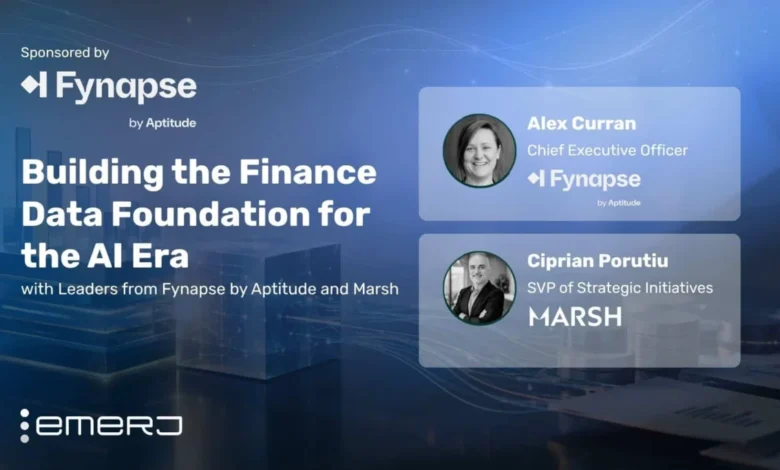
To explore how organizations can overcome these systemic hurdles, the AI in Business Podcast featured a comprehensive two-part series examining the necessary prerequisites for real-time reporting, automated reconciliations, and trusted artificial intelligence. Hosted by Emerj CEO and Head of Research Daniel Faggella and Emerj Senior Editor Yolandi de Weerdt, the discussions featured Alex Curran, Chief Executive Officer at Aptitude Software, and Ciprian Porutiu, Senior Vice President of Strategic Initiatives at Marsh. Across both conversations, industry leaders detailed essential strategies for preparing enterprise data foundations for the next generation of financial technology.
The Evolution of Corporate Finance and the Legacy Architecture Trap
For decades, the mandate of the corporate finance function was retrospective. Accountants and controllers gathered historical records, verified ledgers, ensured compliance, and reported figures after a fiscal period concluded. However, over the past 12 to 18 months, that mandate has fundamentally shifted. Today’s Chief Financial Officers are expected to explain past variances, predict future outcomes, recommend proactive business strategies, and execute these responsibilities in near-real time.
During her appearance on the podcast, Alex Curran emphasized that finance’s primary challenge lies not in a lack of analytical capability, but in the severe mismatch between modern strategic expectations and outdated technology platforms.
"The challenge becomes even harder because they’re expected to do that while operating on technology platforms that originally have been designed for monthly reporting cycles," Curran noted during the discussion. "That tension is what every CFO I speak to is living with right now. That role has dramatically evolved, but the challenge that they have is that the architecture hasn’t kept up with that."
Curran observed that legacy systems were entirely adequate when finance operated strictly on retrospective reporting cycles. However, the rise of advanced analytics and artificial intelligence did not create this architectural weakness; rather, it exposed it. Modern AI applications—ranging from continuous reconciliation workflows to automated anomaly detection and real-time profitability monitoring—require highly granular, timely, and strictly governed transaction-level data to function accurately.
In a traditional financial architecture, data is systematically aggregated long before it ever reaches the general ledger. By the time information is consolidated for executive review, vital transactional details such as specific product identifiers, precise timing, and exact amounts are stripped away. Consequently, if leadership or internal auditors ask a granular question about a consolidated figure, the finance team cannot simply query a database; they must manually reconstruct the data.
This structural limitation has been exacerbated by modern business models. Subscription economies, high-volume digital transactions, complex multi-entity corporate structures, and cross-border regulatory demands have exponentially multiplied the volume of financial data flowing into corporate systems. When legacy architectures fail to keep pace, organizations typically rely on stopgap measures: hiring additional staff, building complex webs of spreadsheets, and inserting manual reconciliation layers.
Uncovering Leading Indicators Through Transaction-Level Visibility
Examining the operational reality from inside a massive, multi-entity global enterprise, Ciprian Porutiu of Marsh framed the challenge through the metaphor of an iceberg. Executive leadership typically focuses exclusively on lagging indicators—such as quarterly revenue, net margins, and earnings per share—which sit safely above the waterline.
"Everything you see—financial results, revenue, top line or bottom line, efficiency, savings—is the top part of the iceberg. It’s above the waterline. Those are the lagging indicators, the ones everyone discusses in the quarterly reviews and every earnings call," Porutiu explained. "What is underneath is the leading indicators, what creates the context for the lagging indicators to provide not just good results but reliable results."
Without visibility into these underlying leading indicators, finance teams operate reactively. Curran illustrated this phenomenon within the banking sector, noting that when a specific lending product begins losing margin due to shifting funding costs, traditional monthly architectures often take up to six weeks for the variance to surface in management accounts. By contrast, a real-time profitability model exposes the margin compression the very next morning, while the trend is still reversible.
Similarly, in the insurance industry, a live profit and loss statement can immediately highlight deteriorating claims experiences within a distinct demographic segment. This allows executives to adjust underwriting appetite and modify pricing models long before compounding loss ratios severely damage quarterly performance.
Achieving this level of agility requires a fundamental redesign of data capture methodologies. Organizations must capture every financial event at the initial transaction level, deferring aggregation strictly to the reporting phase. Preserving complete data lineage ensures that any financial figure can be instantly traced back to its originating transaction. Furthermore, surfacing reconciliation exceptions the moment they occur allows corporate controllers to proactively manage operational differences rather than frantically hunting for discrepancies at period end.
Establishing a Common Financial Language Before Implementing Automation
While the pressure to accelerate financial reporting is universal, rushing into automation without addressing underlying data hygiene can prove catastrophic. Porutiu compares the current race toward AI adoption to navigating a sharp turn on a racetrack: organizations must intentionally slow down to establish proper control before attempting to accelerate.
Automation inherently inherits whatever inconsistencies, errors, and structural silos exist within the underlying data. Porutiu outlines four critical prerequisites that must be resolved prior to deploying advanced automation: establishing a single source of truth, resolving enterprise fragmentation, implementing strict data governance, and maintaining a logical deployment sequence. Attempting to bypass these steps typically results in an automated system that simply produces errors at an unprecedented speed.
Data fragmentation frequently begins when disparate business lines and geographic regions construct localized sources of truth. In many large enterprises, one business unit pulls financial data from a core fiduciary system, another relies on master records, a third utilizes standalone invoicing platforms, and a fourth depends on manual spreadsheets and email chains. Each manual bridge built between these isolated systems introduces human error, which compounds over time and forces audit controls and extensive rework cycles.
This fragmentation manifests acutely in specialized industries like insurance. If "revenue" is defined as gross written premium by one operating entity, net earned premium by another, and parsed under differing accounting standards across international borders, the broader enterprise becomes incapable of producing a single, trustworthy financial figure.
To resolve this, Porutiu advocates for a structured finance value chain: sub-ledger processing, transaction handling, reconciliation, and finally, reporting. Because reporting is the ultimate lagging step, it remains reliable only when every upstream component functions correctly.
Crucially, standardization does not require consolidating all corporate data into one monolithic database, a strategy Porutiu warns is often counterproductive in large enterprises. Instead, organizations should organize data into federated domains—such as claims data, revenue records, or servicing logs—where data ownership remains closely aligned with operational teams. What binds these federated domains together is a shared, standardized organizational language.
"What’s an account? What’s an active account? What is a cost center? What are the products? What are the transactions?" Porutiu asked. "This is extremely important in order to speak the same language and make those data domains speak to each other. It’s almost more important, the API, than the data itself. If you’re able to connect the various data domains, then you have this triangulation of taxonomy, data dictionary, and data domains working together, and that is a data foundation that allows you to do anything else: automation, reporting, AI, anything you want."
Curran echoes this perspective from the software provider’s vantage point, noting that organizations moving the fastest have abandoned the ambition of executing wholesale, multi-year core system replacements. Instead, they focus on targeted architectural decisions that unlock downstream capabilities while preserving their existing operational continuity.
Governing AI Outputs and Phasing Enterprise Transformations
A prevalent misconception in enterprise technology is that finance modernization requires exhaustive, multi-year transformations costing hundreds of millions of dollars. Having observed numerous organizations invest heavily in lengthy overhauls only to encounter the exact same structural limitations they started with, Curran advises CFOs to rigorously stress-test any vendor proposing prolonged, end-to-end rip-and-replace projects.
Successful modernizations rely on four parallel pillars: data readiness, process alignment, robust governance, and phased deployment rollouts. Among these, governance is frequently neglected until organizations encounter severe regulatory or compliance roadblocks.
"Who’s going to own the AI-driven outputs? If AI produces a number and it’s wrong, who is accountable? If AI recommends an action and the business takes it, who governs that decision? And when a regulator asks how a particular figure was derived, who can explain it, and how quickly?" Curran asked. "The hesitation to use AI isn’t around capability; it’s around accountability."
Forward-thinking CFOs increasingly treat AI governance as an essential core finance responsibility. This involves defining institutional standards, maintaining rigorous ownership over automated controls, and preserving clear audit trails that render AI-generated financial outputs entirely defensible. Because the CFO remains legally and professionally accountable for the integrity of corporate financial reporting, finance executives must actively participate in designing governance frameworks alongside internal auditors, risk management peers, and regulatory bodies.
Simultaneously, managing the human element of organizational change remains vital. Porutiu stresses that the gap between a strong strategic vision and successful operational execution is where many modernization initiatives ultimately stall. His solution is a phased rollout strategy that serves simultaneously as an internal trust-building exercise.
By initiating projects with low-hanging operational challenges and allowing cross-functional teams to witness the immediate value flowing from leading indicators to lagging outputs, organizations cultivate internal buy-in. Furthermore, actively involving regional and cross-functional teams directly in the design and testing phases—rather than presenting them with a finalized software tool—drastically improves adoption rates.
"You bring them in the testing, you bring them in the design, and then by the time it goes live, they’re going to say: this is mine. This is not someone else’s that I have to learn. This is mine. I brought it to life," Porutiu emphasized.
Securing executive board approval for these initiatives requires framing foundational data work around recognized C-suite outcomes, such as delivering a single, verifiable financial truth across every international market and client segment. When framed merely as internal administrative cleanup, foundational data projects are frequently mischaracterized as sunk costs; when articulated as strategic value drivers, they secure the necessary capital and executive sponsorship to transform the modern enterprise finance function.