Building Agentic Workflows in Python with LangGraph: A Comprehensive Guide to Persistent AI Agents

The rapid evolution of Large Language Models (LLMs) has transitioned from simple, single-turn interactions to complex, multi-step autonomous processes known as agentic workflows. As developers move beyond basic Retrieval-Augmented Generation (RAG) and simple API wrappers, the need for robust orchestration frameworks has become paramount. LangGraph, an extension of the LangChain ecosystem, has emerged as a specialized library designed for building stateful, multi-actor applications with LLMs. By representing agents as cyclic graphs, LangGraph addresses the limitations of linear chains, allowing for the creation of sophisticated reasoning loops, persistent memory, and seamless tool integration.
The Paradigm Shift in AI Orchestration
Historically, AI applications were built using linear "chains" where data moved in one direction: from input to processing to output. While effective for basic tasks, this model fails when an agent needs to "think" iteratively—revising its plan based on tool outputs or seeking clarification from a user. The industry is currently witnessing a transition toward agentic workflows, where the LLM acts as a central reasoning engine that can loop through various states until a task is completed.
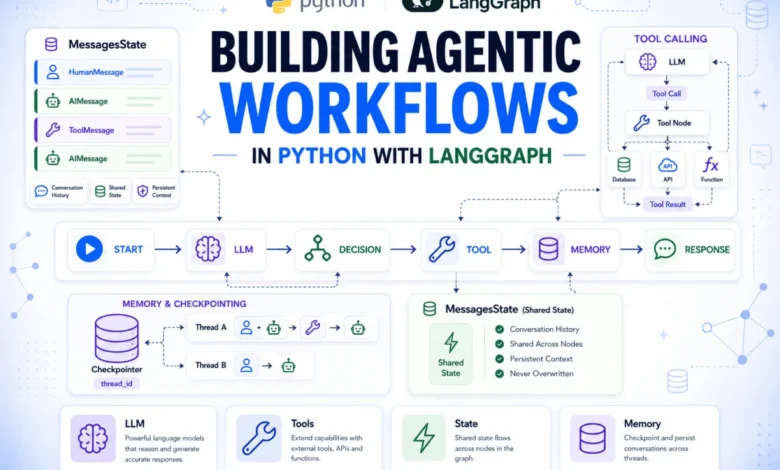
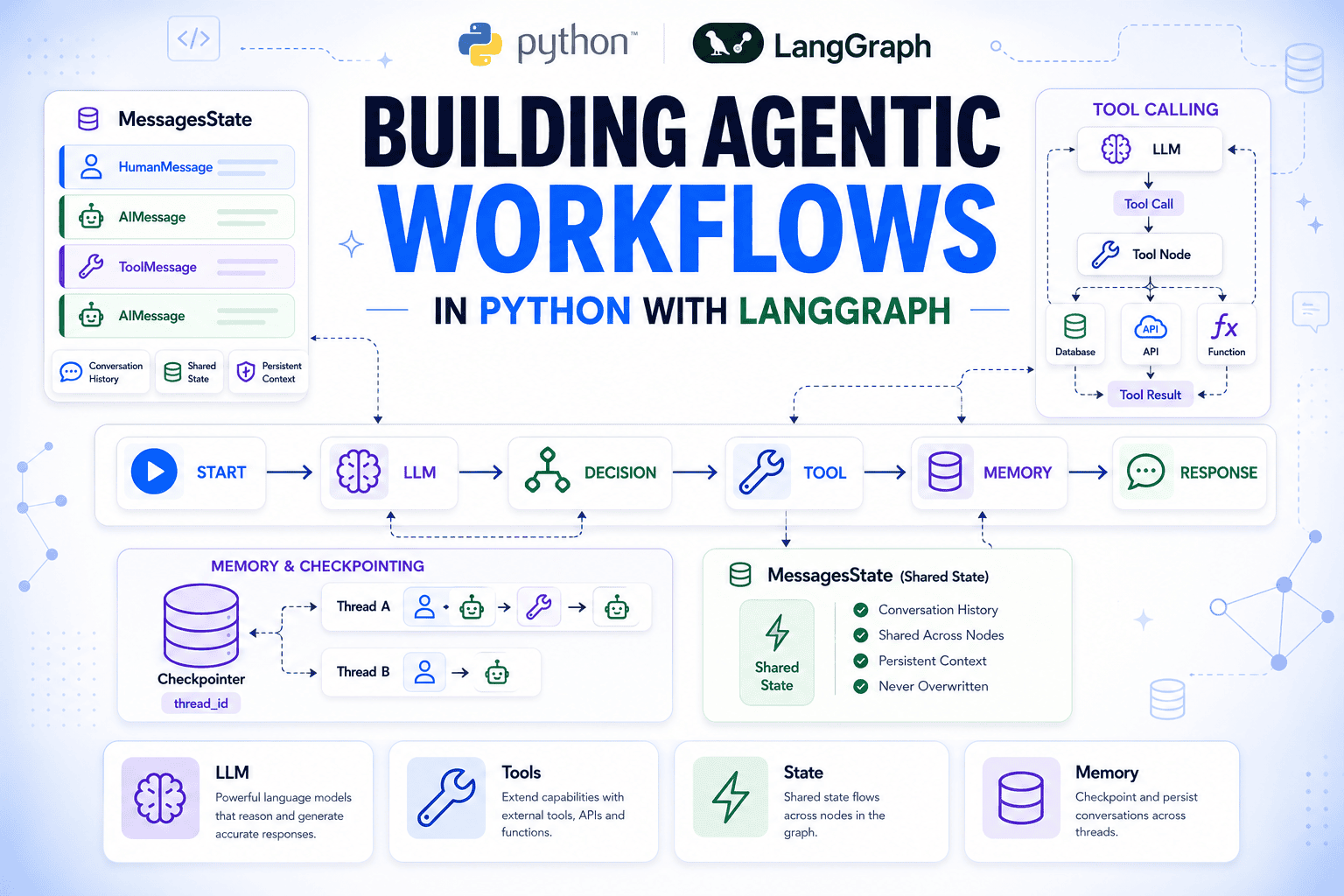
LangGraph facilitates this shift by introducing three core primitives: State, Nodes, and Edges. In this architecture, a "Node" represents a unit of work (such as a model call or a tool execution), "Edges" determine the flow of execution, and "State" serves as the shared memory accessible to every part of the graph. This structure allows for the implementation of the ReAct (Reasoning and Acting) pattern, which has become the standard for modern AI agents.
Core Components of the LangGraph Architecture
To understand how LangGraph functions, one must first master the structural components that govern the flow of information. Unlike traditional programming where state might be scattered across various variables, LangGraph centralizes information in a single, predictable object.
The Role of Shared State
In LangGraph, the State is typically defined as a TypedDict. This object acts as the "source of truth" for the entire workflow. Every node in the graph reads the current state, performs its logic, and returns updates to the state. This design ensures that the entire message history and any auxiliary data (such as user IDs or metadata) are consistently available.
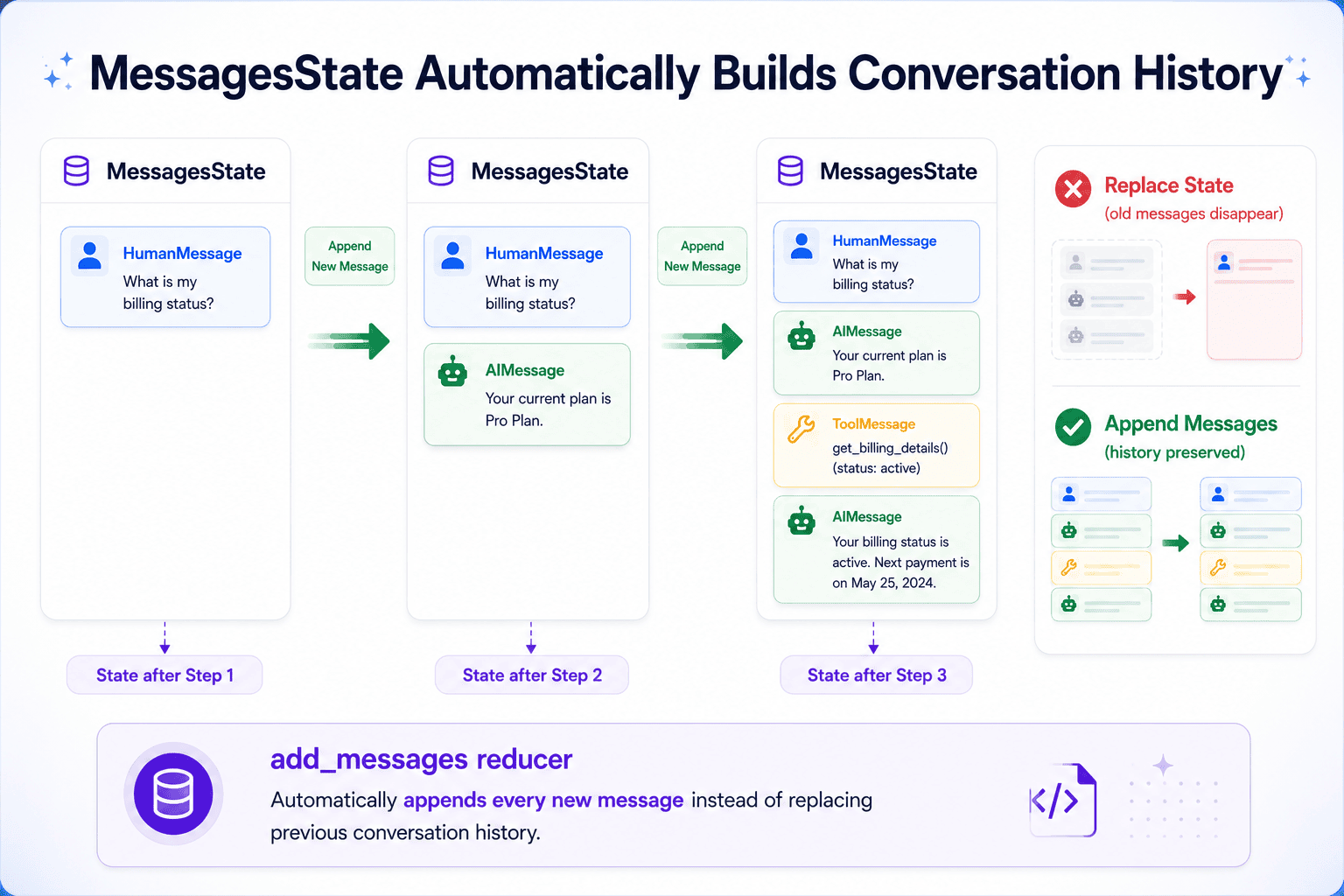
A critical feature within this state management is the "reducer" function. By default, when a node returns a value for a specific field, it replaces the existing value. However, for conversational histories, replacement is undesirable. LangGraph utilizes reducers—most notably operator.add or the specialized add_messages function—to append new information to the state rather than overwriting it. This allows the agent to maintain a chronological log of the conversation.
Nodes and Edges: The Execution Flow
Nodes are the building blocks of the graph. In Python, these are represented as standard functions that accept the current state as an argument. Because they are plain functions, they are highly testable and modular.
Edges define the logic of the transition between nodes. While basic edges move the process from Node A to Node B, "conditional edges" allow the graph to branch. For instance, after an LLM node runs, a conditional edge can determine whether to route the flow to a "tools" node (if the model requested a database lookup) or to the "end" of the graph (if the model has provided a final answer).
Chronology of Development: From Chains to Cyclic Graphs
The development of LangGraph is a direct response to the community’s feedback regarding the limitations of the original LangChain Expression Language (LCEL).
- Late 2022 – Early 2023: The rise of zero-shot prompting. Developers focused on individual prompts and simple sequential chains.
- Mid 2023: The emergence of RAG (Retrieval-Augmented Generation). Systems became more complex, requiring agents to fetch data before answering.
- Late 2023: The "Agentic" realization. Industry leaders, including OpenAI and IBM, began emphasizing that LLMs perform better when given the opportunity to self-correct and iterate.
- Early 2024: LangGraph is officially launched to provide a first-class way to create cyclic graphs, enabling loops that were previously difficult to manage in standard LangChain.
Technical Implementation: Building a Persistent Agent
Building a functional agent requires a structured approach to environment setup and code architecture. The process begins with the installation of essential packages: langgraph, langchain-openai, and python-dotenv.
Setting the Foundation
Security and configuration are handled via environment variables, typically stored in a .env file. This ensures that sensitive API keys for providers like OpenAI or Anthropic are not hard-coded into the application logic.
from dotenv import load_dotenv
load_dotenv()
Managing Conversation History
The built-in MessagesState is the most common state type used for agents. It provides a specialized messages field that automatically handles the deduplication and ordering of HumanMessage, AIMessage, and ToolMessage objects. This abstraction relieves the developer from the burden of manual message stitching.
The Reasoning Loop (ReAct Pattern)
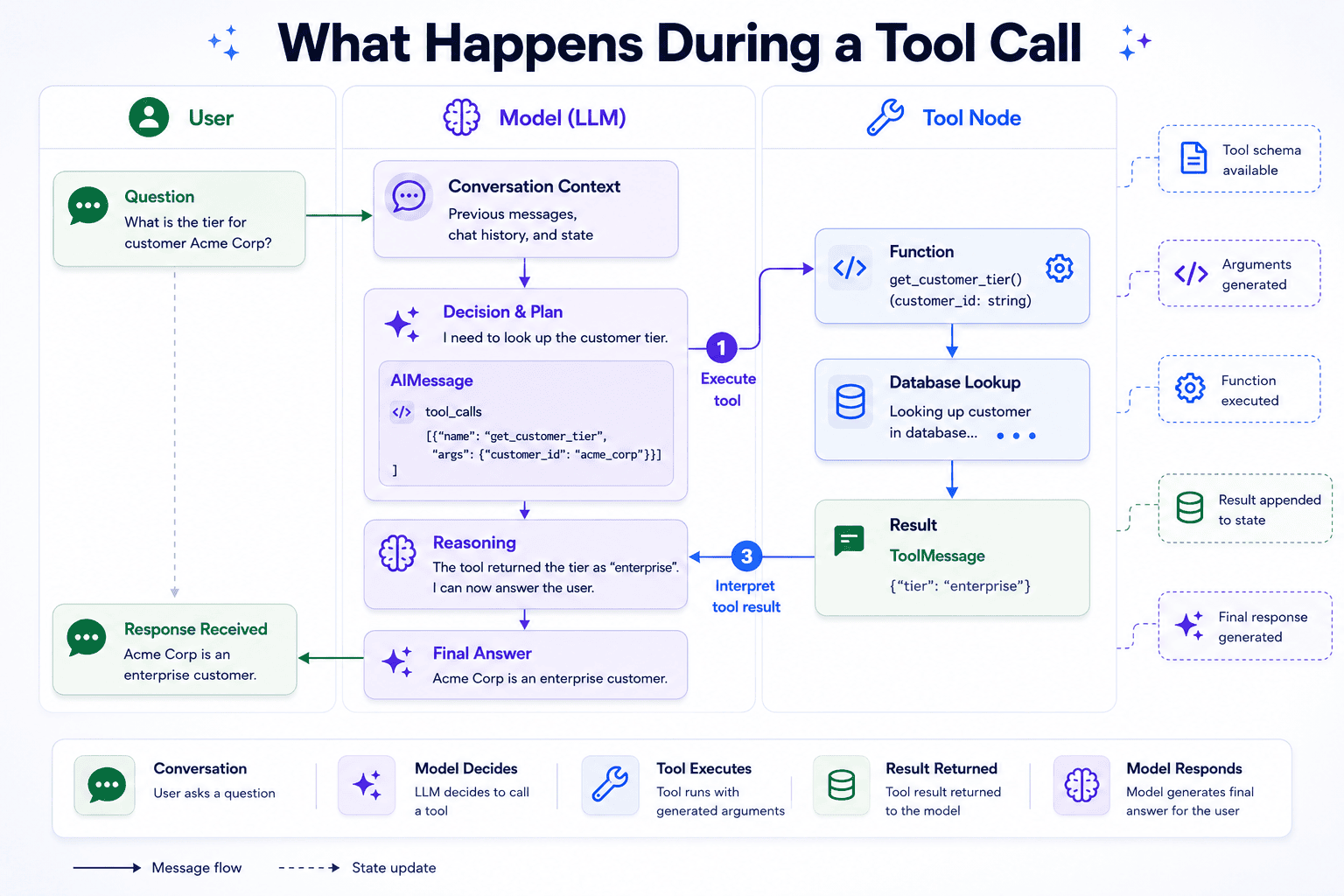
At the heart of the agent is the model call. By binding tools to the LLM using the bind_tools method, the model is made aware of external functions it can invoke. When the model decides to use a tool, it doesn’t return a text answer; instead, it returns a tool_calls payload.
The execution then moves to a ToolNode. This node executes the specific Python function requested by the model—such as querying a SQL database or checking a customer’s subscription tier—and returns a ToolMessage. The graph then loops back to the LLM, which now has the tool’s output in its context window to formulate a final response.
Persistence and Checkpointing: The Key to Enterprise Scalability
One of the most significant challenges in AI development is maintaining state across different user sessions or server restarts. Without persistence, an agent "forgets" the context of a conversation as soon as the function execution finishes.
The Checkpointer Mechanism
LangGraph solves this through "Checkpointers." A checkpointer saves a snapshot of the graph state after every node execution. When a user returns to a conversation (identified by a unique thread_id), the checkpointer restores the previous state, allowing the LLM to pick up exactly where it left off.
For development, the InMemorySaver provides a quick way to test persistence. In production environments, developers typically use persistent databases like PostgreSQL, Redis, or MongoDB to store these checkpoints. This allows for long-running conversations that can span days or weeks, a necessity for customer support bots and personal assistants.
Distinguishing Checkpointers from Stores
While checkpointers handle the state of a specific thread, "Stores" are used for long-term memory across multiple threads. For example, a checkpointer remembers what a user said two minutes ago in the current chat, while a Store remembers the user’s name and preferences across every chat they have ever had.
Industry Impact and Implications
The shift toward graph-based agentic workflows has profound implications for the software industry. By grounding LLM responses in real-time tool outputs, developers can significantly reduce hallucinations—instances where the model makes up facts.
Enhanced Visibility
Traditional AI "black boxes" are difficult to debug. Because LangGraph represents every step as a node, developers can trace the exact path the model took. They can see why a model chose Tool A over Tool B, or where a conditional routing logic went wrong. This level of observability is critical for meeting compliance and safety standards in sectors like finance and healthcare.
Multi-Agent Systems
The architectural principles of LangGraph naturally extend to multi-agent systems. In these setups, a "Supervisor" agent routes tasks to specialized "Worker" agents. This modularity allows for the creation of incredibly complex systems where one agent might specialize in coding, another in research, and a third in quality assurance, all collaborating within a single graph.
Analysis of the Future Landscape
As LLM context windows expand and inference costs decrease, the complexity of agentic workflows is expected to grow. We are likely to see a move toward "Self-Evolving Graphs," where agents can modify their own nodes and edges based on the tasks they encounter.
Furthermore, the integration of "human-in-the-loop" nodes is becoming more common. LangGraph allows a graph to "interrupt" execution, saving the state and waiting for a human to approve a tool call (like sending an email or making a purchase) before resuming. This hybrid intelligence model ensures that while agents are autonomous, they remain under human oversight.
Conclusion
Building agentic workflows with LangGraph represents a maturation of the AI development field. By moving away from rigid, linear logic and embracing cyclic, stateful graphs, developers can create AI agents that are not only more capable but also more reliable and easier to maintain. As the technology continues to evolve, the ability to manage state, persist conversations, and integrate diverse tools will remain the cornerstone of successful AI implementation. Whether for simple automation or complex multi-agent orchestration, the primitives of LangGraph provide the necessary framework for the next generation of intelligent software.