Fine-Tuning vs. Frozen Embeddings: When to Adapt the LLM vs. the Sklearn Head

The rapid evolution of Large Language Models (LLMs) has fundamentally altered the landscape of natural language processing (NLP), shifting the focus from architectural design to deployment strategy. As organizations seek to tailor pre-trained models to specific domains—ranging from legal document classification to medical report triage—a critical debate has emerged within the machine learning community: is full-scale fine-tuning always the optimal path forward? While fine-tuning remains the gold standard for model adaptation, an increasingly viable alternative involves leveraging frozen embeddings paired with traditional machine learning classifiers, such as those found in the scikit-learn ecosystem. This methodological shift is not merely academic; it represents a tactical decision between computational efficiency and absolute model precision.
The Evolution of Domain Adaptation
Historically, the process of adapting a language model to a specific task required significant computational resources, often necessitating the retraining of vast parameter sets. In the pre-transformer era, domain adaptation was often limited by the inability of models to generalize across varied, high-dimensional datasets. The introduction of architectures like BERT, GPT, and their successors changed this paradigm by providing robust, pre-trained "backbones" that encapsulate a deep understanding of syntax and semantics.
In recent years, the democratization of hardware through cloud-based GPU access—such as the widespread availability of NVIDIA T4 instances on platforms like Google Colab—has enabled smaller teams to perform fine-tuning. However, the associated costs of electricity, cloud compute hours, and the engineering time required to maintain large-scale training pipelines have forced researchers to re-examine "lightweight" alternatives. The technique of using a "frozen" model—where the base weights are locked and the LLM acts solely as a feature extractor—has emerged as a cost-effective, high-speed alternative for classification tasks.
Methodology: Frozen Embeddings vs. Parameter-Efficient Fine-Tuning
To understand the trade-offs, one must distinguish between the two primary approaches currently employed by industry practitioners.
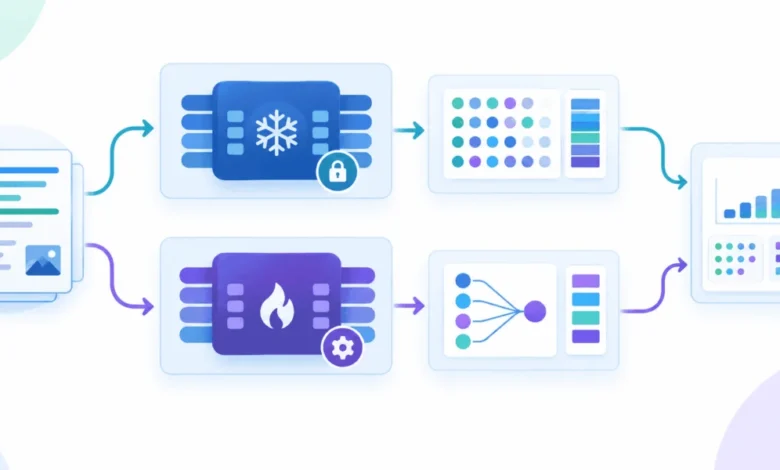
Strategy A, the Frozen Embedding approach, treats the LLM as a static encoder. Input data is passed through the model, and the hidden states—the mathematical representations of the input text—are captured. These vectors are then used as input features for a traditional, shallow machine learning model, such as a Random Forest or Support Vector Machine (SVM). This method avoids the "catastrophic forgetting" often associated with fine-tuning, where a model loses its original capabilities while learning new, specific information.
Strategy B, or Low-Rank Adaptation (LoRA), represents the modern industry standard for parameter-efficient fine-tuning (PEFT). LoRA operates by freezing the pre-trained model weights and injecting small, trainable rank-decomposition matrices into the transformer layers. This allows the model to learn domain-specific nuances while keeping 99% of the original model parameters unchanged. When optimized with quantization (QLoRA), this process can run on consumer-grade hardware, significantly lowering the barrier to entry.
Comparative Analysis of Performance and Latency
Practical testing using standardized datasets, such as the AG News corpus, reveals a distinct divergence in results. When deploying a frozen model, the computational bottleneck is primarily the feature extraction phase. Processing 800 training samples and 200 test samples through a 1.5-billion parameter model requires roughly 96 seconds of inference time. Conversely, the training of a Scikit-Learn classifier on these extracted features is nearly instantaneous, concluding in under three seconds. The result is a highly efficient pipeline that achieves approximately 82% accuracy.
In contrast, the LoRA fine-tuning process is more intensive. Utilizing the same 1.5-billion parameter model with 4-bit quantization, the training process takes approximately 300 seconds—roughly three times longer than the frozen embedding extraction process. However, this investment in time yields a tangible performance increase, with accuracy climbing to 87%.
This five-percentage-point difference highlights the fundamental trade-off: for applications where latency and cost-per-inference are paramount, the frozen approach provides a "good enough" solution with minimal operational overhead. For applications where accuracy is the critical success metric, the added latency and compute cost of fine-tuning are not only justified but necessary.
The Economic and Technical Implications
The implications of these findings extend into the boardroom and the engineering office. For a startup or an enterprise department, the choice between these two strategies is often driven by the "cost of precision."
- Infrastructure Scalability: Frozen embedding strategies allow for the reuse of a single base model across multiple downstream applications. One could theoretically host one base LLM and serve ten different Scikit-Learn heads, each trained on different domain tasks. This architecture is far more memory-efficient than maintaining ten separate fine-tuned models.
- Computational Overhead: Fine-tuning, even with LoRA, creates a "heavier" production environment. Because the model weights are modified, the inference server must load these specific adapters, increasing the complexity of model versioning and deployment (MLOps).
- Data Sensitivity: In scenarios where the training data is highly volatile or updated daily, the frozen approach allows for rapid retraining of the classifier head without touching the underlying LLM. This provides a level of agility that full-model fine-tuning cannot easily match.
Expert Perspectives on Deployment
Leading AI researchers and engineers often note that the "best" model is not always the most accurate one, but the one that best fits the operational requirements of the user. According to industry documentation from organizations like Hugging Face, the decision-making process should be governed by the specific goals of the deployment.
If the objective is to build a high-volume, low-latency API that performs basic sentiment analysis or text classification, the overhead of fine-tuning is often viewed as an unnecessary expense. The "Scikit-Learn Head" is, in effect, a pragmatic engineering choice that treats the LLM as a sophisticated feature engineering tool rather than a bespoke solution. Conversely, for tasks involving complex, specialized vocabulary—such as legal jargon or proprietary medical nomenclature—the nuance captured by LoRA fine-tuning is indispensable. The fine-tuning process allows the model to map its internal understanding of language to the specific, often idiosyncratic, patterns of the target domain.
Future Outlook and Strategic Recommendations
As the ecosystem matures, we are likely to see the emergence of hybrid models. Some researchers are already experimenting with "Dynamic Adapters," which allow a model to switch between different task-specific heads on the fly, effectively merging the efficiency of frozen embeddings with the accuracy of fine-tuned adapters.
For organizations currently evaluating their LLM strategy, the following heuristic is recommended:
- Adopt Frozen Embeddings when: You are operating in a resource-constrained environment, you have multiple classification tasks using the same base model, or the accuracy requirement is above a "baseline" but not "mission-critical."
- Adopt LoRA Fine-Tuning when: The domain-specific language is highly distinct from the training data of the base model, the gain in accuracy translates directly to revenue or safety, and the infrastructure supports the increased memory footprint of active adapters.
In summary, the choice between fine-tuning and frozen embeddings is not a binary win-or-lose scenario. It is a strategic decision that balances the immediate needs of an application against the long-term maintenance costs of the underlying architecture. By understanding the distinct performance curves and computational requirements of each, practitioners can move beyond the "one-size-fits-all" approach to LLM deployment and move toward a more nuanced, cost-effective, and performance-driven operational model. As LLMs continue to grow in size and capability, the ability to make these informed engineering trade-offs will define the next generation of successful AI-driven products.