Navigating the Agentic Era: How Small and Medium Businesses Can Scale Safely with AI

Small and medium-sized businesses (SMBs) across the globe are facing a profound operational bottleneck. On one hand, customer expectations for instant, multi-channel support and rapid sales engagement have never been higher. On the other hand, the traditional constraints of human-only workflows, unsynthesized data, and stretched teams have created a widening capacity gap that conventional hiring can no longer bridge. According to projections from the U.S. Bureau of Labor Statistics, employment of customer service representatives is expected to decline by 5% through 2034, even as overall customer inquiry volumes continue to climb. This stark divergence underscores a fundamental shift in the modern economy: businesses can no longer hire their way out of demand spikes; instead, they must look to automation and artificial intelligence to sustain operations.
The urgency of this transformation is particularly evident in sales and revenue operations. A landmark Harvard Business Review study examining 2,241 U.S. firms found that the average company took 42 hours to respond to a new inbound sales lead. More critically, the research revealed that organizations waiting 24 hours or longer to respond were more than 60 times less likely to qualify that lead compared to those responding within the very first hour. Although published more than a decade ago, this study remains a cornerstone benchmark for speed-to-lead metrics, demonstrating how rapidly qualification rates deteriorate as response times increase. In an era where consumers expect instantaneous digital interactions, these historical delays are no longer commercially viable.
Despite the pressing need for speed and responsiveness, consumer trust in emerging AI technologies remains cautious. Recent data from the Pew Research Center indicates that while roughly half of U.S. adults now utilize AI chatbots regularly, only 29% of those users genuinely trust the information provided by these tools. This dichotomy between widespread adoption and low trust places a heavy burden on business leaders. SMB executives are tasked not merely with deploying AI tools to handle high-volume interactions, but with establishing the rigorous data foundations, workflows, and guardrails necessary to ensure these autonomous agents act reliably, accurately, and securely.
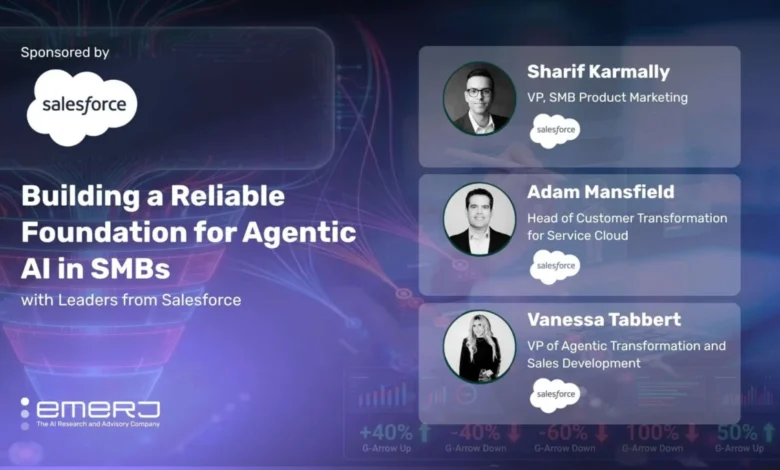
To address these pressing challenges, Emerj recently hosted an in-depth conversation series exploring "agentic readiness" for small and medium-sized businesses. The panels featured key executive leaders from Salesforce: Sharif Karmally, Vice President of SMB Product Marketing; Matt Kravitz, Head of Customer Transformation for Service Cloud; and Vanessa Tabbert, Vice President of Agentic Transformation and Sales Development. Together, these industry veterans laid out a comprehensive blueprint for how SMBs can transition from basic customer management tools to intelligent, autonomous agent ecosystems without falling victim to data fragmentation or operational drift.
Establishing a Structured Data Foundation
The foundation of any successful AI agent deployment begins long before the first model is trained or activated; it starts with data hygiene and architectural readiness. According to Sharif Karmally, many early AI agent failures stem less from technological limitations within the large language models themselves and more from the fragmented spreadsheets, stale database fields, and inconsistent customer histories they are forced to navigate. SMBs frequently underestimate how rapidly data accuracy degrades when multiple disparate systems, isolated inboxes, and manually maintained documents serve as the de facto source of truth for an enterprise.
Karmally describes this architectural hazard through the concept of "context rot," noting that simply accumulating more data without rigorous structural organization yields diminishing returns. In enterprise environments, the introduction of unstructured data sources often degrades the reliability of automated systems over time. To combat this, Karmally advocates for a unified CRM as the mandatory minimum viable infrastructure. A centralized customer relationship management platform provides the pre-built architecture required to keep customer data synchronized and up to date, ensuring that autonomous agents operate within a reliable framework.
Matt Kravitz builds upon this structural perspective by outlining a distinct maturity model for service agents. In Kravitz’s framework, agent capabilities naturally progress through three distinct tiers: Level 1 agents can reason generically and answer basic, predictable questions; Level 2 agents gain the ability to access contextual business data via a CRM or data cloud; and Level 3 agents possess the autonomy to take direct operational actions on behalf of the company. A critical pitfall for many SMBs, Kravitz warns, is attempting to deploy Level 3 autonomous behaviors while their underlying data architecture remains stuck at Level 0. Without structured data context, advanced autonomy invariably leads to erratic execution and diminished customer trust.
Focusing on High-Volume, Low-Risk Use Cases
For organizations beginning their journey toward agentic automation, attempting to overhaul every department simultaneously is a recipe for failure. The Salesforce leadership panel emphasizes that early agent deployments succeed when they target workflows that are already repetitive, well-understood, and overwhelming to human teams. By starting with high-volume, low-complexity use cases, businesses can capture immediate operational efficiencies while minimizing strategic risk.
Matt Kravitz notes that inbound customer demand naturally clusters around a predictable subset of routine inquiries that rarely require deep cognitive reasoning or complex business logic. Level 1 agents designed for these specific tasks can typically be deployed within a matter of days, immediately lifting the burden off human support staff. Conversely, Kravitz cautions leaders against rushing to implement advanced generative summarization or conversational drafting tools unless their business model involves exceptionally long customer case durations. For the typical SMB, the fastest path to positive return on investment lies in resolving the handful of repetitive interactions that dominate daily customer service queues.
In the realm of sales development, Vanessa Tabbert experienced a similar dynamic when scaling her organization’s agentic transformation. Tabbert’s sales development representatives (SDRs) were routinely overwhelmed by incoming lead volumes, forcing them to systematically deprioritize a significant portion of inbound opportunities simply because human capacity was outstripped by demand. By deploying an AI agent specifically to engage this neglected segment of the sales funnel—leads that previously would have been ignored—Tabbert’s team booked 150 qualified meetings in the very first month alone.
Following rapid iteration and fine-tuning of the agent’s parameters based on real-world interactions, performance scaled dramatically. Within a short period, the same infrastructure was booking 150 meetings in a single week, maintaining the exact same standard of lead quality and quantity. This measurable success underscores the strategic value of initiating automation where human teams are already constrained and customer demand is already pooling unaddressed.
Governing Autonomous Execution
As artificial intelligence agents transition from passive informational assistants to active participants capable of executing business workflows, the question of governance becomes paramount. Sharif Karmally points out that the moment multiple human staff members or autonomous agents begin modifying the same customer records concurrently, informal norms and tribal knowledge are no longer sufficient to maintain operational integrity.
Governance in an agentic environment is not about stifling capability; rather, it is about establishing explicit operational boundaries. Leaders must clearly define what an agent is permitted to do autonomously, what actions are strictly forbidden, and precisely at which junctures human intervention or review is mandatory. Without these guardrails, agents run the risk of overwriting critical database fields, executing unauthorized financial or administrative transactions, or generating conflicting updates that disrupt downstream business processes.
Vanessa Tabbert reinforces this perspective by emphasizing that autonomous agents should not be viewed as "set-and-forget" software installations. Much like human employees, AI agents require ongoing measurement, performance coaching, and continuous refinement. By establishing hard operational stops—such as requiring human sign-off for high-value contract modifications or escalated service disputes—organizations can harness the speed and scale of autonomy without relinquishing strategic control. Furthermore, centralized CRM platforms play a vital role in this governance model by acting as the arbiter of truth, surfacing data discrepancies, and maintaining a transparent audit trail of every agent-driven action.
Embedded Workflow Integration for Seamless Adoption
A recurring theme across all executive insights is that technological sophistication is irrelevant if the end-users—human employees—reject the tools. Vanessa Tabbert summarizes this operational reality bluntly: tools that add administrative friction or require unnatural workflow changes are bound to fail. For AI agents to deliver sustainable value, they must integrate seamlessly into the existing software environments and communication channels that teams already trust and utilize daily.
In practice, this means meeting employees where they already work. Sharif Karmally highlights examples where agents are embedded directly into collaboration platforms like Slack. In these environments, an integrated agent can monitor communication threads, identify relevant operational updates, and automatically log those changes into the core CRM without requiring human workers to switch applications or perform manual data-entry tasks.
Matt Kravitz illustrates the ultimate evolution of this philosophy within customer service consoles. At the highest level of maturity, the service console transforms from a static transactional dashboard into an augmented workspace that actively listens to ongoing customer interactions and offers proactive assistance. Instead of forcing agents to search for order statuses or manually process cancellations, an augmented console can intelligently eavesdrop on the conversation and prompt the representative—or execute the action directly—within a single pane of glass.
Broader Implications and Future Outlook
The convergence of shrinking customer service labor pools, escalating digital inquiry volumes, and rapidly maturing agentic AI platforms marks a structural turning point for small and medium-sized businesses. The traditional tradeoff between operational scale and personalized customer engagement is steadily dissolving. However, as the insights from Salesforce’s leadership team demonstrate, capturing the benefits of agentic automation requires disciplined execution.
SMB leaders cannot simply plug AI into broken workflows or fragmented data siloes and expect operational excellence. Success demands a deliberate, step-by-step approach: anchoring automation to a unified CRM data structure, selecting high-volume and low-risk initial use cases, establishing rigorous governance and operational boundaries, and embedding agents directly into existing employee workflows. By methodically addressing these four pillars, SMBs can successfully navigate the agentic era, transforming technological capacity into sustainable, measurable growth.