Build And Understand a Vector Database From Scratch in 10 Easy Steps

The Mechanics of Semantic Search
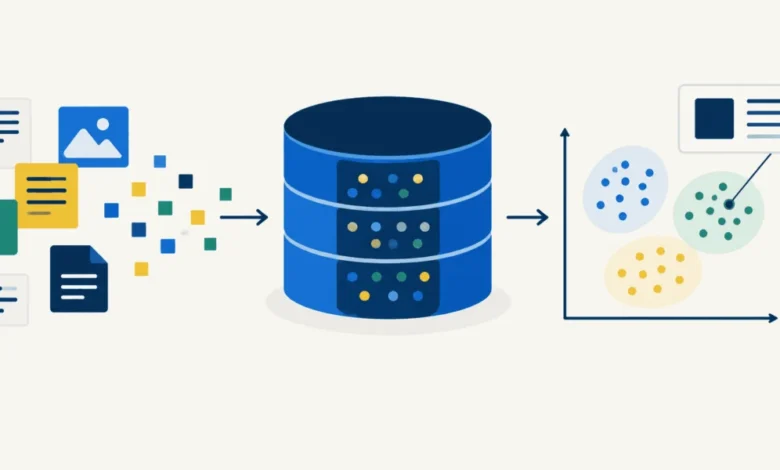
At its core, a vector database departs from traditional keyword-based retrieval systems. While a conventional database identifies records through exact matches of strings or tokens, a vector database operates by mapping human language into high-dimensional numerical space. This process, known as embedding, converts unstructured data—such as text documents, images, or audio files—into vectors of numbers. When a user submits a query, it is similarly transformed into a vector. The database then calculates the mathematical "distance" or "direction" between the query vector and the document vectors, retrieving results that are conceptually similar rather than lexicographically identical.
This shift in methodology is the foundation of the current generative AI boom, allowing Large Language Models (LLMs) to retrieve contextually relevant information from vast, proprietary datasets. Understanding how these systems function is essential for engineers aiming to move beyond high-level API usage and into the realm of custom, high-performance data architecture.
Setting the Foundation: The 10-Step Architecture
The tutorial utilizes Python and the numerical computation library NumPy to construct a functional database. The process is divided into logical milestones that ensure the student grasps the importance of every component, from initial setup to production-grade scaling.
- Environmental Setup: The process begins by preparing the workspace with the necessary dependencies:
numpyfor matrix mathematics andsentence-transformersfor generating the embeddings. This stage establishes the helper functions required to display results and manage terminal output, ensuring that the development process remains transparent and observable. - Indexing Strategy: The database initialization involves loading a pre-trained model—specifically the lightweight
all-MiniLM-L6-v2—which is highly efficient for most standard applications. Theadd()function serves as the ingest engine, encoding documents into a fixed dimension of 384 numbers. This fixed dimensionality is critical; it ensures that the index size remains predictable, regardless of the length or complexity of the input text. - Semantic Querying: By performing an initial search, the tutorial highlights the stark difference between vector-based retrieval and traditional indexing. When searching for "what keeps a cell supplied with energy?", the system correctly identifies documents discussing mitochondria, even though the query and the documents may share minimal overlapping vocabulary.
- Contextual Retrieval: The fourth step demonstrates the power of semantic matching by querying concepts that do not appear in the corpus at all. By searching for "superheroes," the system successfully retrieves data on fictional characters, proving that the model captures the underlying meaning of the terms rather than just the literal strings.
- Quantitative Scoring: Vector search relies on cosine similarity scores, which quantify the closeness of the query to the data. Unlike binary search results, these scores allow developers to set thresholds, filtering out irrelevant results to maintain high precision in production environments.
- Metadata Filtering: Real-world applications require more than just similarity. By attaching metadata—such as topic tags—to documents, the database allows for hybrid filtering. This ensures that a search for "mitochondria" in a biology context does not erroneously pull up irrelevant results from a comic book dataset.
- Refinement of Constraints: This step explores the logic of "k-nearest neighbor" (k-NN) searches. It illustrates how the system handles scenarios where the filter is narrower than the requested number of results, ensuring that the database does not hallucinate or pad results with noise.
- Operational Guard Rails: Reliability in data engineering is paramount. The tutorial introduces error handling to ensure that document lists and metadata entries remain in strict one-to-one alignment. This prevents silent data corruption, which is a common pitfall in large-scale machine learning pipelines.
- Persistence and Serialization: A database is only as useful as its ability to store and retrieve data. By saving the index to disk using
.npyfiles for raw vectors and.jsonfiles for metadata, the tutorial shows how to maintain state across sessions while ensuring that models remain compatible with the data they generated. - Scalability Analysis: The final step tests the performance limits of the architecture. By running synthetic benchmarks against 100,000 documents, the tutorial demonstrates that the search time increases linearly, confirming that the fundamental approach—using matrix multiplication for rapid scoring—is highly efficient for standard enterprise workloads.
Implications for the AI Ecosystem
The simplicity of this "from-scratch" approach carries significant implications for the broader machine learning industry. While commercial vector databases like Pinecone, Milvus, or Weaviate provide sophisticated features such as distributed storage, horizontal scaling, and managed cloud infrastructure, their core functionality remains rooted in the principles outlined in this tutorial.
For organizations evaluating their data stack, this walkthrough serves as a crucial sanity check. It demonstrates that the core of semantic search is essentially a series of dot products. When companies decide whether to build a custom solution or buy a managed service, they are usually choosing between the "bookkeeping" aspects—such as data replication, load balancing, and high-availability backups—rather than the fundamental search algorithms themselves.
Chronology of Development
- Initial Conception: Development begins with the definition of a schema that keeps text, metadata, and embeddings synchronized.
- Vectorization Phase: The transition from text to numerical representation occurs in the
add()operation, which uses a transformer model to generate the embeddings. - Search Phase: The query processing happens through the conversion of the user input into a vector followed by a dot-product operation across the entire corpus.
- Optimization Phase: The final stages demonstrate that once the data is vectorized, the search operation is essentially a matrix-vector multiplication, which is highly optimized in modern CPU and GPU architectures.
Data Performance Observations
The performance data captured in the final step of the tutorial provides an objective look at computational efficiency. At 1,000 documents, the scan time is negligible (0.01 ms). Even at 100,000 documents, the scan time remains within the low-millisecond range (3.73 ms). This confirms that for medium-sized datasets, a "plain" Python and NumPy implementation can be remarkably fast. However, as datasets grow into the millions or billions of records, the requirement for Approximate Nearest Neighbor (ANN) algorithms—such as HNSW (Hierarchical Navigable Small World) or IVF (Inverted File Index)—becomes necessary to avoid the O(n) scan time.
Conclusion: The Future of Data Retrieval
The journey from a basic list of strings to a functional, searchable vector database underscores a major shift in how we interact with information. The ability to retrieve data based on meaning, rather than keyword matching, is becoming the standard for modern information systems. This tutorial effectively strips away the marketing jargon surrounding AI infrastructure, leaving the reader with a clear, mathematical understanding of how modern search works.
As the industry continues to advance, the demand for transparency in these "black box" systems will only grow. By mastering the fundamental steps of building a vector database from scratch, developers are better equipped to build robust, scalable, and explainable AI applications. Whether one intends to build their own custom solution or optimize the use of existing enterprise tools, the foundational knowledge provided here serves as a critical asset in the modern developer’s toolkit. The transition from 25 documents to 25 million may require more sophisticated infrastructure, but the underlying mathematical logic remains constant, proving that elegance in design is the hallmark of effective software engineering.
Related posts: