As the deployment of Large Language Models (LLMs) transitions from experimental prototypes to critical infrastructure in customer support, legal analysis, and software development, the limitations of standardized benchmarks have become increasingly apparent. Publicly available metrics, such as the Massive Multitask Language Understanding (MMLU) or the GSM8K math benchmark, offer a useful snapshot of a model’s general reasoning capabilities. However, these benchmarks lack the nuance required to validate domain-specific logic, such as a company’s internal refusal policies, the accuracy of Retrieval-Augmented Generation (RAG) pipelines, or adherence to proprietary brand guidelines. To bridge this gap, engineering teams are increasingly turning to custom evaluation harnesses.
The Role of the Custom Evaluation Harness
In software engineering, a test harness is the scaffolding that feeds inputs to a system, captures outputs, and evaluates them against a known baseline. When applied to LLMs, this framework becomes a continuous, repeatable pipeline that systematically tests prompts, tracks pass rates, monitors latency, and audits operational costs. By building a custom harness, organizations shift from anecdotal testing to data-driven quality assurance, allowing for regression testing that mirrors the specific complexities of their user base.
The necessity for such infrastructure is underscored by the current landscape of AI development. According to recent industry surveys from organizations like the AI Infrastructure Alliance, over 70% of enterprise-level AI projects fail to transition from pilot to production due to inconsistent model performance and "hallucinations." A custom harness addresses this by creating a controlled environment where the "golden dataset"—a curated collection of real-world inputs—serves as the arbiter of model success.
Architecture and Core Components
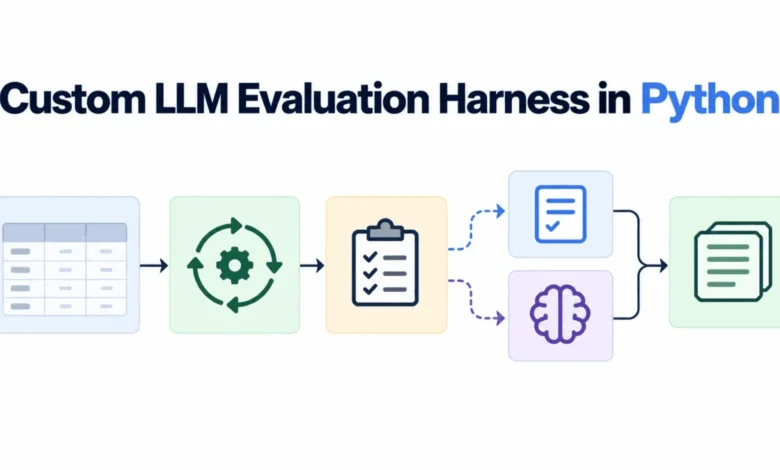
A robust evaluation harness relies on a modular architecture composed of four distinct layers: the Golden Dataset, the Inference Runner, the Judge Layer, and the Logging System. By decoupling these components, developers gain the flexibility to swap model providers, upgrade grading criteria, or adjust logging schemas without disrupting the entire testing lifecycle.
1. The Golden Dataset: Defining the Ground Truth
The foundation of any evaluation is the dataset. Unlike synthetic data, which often fails to capture the chaotic nature of human-computer interaction, a "golden dataset" should be derived from historical user logs and documented edge cases. For instance, a customer service model might require 50 to 100 test cases representing various scenarios: technical inquiries, sensitive policy-related questions, and adversarial attempts to bypass safety filters. Each entry in the dataset should include a unique identifier, the prompt, and a clearly defined expectation, such as a specific "expected concept" or a required behavioral outcome.
2. The Inference Runner: Concurrent Execution
The runner is responsible for the interaction between the application and the model backend. Utilizing libraries like LiteLLM allows engineers to maintain a unified interface across diverse providers such as OpenAI, Anthropic, and Google. By leveraging Python’s asyncio library, the runner can process test cases concurrently rather than sequentially. This is a critical efficiency factor; when testing against hundreds of prompts, parallelization can reduce the evaluation cycle from hours to minutes, significantly lowering the "time-to-feedback" loop for developers.
3. The Judge Layer: Automated Evaluation
The "Judge" is the intelligence that determines whether a model’s output meets the required standards. This is generally implemented in two forms:
- Deterministic Judges: Used for objective, binary checks (e.g., checking if a JSON output contains a specific field or if a string matches a predefined format).
- LLM-as-a-Judge: A more sophisticated approach where a secondary, high-performing model assesses the semantic quality of the target model’s output. By using frameworks like Pydantic to enforce structured output, developers ensure that the judge returns consistent, machine-readable results—such as a boolean pass/fail status and a textual justification for that score.
4. The Logging System: Data Persistence and Analysis
The final component is the logging layer, which records every interaction into a line-delimited JSON format (JSONL). This append-only storage is crucial for maintaining state in the event of a system crash. Furthermore, by logging the "raw output" alongside the judge’s score, developers can retrospectively re-evaluate historical data if the grading rubric evolves, eliminating the need to re-run expensive inference calls.
Technical Implementation and Prerequisites
The implementation of such a system requires a relatively modest technical stack. Python 3.10 or later is recommended to leverage modern asynchronous capabilities. The primary dependencies include litellm for model abstraction and pydantic for data validation.
# Example of asynchronous inference orchestration
import asyncio
import litellm

async def run_case(case: dict, model: str) -> dict:
    response = await litellm.acompletion(
        model=model,
        messages=["role": "user", "content": case["input"]],
        num_retries=3,
        timeout=30,
    )
    return **case, "raw_output": response.choices[0].message.content
This structure enables the developer to isolate the inference process from the logic of the judge, ensuring that as the application grows, the evaluation harness remains stable.
The Broader Impact on AI Governance
The shift toward bespoke evaluation harnesses has profound implications for corporate AI governance. As regulatory frameworks, such as the European Union’s AI Act, begin to demand greater transparency and "human-in-the-loop" verification for high-risk AI systems, companies must be able to prove that their models are consistently behaving as intended. A custom evaluation harness serves as a comprehensive audit trail. By maintaining a history of test results, organizations can demonstrate compliance, track the performance degradation of models over time, and provide empirical evidence to stakeholders regarding the safety and reliability of their deployed agents.
Analysis of Future Directions
The next phase of evolution for evaluation harnesses will likely involve the integration of "Active Learning" and "Automated Dataset Curation." As models are tested, the harness could theoretically identify "failure clusters"—specific types of inputs where the model consistently struggles—and suggest new test cases to be added to the golden dataset. This creates a self-improving loop where the evaluation system not only measures performance but actively contributes to the model’s training curriculum.
Moreover, the decoupling of the inference and judging layers allows for more cost-effective testing. By using a smaller, cheaper "judge" model for simple tasks and reserving powerful, high-cost models for complex evaluations, organizations can optimize their operational expenditure without compromising on the quality of their oversight.
Conclusion
Building a custom evaluation harness is no longer an optional task for high-stakes AI applications; it is a necessity for long-term operational success. By focusing on modularity, concurrency, and structured data, developers can construct a system that provides the visibility required to maintain control over non-deterministic models. While the initial setup requires significant effort in defining expectations and curating datasets, the resulting ability to rapidly iterate, debug, and validate model behavior provides a competitive advantage in an increasingly AI-driven market. Whether integrated into a CI/CD pipeline or used as a standalone auditing tool, a custom harness is the definitive way to ensure that as your models scale, their quality remains intact.