The Evolution of Agentic AI Architecture From Brute Force Orchestration to Specialized Swarms and Standardized Protocols

By mid-2026, the field of artificial intelligence has undergone a fundamental architectural transformation, shifting from the era of monolithic, general-purpose models toward a highly modular and specialized ecosystem. Just two years ago, the primary challenge for AI engineers involved the manual construction of complex reasoning loops, often referred to as ReAct (Reasoning and Acting) patterns. These systems relied on brittle prompt chains and external orchestration frameworks to force large language models (LLMs) to plan, execute tools, and critique their own performance. Today, the industry has largely abandoned these "brute-force" methods in favor of native reasoning capabilities, standardized communication protocols, and multi-agent "swarms" that function as decentralized microservices.
The Obsolescence of External Orchestration Loops
The architectural shift began in earnest throughout 2025 as foundation model providers integrated "System 2" thinking—deliberative, analytical reasoning—directly into the model architectures. In the previous paradigm, engineers used frameworks like LangChain or LlamaIndex to simulate reflection. This involved sending a prompt to a model, receiving a response, and then using a separate code loop to ask the model to "check its work." While functional, these external loops were plagued by high latency, excessive token consumption, and a lack of reliability.
By the second quarter of 2026, leading models now utilize "test-time compute" to handle these processes internally. Modern models generate hidden reasoning tokens, allowing them to explore multiple logical branches and self-correct before producing a final output. This internal cognitive process has rendered many external orchestration frameworks redundant. Current data suggests that by moving reasoning inside the model boundary, enterprises have seen a 35% reduction in total inference latency and a significant decrease in "hallucination" rates during complex multi-step tasks. The role of the AI engineer has consequently moved up the stack; rather than prompting a model to think, engineers now focus on designing the environments and sandboxes where these autonomous agents operate.
The Rise of the Agentic Swarm: AI as Microservices
As models became more capable of internal reasoning, the industry realized that attaching dozens of tools to a single, massive model created a cognitive bottleneck. When one model is responsible for database access, email composition, code execution, and customer support, the context window becomes cluttered, and the likelihood of tool-calling errors increases.
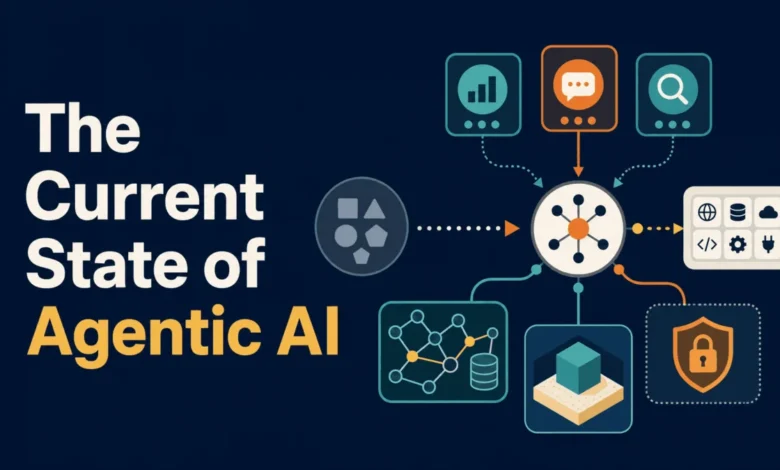
The solution that emerged in late 2025 and matured in 2026 is the "agentic swarm." This architecture treats agents as specialized microservices. Instead of a single "do-it-all" bot, a swarm consists of a collection of smaller, highly optimized agents that communicate via a standardized handoff protocol. A typical enterprise swarm now includes a "Triage Agent" that acts as a router, identifying the user’s intent and handing the conversation off to a "Specialist Agent," such as a SQL Fetcher or a Data Analyst.
This modularity allows for "stateless-per-agent" execution. Each agent only holds the context necessary for its specific task, keeping context windows lean and reducing the risk of "lost-in-the-middle" information retrieval issues. Furthermore, this allows organizations to use a heterogeneous mix of models. A high-reasoning, expensive model might handle the triage and final synthesis, while faster, cheaper models—such as the latest iterations of Qwen or Llama—handle the repetitive data-fetching tasks.
Standardization via the Model Context Protocol (MCP)
One of the most significant hurdles to agentic AI in 2024 was the lack of interoperability between models and real-world data sources. Every new integration required a bespoke set of JSON schemas, custom API wrappers, and complex error-handling logic. This changed with the industry-wide adoption of the Model Context Protocol (MCP).
MCP serves as a universal adapter, similar to how USB standardized hardware connections or REST standardized web services. Under this protocol, data sources—whether they are local PostgreSQL databases, GitHub repositories, or Slack workspaces—are exposed through an MCP server. The agent does not need to know the underlying API of the service; it simply connects to the MCP server, which automatically exposes the available tools and resources.
Industry analysts report that the adoption of MCP has reduced the time-to-production for AI agents by nearly 60%. By separating the execution of the tool (which happens on the MCP server) from the reasoning (which happens in the model), organizations have improved security and reduced the "integration tax" that previously hindered AI deployment.
Chronicling the Transition: 2024 to 2026
The timeline of this evolution highlights a rapid maturation of the technology:
- Mid-2024: The peak of "Agentic Workflows." Developers focus on multi-turn prompting and manual reflection loops.
- Late-2024: Introduction of specialized "agentic" models with improved tool-calling accuracy.
- Early-2025: Emergence of the Model Context Protocol (MCP) as an open standard. Initial experiments with "agent handoffs" begin.
- Late-2025: Major providers release models with native "System 2" reasoning, making external Plan-and-Execute loops largely obsolete.
- Mid-2026: The "Swarm" becomes the standard enterprise architecture, utilizing memory graphs for persistent learning.
Persistent Memory and the Integration of Memory Graphs
A persistent criticism of early AI agents was their lack of long-term memory. Once a session ended, the agent "forgot" everything it had learned about the user’s preferences or the specific edge cases of a company’s codebase. In 2026, this has been addressed through the implementation of "Memory Graphs."
Unlike simple vector databases, which retrieve information based on semantic similarity, Memory Graphs use graph databases like Neo4j to store relationships between entities, facts, and past outcomes. When a swarm executes a task, a background "Memory Agent" asynchronously evaluates the trajectory of the conversation. It extracts pertinent facts—such as "The user prefers Q3 reports in CSV format"—and updates the graph.
This system creates a "context pipeline" where the agent’s memory is injected into the prompt dynamically. This has moved the field from "prompt engineering" to "context engineering," where the system improves its performance over time without requiring the underlying models to be fine-tuned.
The New Frontier of Security: Combating AIjacking
The shift to multi-agent swarms has expanded the cyber-attack surface. In the monolithic era, security focused on preventing a single model from outputting harmful content. In 2026, the primary concern is "AIjacking" or indirect prompt injection.
In a swarm, a vulnerability in one agent can lead to lateral movement across the entire system. For example, if an "Email Reader Agent" encounters a malicious instruction embedded in an email, it might be tricked into passing a command to a "Database Agent" to delete records. Because the handoff protocols are automated, the malicious instruction can pivot through the swarm without direct human oversight.
To counter this, three defensive layers have become mandatory in production environments:
- Sandboxed Execution: All code execution tools run in isolated, ephemeral environments (like WebAssembly or gVisor) to prevent host system compromise.
- Human-in-the-Loop (HITL) Triggers: Sensitive actions, such as wire transfers or data deletions, require a cryptographic signature from a human operator before the swarm can proceed.
- Inspector Agents: Swarms now include "Security Agents" whose sole task is to monitor the communication between other agents, looking for signs of "adversarial drift" or hijacked intent.
Broader Impact and Industry Implications
The maturation of agentic AI architecture has profound implications for the labor market and software development. The "AI Engineer" of 2026 is less of a Python coder and more of a system architect. The focus has shifted toward designing resilient topologies, managing credential isolation on MCP servers, and auditing the "reasoning traces" of autonomous swarms.
Enterprises are moving away from purchasing "all-in-one" AI platforms and are instead investing in "agentic infrastructure." This includes private MCP server farms and dedicated graph databases for organizational memory. The goal is no longer to find the "smartest" model, but to build the most resilient and specialized swarm.
As we look toward the latter half of 2026, the trend of specialization shows no signs of slowing. The transition from "thinking" models to "doing" systems is complete, and the remaining challenges lie in the governance, security, and scaling of these digital workforces. The architectural intuitions developed today—starting with small, three-agent swarms—are already providing the blueprint for massive, thousand-agent systems that will define the next decade of computing.