As global energy markets navigate a volatile landscape shaped by geopolitical tensions in the Middle East and ongoing disruptions stemming from the Russia-Ukraine war, central bank policy has once again taken center stage in macroeconomic discussions. Economists and market analysts are increasingly debating whether the United States Federal Reserve is misinterpreting the underlying drivers of domestic inflation. Recent corporate earnings reports—most notably from major commercial carriers such as United Airlines—provide a clear lens through which to examine the complex mechanics of modern price transmission. These developments suggest that aggressive monetary tightening in response to supply-side energy shocks could inadvertently push the broader economy into an unnecessary slowdown.

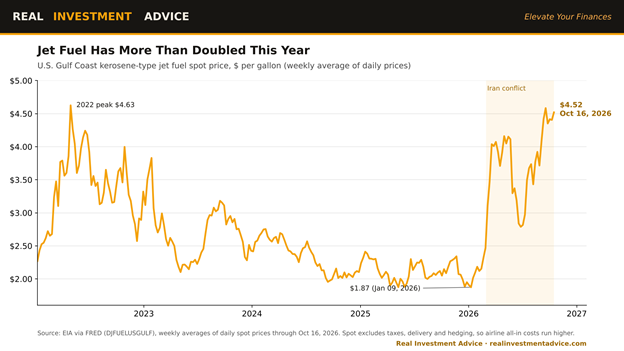
The central debate hinges on how accurately official inflation metrics capture the true state of consumer price growth, particularly when energy market shocks filter through non-energy sectors of the economy. In its recent quarterly financial disclosure, United Airlines reported a staggering 62% year-over-year surge in fuel expenditures, with the average cost per gallon of jet fuel climbing to $3.90. Corporate leadership, including CEO Scott Kirby, acknowledged that the airline would be unable to fully recapture 100% of these soaring fuel expenses through ticket price adjustments in the fourth quarter.
Nevertheless, the partial pass-through of these costs has triggered notable upward pressure on consumer airfares. Bureau of Labor Statistics (BLS) data indicates that commercial airline fares have risen by 22.4% over the preceding twelve months. Crucially, while these price hikes originate from elevated energy costs, the BLS classifies airfares as a transportation service rather than a direct energy commodity. Consequently, rising airline ticket prices are embedded directly into the core Consumer Price Index (core CPI), a widely watched benchmark that explicitly aims to exclude volatile energy and food prices to provide a clearer view of underlying structural inflation trends.
With airfares carrying a weight of approximately 1.1% in the BLS core CPI calculation, this single category accounted for roughly a quarter-point of the annual core CPI reading of 2.56%. This dynamic illustrates a structural vulnerability in how core inflation is measured during periods of geopolitical supply shocks. The ripple effects of disruptions originating in regions such as the Strait of Hormuz and Eastern Europe are effectively bypassing the energy exclusion filters of the index, leaking directly into core inflation readings and potentially distorting the policy signals received by Federal Reserve officials.
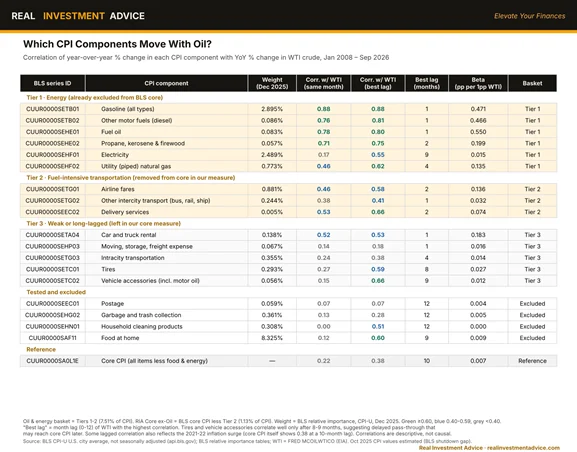
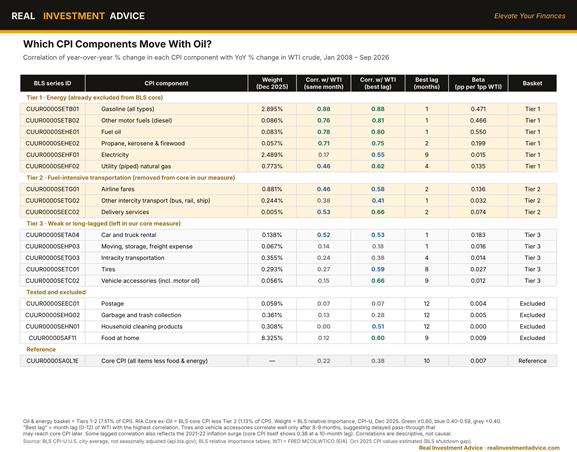
To better understand the magnitude of this phenomenon, analysts have developed specialized analytical models designed to strip out all energy-sensitive components from core inflation metrics. By evaluating historical correlations between West Texas Intermediate (WTI) crude oil prices and various CPI sub-components dating back to 2008, researchers have mapped out distinct tiers of sensitivity. Tier 1 encompasses direct energy components like electricity and natural gas, which the BLS already removes from core figures. Tier 2 includes highly sensitive transportation and logistics services, while Tier 3 comprises goods such as motor oil, vehicle accessories, and synthetic rubber products that exhibit strong correlations with crude prices over a longer time lag, typically around nine months.

When these energy-adjacent variables are systematically filtered out, the resulting alternative core inflation metric paints a distinct picture of domestic price stability. While the official BLS core CPI climbed toward 2.85% during the peak of recent oil price volatility, alternative models tracking true core pressures peaked at a much more muted 2.59% before declining toward 2.35%. This divergence highlights a persistent structural reality: traditional core inflation measures tend to diverge from underlying domestic demand pressures precisely during periods of external oil shocks. Because many petroleum-derived goods and services experience delayed cost transmission, current official core readings may be artificially elevated by energy shocks that materialized several months prior.
This mismeasurement carries significant weight for monetary policy formulation. The Federal Reserve adjusted the federal funds rate upward to a target range of 3.75% to 4.00%, with policy minutes and public commentary from regional Fed presidents—such as Dallas Fed President Lorie Logan—suggesting that further tightening may remain appropriate to anchor inflation expectations firmly at the central bank’s 2.0% objective. Central bank officials typically evaluate monetary restrictiveness by comparing the nominal policy rate against prevailing inflation metrics.
When utilizing the headline CPI, the real federal funds rate hovers near zero, providing ammunition for hawkish policymakers who argue that monetary policy has not yet achieved a sufficiently restrictive stance. However, when measured against filtered core inflation models that adjust for external oil shocks, the real federal funds rate rises to approximately 1.40%. Comparing this figure to the Federal Reserve’s own longer-run economic projections—which place the neutral federal funds rate at roughly 3.2% alongside a 2.0% inflation target—suggests that monetary policy is already operating slightly above neutral. Any additional rate hikes under these conditions would actively push monetary settings deeper into restrictive territory.
Beyond the short-term policy rate set by the central bank, broader financial conditions are increasingly tightened by developments within the fixed-income market. Households and corporations do not borrow exclusively at the federal funds rate; instead, key credit benchmarks such as residential mortgages, commercial real estate loans, and corporate debt issuance are priced off longer-term Treasury yields. The benchmark 10-year Treasury yield has sustained levels near 5.0%. Subtracting filtered core inflation estimates yields a real 10-year yield of approximately 2.64%, representing the highest sustained real borrowing cost environment observed since 2010 and standing well above the post-2008 historical average of 0.26%.

These elevated borrowing costs have exerted measurable downward pressure on credit-sensitive sectors, including housing, capital expenditures, and corporate refinancing schedules. In effect, the bond market has proactively tightened financial conditions, absorbing a substantial portion of the heavy lifting typically assigned to the central bank.
The underlying economic catalysts behind recent commodity price fluctuations further complicate the monetary policy outlook. The ascent in crude oil prices—which moved from multi-year lows to a persistent trading range between $80 and $105 per barrel—did not originate from an overheating domestic economy characterized by rampant consumer demand and robust wage-push inflation. Rather, the price surge was driven primarily by supply-side geopolitical disruptions, including conflicts involving Iran and threats to maritime shipping lanes in vital global trade corridors.
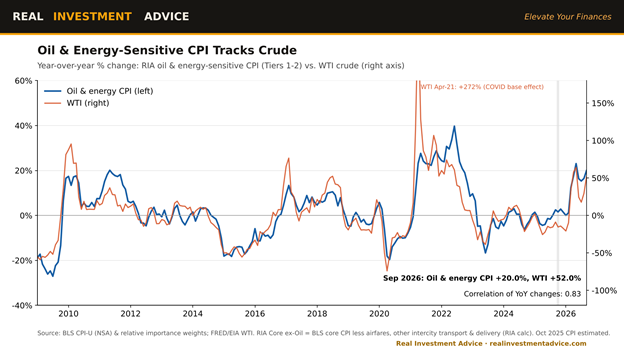
Standard monetary policy tools are fundamentally unequipped to resolve structural supply chain bottlenecks or geopolitical conflicts. Higher interest rates cannot physically reopen shipping lanes, repair damaged energy infrastructure, or extract additional barrels of crude oil from the ground. Instead, monetary tightening operates through the indirect channel of dampening aggregate demand, and the transmission lag of such policy actions typically requires twelve to eighteen months to fully materialize across the broader economy.
Consequently, if the Federal Reserve continues to tighten monetary policy in direct response to inflation readings that are temporarily inflated by exogenous oil shocks, it runs a substantial risk of committing a policy error. Overtightening risks unnecessarily decelerating economic growth at a time when private sector credit creation is already absorbing the dampening effects of multi-year high real borrowing costs. The growing recognition of this delicate balance among institutional investors helps explain the shifting dynamics in long-term bond yields, as fixed-income markets increasingly price in the potential hazards of an overly aggressive monetary stance.
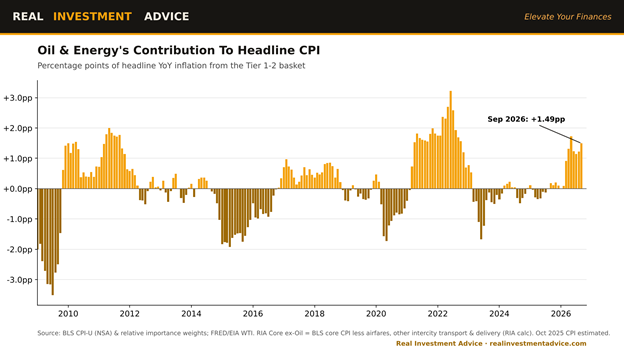
As upcoming inflation prints are released, market participants will closely monitor whether official core CPI metrics continue their descent back toward the Federal Reserve’s target. Should underlying domestic price pressures continue to cool while headline metrics remain distorted by legacy energy pass-throughs, the central bank will face a critical test in distinguishing between transitory supply shocks and persistent demand-driven inflation. Navigating this distinction successfully will determine whether the economy can achieve a stable expansion or whether monetary authorities will inadvertently tip a resilient financial system into an avoidable downturn.