Automated Laundering Operations Detected in Massive $6.36 Billion Binance Hack Investigation

The ongoing fallout from the unprecedented $6.36 billion security breach targeting cryptocurrency exchange Binance has taken a sophisticated turn, as prominent blockchain investigator SomaXBT revealed that more than half of the transactions tied to the stolen funds exhibit clear signs of automation. This development underscores the escalating technical prowess of malicious actors who are increasingly deploying artificial intelligence and automated scripts to launder astronomical sums of digital assets across multiple blockchains at an industrial scale.
The revelation comes amid intensive, global efforts by cybersecurity experts, blockchain sleuths, and centralized platforms to trace, intercept, and freeze funds stemming from one of the largest cyberheists in financial history. As digital asset forensics enter a new frontier, the intersection of advanced cybercrime and automated blockchain exploitation poses profound challenges for the security architecture of the entire decentralized finance (DeFi) and centralized finance (CeFi) ecosystems.
Detailed Forensic Breakdown of the Automated Laundering Process
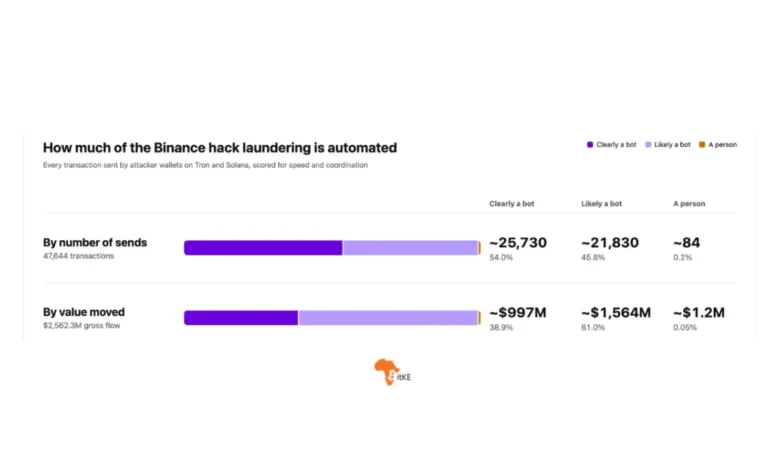
According to a comprehensive technical analysis conducted by SomaXBT and shared publicly via social media platform X, a staggering 54% of the examined transactions were executed using automated processes. The investigator scrutinized a vast dataset comprising 47,644 individual transactions routed through the TRON and Solana blockchain networks.
By analyzing raw on-chain data, mapping transaction vectors, and identifying recurring behavioral patterns within the ledger entries, the investigation uncovered a highly coordinated laundering operation. Rather than relying on manual transfers, which are typically slower and more susceptible to real-time freezing by exchanges and compliance tools, the attackers utilized automated scripts, smart contract interactions, and decentralized cross-chain bridges. These systems allow stolen assets to be split, swapped, and obfuscated within milliseconds of hitting an intermediate wallet.
This automated layering process significantly complicates the work of forensic investigators. Traditional blockchain analysis often relies on human-speed tracking, where investigators flag suspicious wallet addresses and alert exchanges to halt incoming deposits. However, when automated bots fracture a lump sum of millions of dollars into thousands of micro-transactions executed simultaneously across competing layer-1 networks, manual tracking becomes virtually obsolete. The malicious actors effectively weaponize speed and scale to overwhelm standard compliance monitoring systems.
Background Context: The Anatomy of the $6.36 Billion Binance Exploit
The backdrop to this ongoing laundering operation is the monumental security breach that rocked the digital asset industry, resulting in the theft of an estimated $6.36 billion. The incident immediately triggered emergency protocols across the global cryptocurrency sector, uniting competing exchanges, blockchain foundations, and law enforcement agencies in an unprecedented containment effort.
Security analysts noted that the scale of the exploit required a high degree of premeditation and an intimate understanding of multi-chain liquidity pools. Following the initial extraction of funds, the perpetrators immediately began executing a textbook money laundering strategy, moving assets through privacy-enhancing protocols, decentralized exchanges (DEXs), and cross-chain bridges to sever the cryptographic link between the stolen capital and the original exploit addresses.
The utilization of networks like TRON and Solana for the laundering phase was strategic. TRON, known for its high volume of Tether (USDT) transfers, and Solana, prized for its high throughput and low transaction fees, provided the ideal infrastructure for high-frequency, automated splitting and routing of capital. By leveraging these networks, the hackers could execute tens of thousands of transactions rapidly without incurring prohibitive gas fees, ensuring that the cost of laundering remained a negligible fraction of the total stolen bounty.
Industry Reactions and the Growing Threat of AI in Cybercrime
The integration of automated processes and artificial intelligence into cybercrime has long been a subject of concern among cybersecurity professionals, but the Binance hack has provided a stark, real-world demonstration of its devastating efficacy.
Reacting to the evolving security landscape, Changpeng "CZ" Zhao, co-founder and former CEO of Binance, addressed the broader implications of automated cyber threats. In a public statement reflecting on the incident and subsequent findings, Zhao warned, "Banks are also not safe with the security risks of AI." His comments highlight a growing consensus within the financial technology sector that traditional financial institutions, long accustomed to legacy perimeter security, are profoundly vulnerable to the speed and adaptability of AI-driven exploits.
This sentiment is further reinforced by internal research within the cryptocurrency sector. A notable report published by Binance Research previously indicated that artificial intelligence tools are currently twice as effective at facilitating system exploitation as they are at enhancing defensive detection mechanisms. This asymmetry creates a persistent uphill battle for security teams, who must constantly react to attacks conceived and executed at machine speed.
The Implications for Cryptocurrency Regulation and Compliance
The deployment of automated laundering techniques in the wake of the Binance breach has ignited intense discussions regarding regulatory oversight, cross-border cooperation, and the responsibilities of blockchain infrastructure providers.
Regulators worldwide have increasingly scrutinized the role of cross-chain bridges and decentralized mixing services, which serve as crucial chokepoints in laundering operations. Critics argue that insufficient compliance standards and a lack of mandatory know-your-customer (KYC) protocols on certain decentralized platforms inadvertently provide safe havens for illicit capital. Conversely, proponents of decentralized finance emphasize that core blockchain protocols are immutable and permissionless by design, arguing that blanket regulation could stifle innovation without effectively stopping bad actors who operate outside the law.
The findings by SomaXBT add empirical weight to the argument that future regulatory frameworks must address not just the illicit funds themselves, but the technological mechanisms—such as automated trading bots and unregulated cross-chain routers—that facilitate their movement. Law enforcement agencies, including international cybercrime task forces, are increasingly adopting advanced graph-analytic tools and AI-driven forensic software to counter the automation used by hackers, striving to match the speed of criminal syndicates with equally sophisticated defensive technology.
Chronology of Events and Ongoing Investigation Efforts
While the precise timeline of the initial exploit and subsequent laundering phases remains a dynamic subject of investigation, the operational trajectory of the hackers has followed a distinct chronological progression:
- The Initial Breach: Hackers compromise security parameters, illicitly extracting digital assets valued at approximately $6.36 billion from Binance-associated pools.
- Immediate Containment and Freezing: Binance and industry partners initiate emergency measures, blacklisting addresses and collaborating with major networks to freeze a portion of the movable assets.
- Cross-Chain Migration: Recognizing the tightening net of centralized freezes, the perpetrators begin moving remaining funds across chains, shifting focus toward high-speed networks like TRON and Solana.
- Deployment of Automation: As revealed by SomaXBT’s recent analysis of 47,644 transactions, the hackers transition to automated scripts, executing over 50% of their laundering transfers through programmatic routines to bypass manual tracking.
- Ongoing Forensic Mapping: Independent investigators and blockchain analytics firms continue to map raw on-chain data, uncovering intricate laundering webs and providing vital intelligence to compliance officers and law enforcement agencies.
The Path Forward for Digital Asset Security
The ongoing saga of the $6.36 billion Binance hack and its automated laundering phase serves as a watershed moment for the cryptocurrency industry. It demonstrates both the resilience of the decentralized forensic community—exemplified by continuous, transparent on-chain investigations by independent analysts like SomaXBT—and the terrifying efficiency of modern cybercriminal methodologies.
As digital finance continues to evolve, the race between automated exploitation and automated defense will likely define the next era of cybersecurity. For exchanges, developers, and regulatory bodies, the imperative is clear: securing the future of financial transactions will require not only reactive freezing mechanisms, but proactive, AI-powered defensive architectures capable of intercepting threats before they can scale across the decentralized web.