Raenest Launches Stablecoin Vault to Allow Users in Emerging Markets Earn Up to 7% Variable APY on USDC and USDT Balances

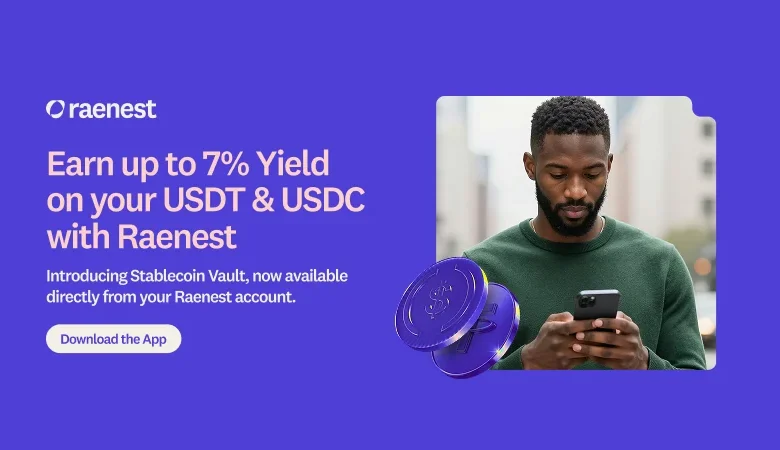
Global money management and cross-border payment platform Raenest has officially announced the launch of its newest financial product, Stablecoin Vault. Designed specifically for individuals and businesses operating within emerging markets across Africa, Latin America, and Asia, the new product enables eligible users to earn a variable Annual Percentage Yield (APY) of up to 7% on their holdings of USD Coin (USDC) and Tether (USDT). The offering is integrated directly into the Raenest mobile application, marking a significant milestone in the company’s ongoing mission to bridge traditional financial architecture with decentralized finance (DeFi) tools.
The introduction of the Stablecoin Vault reflects a broader, macro-level transformation in the mechanics of global capital flows. As stablecoins transition from niche crypto-native instruments into deeply integrated components of international trade, commerce, and personal finance, demand is surging for efficient mechanisms to receive, hold, transfer, spend, and compound digital assets. Raenest’s strategic deployment of the Vault aims to eliminate the friction and fragmentation traditionally associated with moving money across borders, unifying diverse financial operations into a single, cohesive user experience.
The Mechanism Behind Stablecoin Vault
The newly launched Stablecoin Vault is engineered to provide a seamless yield-generation mechanism for digital asset holders. By integrating the feature directly into its multi-currency application, Raenest allows eligible customers to allocate their idle USDC and USDT balances toward yield-generating protocols without requiring advanced technical knowledge of decentralized finance interfaces.
The security and optimization of the Stablecoin Vault infrastructure are powered by Gauntlet, a prominent risk management and economic simulation firm. Operating since 2018, Gauntlet has established itself as a trusted institutional partner in the decentralized finance ecosystem, securing and optimizing DeFi protocols and managing over $1.5 billion in assets across various vaults for more than 150 fintech companies and financial institutions worldwide, including Raenest.
Despite the attractive up to 7% variable APY, Raenest has emphasized transparency regarding the underlying market mechanics. The yield rates are inherently variable, meaning they will fluctuate in response to shifting market conditions within the broader decentralized finance ecosystem. Furthermore, the company has explicitly reminded users that the Stablecoin Vault functions differently from a conventional bank account; consequently, balances held within the Vault do not carry traditional government-backed deposit insurance, such as FDIC coverage. While funds are managed through robust risk frameworks provided by Gauntlet, returns remain subject to market variables and potential risks intrinsic to DeFi protocols.
Expanding the Ecosystem: Comprehensive Stablecoin Management
The Stablecoin Vault represents only one pillar of Raenest’s broader, comprehensive stablecoin strategy. The platform empowers users to establish dedicated, individual wallet addresses specifically for USDC and USDT, allowing them to receive and store stablecoins in their original native formats. This capability ensures that global earners—such as remote workers, freelancers, digital nomads, and international enterprises—can consolidate a larger share of their multinational earnings within a unified platform.
Once stablecoins are credited to a user’s Raenest account, the platform grants extensive flexibility regarding fund movement and liquidity management. Customers can dispatch USDC and USDT across multiple supported blockchain networks, execute peer-to-peer transfers, or convert digital assets instantly into traditional fiat currencies—such as U.S. Dollars (USD), British Pounds (GBP), and Euros (EUR)—as their specific financial obligations dictate.
Crucially, this liquidity is bridged directly to the physical and digital economy through the Raenest Card. Users are equipped to spend directly from their stablecoin balances at merchant locations worldwide, running alongside their traditional fiat currency balances. By fusing fiat holding accounts, multi-currency capabilities, crypto wallets, and everyday spending cards into a single platform, Raenest is effectively designing a borderless financial operating system for the modern global workforce.
Leadership Perspective and Strategic Vision
Commenting on the official rollout of the product, Victor Alade, CEO and Co-founder of Raenest, highlighted the evolving role of digital currencies in cross-border commerce.

"Stablecoins are becoming an important part of how people and businesses manage money across borders," stated Alade. "With Stablecoin Vault, we’re giving users more ways to put their balances to work, while continuing to build a platform that brings global money management into one place."
This strategic product launch aligns seamlessly with Raenest’s overarching corporate trajectory. Over the past several years, the Nigerian-founded fintech has experienced exponential growth, evolving from a regional payment solution into a globally recognized financial platform. The company has successfully scaled its operations to serve more than one million active users distributed across over 50 countries, facilitating the processing of more than $2 billion in cumulative transaction volume.
The company’s rapid expansion has been strongly supported by institutional investors who recognize the immense market potential for cross-border financial solutions tailored to emerging economies. Notably, Raenest secured $11 million in strategic funding following milestones that included surpassing 700,000 active users, onboarding over 300 corporate enterprises, and processing its first billion dollars in transaction volume. These financial injections have allowed the enterprise to accelerate product development, expand regulatory compliance frameworks, and broaden its geographic footprint across continents where access to stable, dollar-denominated financial instruments remains in high demand.
Chronology and Growth Milestones
To understand the context of the Stablecoin Vault release, it is instructive to examine Raenest’s rapid operational timeline and developmental milestones:
- Founding and Early Growth: Raenest established its core infrastructure to address the severe pain points experienced by African remote workers and global earners facing high transaction fees, slow settlement times, and limited access to hard currencies. The platform initially introduced multi-currency accounts in USD, GBP, and EUR.
- Scaling Transaction Volume: The fintech rapidly scaled its user base, surpassing 700,000 customers and onboarding hundreds of businesses as the demand for borderless payment infrastructure intensified across emerging markets.
- Capital Injection ($11 Million Funding): Following strong operational metrics and crossing the $1 billion transaction milestone, Raenest successfully secured $11 million in funding from prominent venture capital investors, positioning the firm for aggressive technological expansion.
- Introduction of Stablecoin Products: Building upon its multi-currency fiat accounts and virtual dollar cards, Raenest rolled out dedicated support for USDC and USDT, enabling users to hold and transfer native stablecoins.
- Global Launch of Stablecoin Vault: Raenest officially introduced the Stablecoin Vault in partnership with risk-management firm Gauntlet, enabling eligible users in Africa, Latin America, and Asia to earn up to 7% variable APY on their digital asset holdings.
Broader Economic Implications for Emerging Markets
The introduction of yield-generating stablecoin products by emerging market-focused fintechs like Raenest carries profound implications for the global financial landscape. In many developing economies across Africa, Latin America, and Asia, citizens and domestic businesses contend with macroeconomic volatility, rapid local currency depreciation, high inflation rates, and restricted access to stable foreign banking services.
For decades, holding U.S. dollars was viewed primarily as a defensive strategy to preserve purchasing power against local currency devaluation. However, traditional banking channels in emerging markets often make it difficult, expensive, or bureaucratically cumbersome for ordinary citizens to open foreign currency accounts or earn meaningful interest on dollar-denominated savings.
Stablecoins—specifically fully reserved digital assets like USDC and USDT—have fundamentally altered this dynamic by offering instant, borderless, and permissionless access to digital dollars on public blockchains. By embedding these assets into user-friendly fintech applications and coupling them with secure yield-generating mechanisms curated by institutional-grade risk managers like Gauntlet, companies like Raenest are democratizing access to financial tools that were previously restricted to institutional investors or high-net-worth individuals in developed nations.
Furthermore, this trend exerts structural pressure on traditional banking institutions in emerging markets to modernize their cross-border payment offerings and improve deposit rates. As more freelancers, remote contractors, import-export enterprises, and digital businesses migrate their working capital onto borderless platforms where funds can be instantly accessed, converted, spent via card, and now put to work earning yield, traditional financial service providers must innovate to remain competitive.
Future Outlook for Raenest
As regulatory frameworks surrounding digital assets continue to evolve globally—with jurisdictions from the UK to various emerging economies issuing updated guidelines on peer-to-peer crypto transactions and stablecoin usage—Raenest is positioning itself as a compliant, user-centric bridge between traditional finance and decentralized web3 infrastructure.
The company’s long-term roadmap centers on deepening its multi-currency ecosystem, expanding merchant acquisition services, enhancing investment avenues (such as its existing U.S. stock investment features), and scaling its yield products safely across new geographic territories. By continuing to consolidate receiving, holding, transferring, spending, and growing money into a single intuitive application, Raenest aims to redefine the standard of financial mobility for the next generation of global earners.