The Reality of Dividend Investing: Balancing Income Goals with Market Volatility in Retirement Planning

The allure of living entirely off investment dividends without touching the underlying principal is a cornerstone of the traditional retirement dream. For many investors nearing the end of their professional careers, the prospect of shifting from a growth-oriented accumulation phase to an income-generating distribution phase creates a sense of financial security. However, recent inquiries into portfolio restructuring strategies reveal a significant disconnect between investor expectations regarding risk tolerance and the historical reality of market volatility.
A typical case involves an investor sixteen months from retirement, managing approximately $540,000 in assets. The proposal under consideration involves moving roughly $400,000—the bulk of the portfolio—into a actively managed strategy focused on 70 to 90 dividend-paying stocks, supplemented by bond funds. The investor aims for a portfolio structured to limit drawdowns to 10% to 15%, under the assumption that dividend income will negate the need to sell shares during market downturns. While the strategy offers a perceived shield against market timing, financial experts caution that such expectations may be fundamentally misaligned with the mechanics of the equity market.
The Mechanics of Dividend Payouts and Market Valuation
To understand the limitations of a dividend-only strategy, one must first address the mechanical reality of how dividends affect share prices. When a publicly traded company issues a dividend payment, the share price typically adjusts downward by an amount commensurate with the payout. This is not a failure of the system, but a reflection of the company’s balance sheet; cash held by the corporation is transferred to the shareholder, reducing the net value of the company.
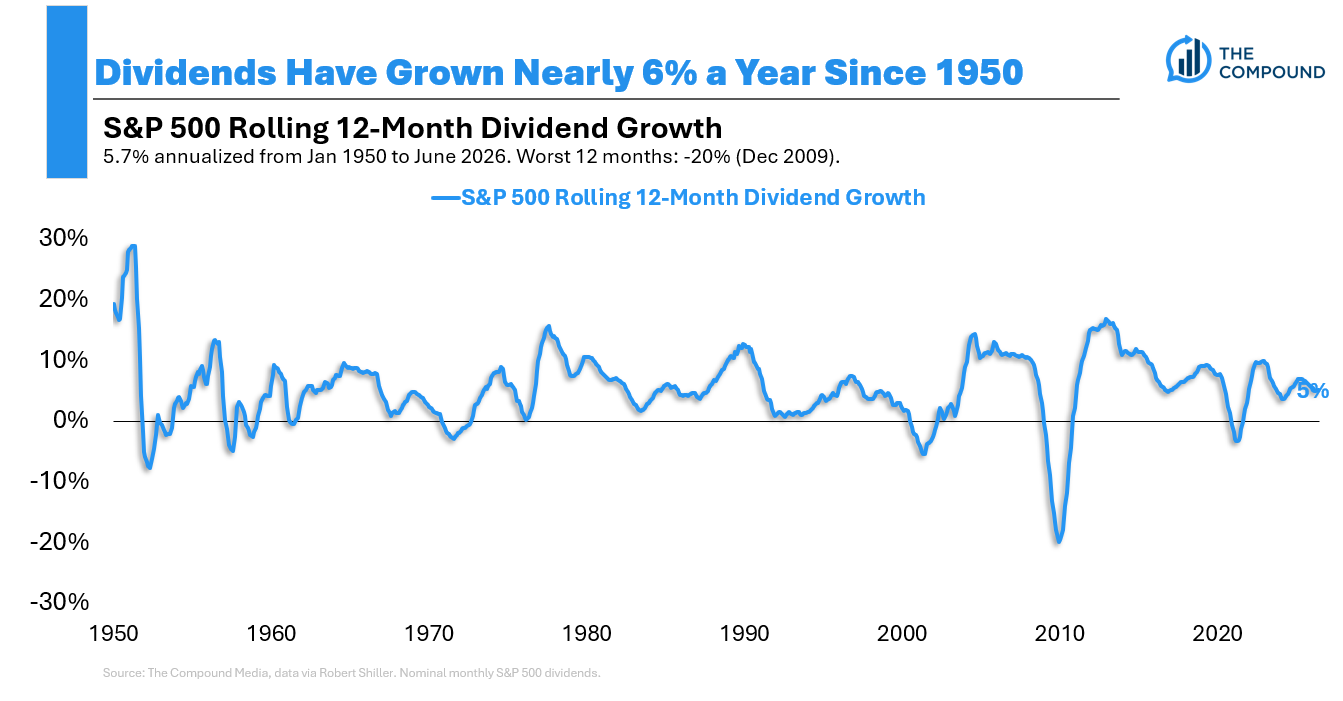
Consequently, dividends are not “free money” generated in a vacuum. While they provide a tangible cash stream that differs from the coupon payments of fixed-income instruments, they remain inextricably linked to the underlying equity. The primary advantage of dividends, historically, has been their tendency to grow over time. Data from the S&P 500 shows that from 1950 to the present, rolling 12-month dividend growth has averaged approximately 6%, consistently outpacing the long-term average inflation rate of 3.5%. This growth component provides a hedge against the rising cost of living, which is a critical consideration for retirees.
Historical Drawdowns and the Limits of Protection
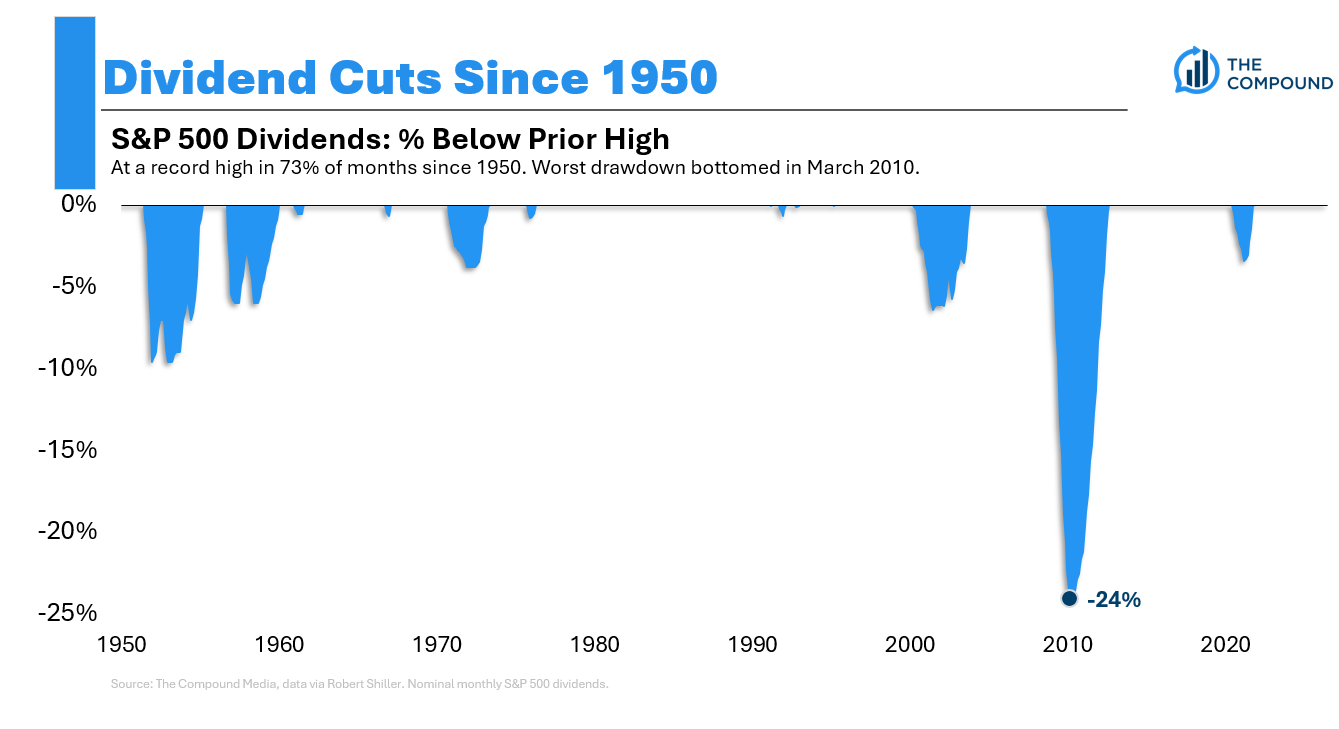
Despite the long-term benefits of dividend growth, the strategy is not immune to economic cycles. History confirms that dividend payouts are subject to contraction during severe systemic shocks. The Great Financial Crisis of 2008–2009 serves as the most prominent example of this vulnerability. While broad equity market indices experienced precipitous declines, dividend payouts also retreated, though to a lesser degree than share prices.
During the 1987 market crash, for instance, the S&P 500 experienced a single-day drop of roughly 33%, yet aggregate dividend payouts remained largely unaffected. However, during the 2008 financial crisis, when the S&P 500 suffered a peak-to-trough decline of approximately 56%, dividend payouts fell by roughly 24%. While a 24% reduction in income is significantly less severe than the loss of half of one’s portfolio value, it remains a meaningful disruption for a retiree relying exclusively on those funds for daily expenses. The data suggests that while dividends provide more durable downside protection than the broader market, they are not a substitute for the safety offered by cash or high-grade government bonds.
Assessing the Feasibility of Risk Caps
The investor’s request to cap drawdowns at 10% to 15% while holding a portfolio composed primarily of dividend-paying stocks presents a significant logical challenge. Market volatility is an inherent feature of equity ownership, and dividend stocks are not exempt from this volatility. Major dividend-focused Exchange Traded Funds (ETFs)—such as those tracking high-dividend yields or dividend growth—consistently demonstrate drawdowns that exceed 15% during standard market corrections and bear markets.
Financial advisors note that attempting to engineer a portfolio with such a rigid drawdown cap while simultaneously seeking the income growth required to beat inflation often forces an investor into a corner. To achieve a 10% to 15% limit, one would typically need to hold a much higher allocation of bonds or short-term treasury instruments. However, increasing bond allocations often reduces the overall yield of the portfolio, potentially forcing the investor to sell principal after all, thereby defeating the original purpose of the strategy.
The Professional Perspective: Portfolio vs. Plan
The professional consensus in the wealth management sector is that a portfolio is not a financial plan. When evaluating an actively managed strategy with a 0.6% fee, investors are advised to look beyond the asset allocation and examine the holistic nature of the advice provided. An effective retirement plan must account for several critical variables:
- Tax Efficiency: Dividend income is often taxed differently than capital gains. Depending on the investor’s tax bracket and the type of account (tax-advantaged vs. taxable), the net income from a dividend-heavy portfolio may be significantly lower than anticipated.
- Total Return Focus: Over long time horizons, total return—which includes both price appreciation and dividends—is the most reliable metric for portfolio health. Focusing solely on dividend yield can lead to “yield chasing,” where investors ignore the underlying growth prospects of a company, potentially leading to long-term stagnation of the principal.
- Planning for Contingencies: A comprehensive plan should include stress testing for scenarios where dividends are cut or market conditions remain flat for an extended period. Relying on a five-to-ten-year market recovery window is a speculative assumption that can be dangerous if a retiree requires immediate liquidity during a prolonged downturn.
Strategic Implications for Nearing Retirement
The transition into retirement requires a shift from maximizing growth to managing sequence-of-returns risk. The danger in the proposed strategy lies not in the dividend-investing philosophy itself, but in the psychological reliance on the idea that one will "never touch the principal."
When reality deviates from expectations—as it inevitably does during market cycles—investors who have built their entire plan on a rigid premise are often prone to overreacting. Abandoning a strategy at the bottom of a market cycle due to unforeseen volatility is the most common cause of failure in retirement planning.
For the investor in question, the decision to commit $400,000 to an actively managed, dividend-focused strategy should be viewed through the lens of total portfolio risk. If the advisor cannot provide a clear mechanism for handling market volatility that exceeds the 15% threshold, or if they cannot articulate how the portfolio will function during a dividend-cutting environment, the strategy may be fundamentally incomplete.
Ultimately, the goal of retirement security is rarely achieved through a single, static portfolio. Instead, it is built through the integration of income streams, a realistic understanding of risk, and the flexibility to adjust distributions as market conditions evolve. The "dividend dream" is attainable for many, but only for those who accept that volatility is the price of entry into the equity markets, and that protecting against that volatility requires a broader approach than just selecting the right dividend stocks.
Related posts: