A Comprehensive Roadmap to Mastering Voice Agents and Conversational AI Architecture

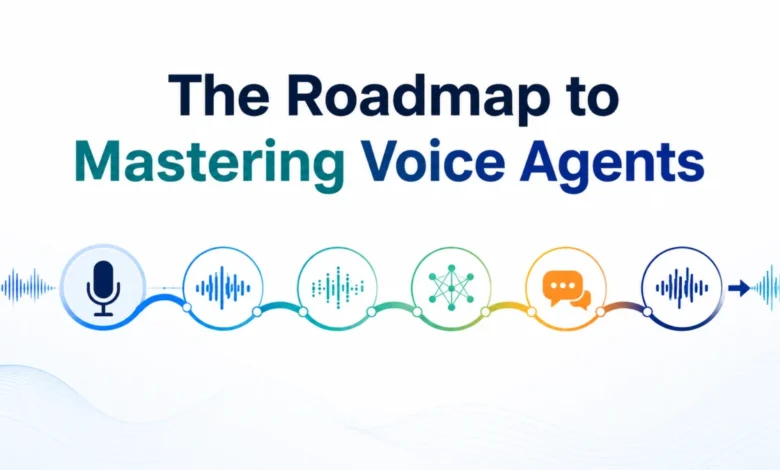
The rapid evolution of generative artificial intelligence has moved beyond the constraints of text-based interfaces, ushering in an era where voice interaction serves as the primary gateway for human-machine communication. As voice agents transition from rudimentary, command-based systems to sophisticated, reasoning-capable entities, developers and engineers must master a complex, multi-layered pipeline that integrates automatic speech recognition (ASR), large language models (LLMs), and high-fidelity text-to-speech (TTS) synthesis. This article explores the fundamental architectural requirements of voice agents and provides a structured seven-stage roadmap for building robust, production-ready systems.
The Evolution of Conversational Interfaces
The trajectory of voice-enabled technology has been defined by three distinct eras. In the 2010s, the "Command and Control" era relied on rigid, intent-based frameworks like Siri and Alexa, which were limited to specific, pre-programmed triggers. The mid-2020s marked the "Generative Integration" phase, where LLMs began to replace static decision trees, allowing for dynamic, open-ended dialogue. We are now entering the "Real-Time Interaction" era, characterized by low-latency, multi-modal systems capable of handling human nuances such as interruptions, emotional cues, and rapid turn-taking.
Market analysts from firms like Gartner and McKinsey have noted that the global conversational AI market is projected to grow at a compound annual growth rate (CAGR) exceeding 20% through 2030. This growth is driven by a shift in consumer expectations: users increasingly demand that digital assistants function with the same fluid, interruptible, and context-aware capabilities as human interlocutors.
The Anatomy of a Voice Agent Pipeline
Unlike text-based agents, which operate in a linear request-response loop, a voice agent is an orchestration of three concurrent, latency-sensitive processes.
- Speech-to-Text (STT) Layer: This stage utilizes advanced neural networks to convert acoustic signals into textual tokens. The primary metric here is the Word Error Rate (WER), which must be minimized to ensure the LLM receives accurate data. Modern systems now employ "streaming" ASR, which begins transcribing audio segments before the user has finished speaking.
- Language Processing Layer: Once transcribed, the text is routed to an LLM. Unlike text agents, this layer must be optimized for brevity and phonetic clarity. Because there is no visual interface to present bulleted lists or bold text, the LLM must be prompted to prioritize natural, spoken-word structures.
- Text-to-Speech (TTS) Layer: The final stage involves converting the LLM’s response into audio. Recent breakthroughs in generative audio—such as those seen in OpenAI’s GPT-4o and ElevenLabs’ Turbo v2.5—have drastically reduced the latency between text generation and speech synthesis, enabling near-instantaneous responses.
A Structured Seven-Stage Roadmap for Development
To bridge the gap between prototype and deployment, developers should adhere to a sequential pedagogical framework designed to isolate and solve the specific challenges inherent to voice.
Stage 1: Foundational Pipeline Architecture
The initial phase requires a mastery of audio data processing. Developers must familiarize themselves with standard sampling rates (usually 16kHz for telephony), audio encoding formats (WAV, Opus, MP3), and the fundamental challenges of acoustic noise cancellation. Understanding why a 500ms delay in transmission can lead to user frustration is the cornerstone of this stage.
Stage 2: Prompt Engineering for Spoken Language
While prompt engineering is well-documented for text, voice-specific prompting requires a shift in strategy. Developers must constrain models to avoid complex nested lists, markdown formatting, or symbols that do not translate well into audio. The focus shifts to "prosody-aware" writing, where instructions guide the LLM to use conversational filler, varied sentence lengths, and natural cadence.
Stage 3: Achieving Low-Latency Streaming
Latency is the primary antagonist of a successful voice agent. To achieve a human-like response time (ideally under 400-600ms), engineers must implement streaming architectures where the TTS engine begins synthesizing the beginning of a sentence while the LLM is still generating the end. This requires high-performance, asynchronous codebases, often utilizing WebSockets for bidirectional communication.
Stage 4: Conversation Design and Human Factors
Technical perfection does not equate to user satisfaction. Conversation design—the practice of mapping out interaction flows—is essential for managing user expectations. This stage covers the implementation of "barge-in" capabilities (the ability for the user to interrupt the agent), the design of recovery prompts when the agent fails to understand, and the establishment of a consistent brand personality through tone of voice.
Stage 5: Tool Integration and State Memory
A truly intelligent agent must go beyond conversation; it must act. This stage involves connecting the agent to external APIs via function calling. For instance, a healthcare-focused voice agent must be capable of querying an Electronic Health Record (EHR) database in real-time. Furthermore, implementing long-term memory via vector databases allows the agent to recall user preferences or previous interaction history, creating a more personalized experience.
Stage 6: Deployment, Monitoring, and Evaluation
Deploying a voice agent is fundamentally different from hosting a web server. Infrastructure considerations include telephony integration (using platforms like Twilio or Vonage for PSTN connectivity) and monitoring tools to track the "End-to-End Latency" (E2EL). Evaluation metrics must shift from simple BLEU scores to "Human-in-the-Loop" (HITL) testing, where recordings are analyzed for task completion rates and user sentiment.
Stage 7: Advanced Multimodal and Affective Computing
The final stage focuses on the frontiers of the field: emotion recognition and voice cloning. By analyzing the prosody, pitch, and speed of a user’s voice, the agent can adjust its own tone to match the situation—providing a calm demeanor in an emergency or a helpful, upbeat tone during a customer service interaction.
Broader Implications and Industry Impact
The widespread adoption of voice agents is set to fundamentally alter the professional landscape. In healthcare, ambient documentation tools are already reducing the administrative burden on clinicians by automatically transcribing and summarizing patient visits. In the retail sector, autonomous voice agents are replacing traditional IVR (Interactive Voice Response) menus, allowing customers to resolve complex issues without being transferred to a human agent.
However, the rapid deployment of this technology brings significant ethical considerations. Data privacy, specifically regarding the storage and processing of voice biometrics, is under increasing scrutiny by regulators worldwide. Companies are now tasked with ensuring that their voice agents are not only effective but also compliant with stringent data protection frameworks like the GDPR and CCPA.
Conclusion: The Future of Interaction
The transition from text-based chatbots to fluid, conversational voice agents represents a seismic shift in how humans interact with technology. By mastering the seven-stage development roadmap—from understanding the underlying audio pipeline to refining the nuances of conversation design—engineers are empowered to build systems that are not merely tools, but functional, responsive participants in human discourse. As latency continues to drop and LLM reasoning capabilities improve, the distinction between human and machine interaction will continue to blur, necessitating a design-first approach that prioritizes clarity, empathy, and reliability in every spoken exchange. The developers who succeed will be those who balance technical rigor with the art of natural communication.
Related posts: