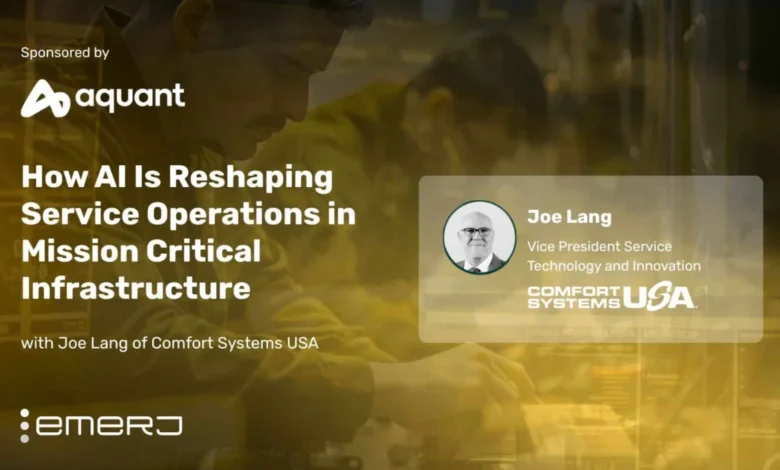
How AI Is Reshaping Service Operations in Mission Critical Infrastructure

The global industrial landscape is currently navigating a critical structural mismatch that threatens the stability of energy, infrastructure, and data-center assets. As the digital economy accelerates, uptime requirements for mission-critical systems are being tightened to near-zero, yet the traditional maintenance models and technician capacities remain tethered to legacy frameworks. This widening gap has created an urgent need for a paradigm shift in service operations—a shift increasingly powered by artificial intelligence and prescriptive data analytics.
The scale of the challenge is underscored by the rapid expansion of the "grid edge." According to analysis from the Electric Power Research Institute, cited by the U.S. Department of Energy, data centers are projected to consume up to 9 percent of total U.S. electricity generation by 2030. This represents more than a doubling of their 2023 share, driven largely by the massive computational requirements of generative AI and cloud computing. The financial stakes of this transition are immense; the Institute for Supply Management recently reported that unscheduled downtime now costs the world’s 500 largest companies an estimated $1.4 trillion annually, a figure representing roughly 11 percent of their total revenue.
As the demand for reliability grows, the human capital required to sustain it is in decline. The U.S. Bureau of Labor Statistics projects approximately 81,000 electrician openings annually through 2034. Crucially, these openings are being driven by a "silver tsunami" of retirements rather than a lack of industry growth. This loss of tribal knowledge, combined with a shortage of new entrants, has left service organizations in a precarious position. To address these compounding pressures, industry leaders are turning to AI-enabled service transformations.
In a recent episode of the AI in Business podcast, Yolandi de Weerdt of Emerj was joined by Joe Lang, Vice President of Service Technology and Innovation at Comfort Systems USA, to discuss the operational and strategic shifts required to modernize service for mission-critical infrastructure. Lang, a veteran with over 18 years of experience in executive service leadership, argues that the solution lies not just in better tools, but in a fundamental reimagining of how maintenance data is gathered, processed, and delivered to the field.
The Shift to Anomaly Detection and Condition-Based Maintenance
Traditional maintenance cycles are built on the assumption of predictable intervals—servicing equipment every six months regardless of its actual health. However, Joe Lang points out that equipment behavior often undergoes subtle changes in the unmonitored periods between these scheduled visits. When these anomalies are ignored, they inevitably progress into catastrophic failures and avoidable downtime.
Lang posits that anomaly detection is no longer an "advanced" or "optional" feature of AI; it is the primary operational discipline required for modern service. The goal is to treat real-time equipment behavior as the ultimate source of truth. Most industrial failures are not sudden surprises; they are the culmination of detectable behavioral drifts.
"AI gives technicians a head start," Lang explained during the interview. "When the system flags a deviation, it’s often the earliest sign that something is drifting out of normal behavior. Acting at that moment prevents failure rather than reacting to it. It changes the rhythm of service work—teams stop chasing emergencies and start addressing issues before they become critical."
To successfully implement anomaly detection, organizations must establish specific operational requirements. These include a robust telemetry layer capable of capturing high-frequency sensor data, a logic layer that can distinguish between "normal" environmental noise and genuine mechanical drift, and an automated alert system that prioritizes notifications based on the severity of the deviation. By establishing this "operating floor," service organizations can move away from calendar-based assumptions and toward a model that responds to the actual physical state of the asset.
Moving Beyond Prediction to Prescriptive Guidance
One of the most significant insights shared by Lang is the distinction between predictive and prescriptive maintenance. While predictive maintenance forecasts when a failure might occur, prescriptive maintenance recommends the next-best action to resolve the issue.
In the current environment, technician performance often fluctuates based on the individual’s familiarity with specific equipment or the ambiguity of the symptoms presented. Lang argues that this variability is rarely a personnel issue; rather, it is an information issue. When technicians arrive at a site, the diagnostic evidence they need is often scattered across disconnected systems, buried in static PDF manuals, or locked within the minds of senior staff members who are nearing retirement.
Prescriptive guidance aims to stabilize this variability by providing every technician with a unified, informed starting point. By consolidating service histories, Original Equipment Manufacturer (OEM) documentation, resolution patterns, and real-time equipment context, an AI system can surface the most likely fault and the exact steps needed to fix it before the technician even opens the equipment panel.
Lang is careful to note that this technology is not intended to replace human judgment. Instead, it is designed to eliminate the "first ten minutes" of uncertainty that often lead to inconsistent outcomes and failed first-time fixes. When the likely fault and recommended intervention are delivered at the moment of service, diagnostic swings narrow, and a constrained workforce can operate with a much higher baseline of performance.
To make prescriptive guidance effective, Lang identifies several critical evidence sources that must be integrated:
- Telemetry and IoT Data: Real-time sensor readings and error codes.
- Asset History: A comprehensive record of past repairs and recurring issues.
- Technical Documentation: Digitized and searchable OEM manuals.
- Resolution Logic: Data on what specific actions successfully resolved similar symptoms in the past.
The Data Interoperability Crisis and the Cost of Fragmentation
The transition to AI-driven service is frequently hindered by the fragmented state of equipment data. Research from the National Institute of Standards and Technology (NIST) found that inadequate interoperability of facility and equipment data costs U.S. capital-facilities owners and operators approximately $10.6 billion annually during the operations and maintenance phase alone.
This fragmentation means that technicians often lack the asset history or manuals they need at the point of service. Without a single, structured data environment that an AI model can reason over, the promise of prescriptive guidance remains out of reach. Lang emphasizes that organizations must move away from "data silos" and toward a unified architecture where information can be delivered back to technicians in real time through mobile interfaces or augmented reality tools.
Effective diagnostic-workflow design requires a commitment to data hygiene. This includes the categorization of assets into logical equipment groups and the standardization of how service notes are recorded. Without this foundation, AI models cannot accurately identify patterns or provide reliable recommendations.
Operational Transformation: Avoiding the "Part-Time" Project Trap
Perhaps the most significant barrier to modernizing service operations is how organizations resource these initiatives. Lang observes that many modernization efforts stall because companies treat them as "part-time" projects. They might pull a batch of data here or load a platform there, but they fail to assign dedicated ownership or provide the necessary funding to see the transition through to completion.
Lang uses a vivid analogy to describe the challenge: "This is where you’ll modify the plane while you’re flying it. You’ve got to modify it so it can continue to fly and land and take off again. You absolutely have to resource this correctly when you start down this path."
For a service transformation to succeed, it requires a dedicated project team that is insulated from daily "firefighting" duties. This team must be responsible for asset data structuring, model training, and, perhaps most importantly, change management. Transitioning a workforce of veteran technicians to a new, AI-augmented workflow requires clear communication, training, and a demonstration of the technology’s value in making their jobs easier and more efficient.
The operational requirements for this shift include:
- Executive Sponsorship: High-level buy-in to ensure the project remains a priority.
- Structured Asset Data: A clean, organized inventory of all mission-critical components.
- Dedicated Personnel: Staff whose primary focus is the implementation and refinement of the AI system.
- Continuous Feedback Loops: Mechanisms for technicians to provide feedback on the accuracy of AI recommendations, allowing the system to learn and improve over time.
Broader Impact and Industry Implications
The implications of AI-enabled service operations extend far beyond individual company balance sheets. As the U.S. and global economies become increasingly dependent on data centers and a modernized electrical grid, the ability to maintain these assets with a shrinking workforce becomes a matter of national economic security.
The shift toward prescriptive maintenance has the potential to significantly lower the barrier to entry for junior technicians. By providing them with "on-the-job mentorship" via AI guidance, companies can onboard new workers more quickly and bring them up to a high level of competency in a fraction of the time required by traditional methods. This could prove to be the most effective strategy for mitigating the impact of the ongoing labor shortage.
Furthermore, the environmental impact of this shift is noteworthy. By optimizing maintenance schedules and ensuring that equipment operates at peak efficiency, organizations can reduce energy consumption and extend the lifespan of expensive capital assets. This aligns with broader corporate sustainability goals and the global push toward carbon neutrality.
In conclusion, the insights shared by Joe Lang highlight a pivotal moment for the service industry. The combination of committed resourcing, structured data, and AI-driven prescriptive guidance represents the only viable path forward for organizations managing mission-critical infrastructure. Those who successfully "modify the plane while flying it" will gain a significant competitive advantage, while those who remain tethered to reactive, fragmented models risk being grounded by the rising costs of downtime and the scarcity of skilled labor.