Beyond Prediction: Reimagining Algorithmic Trading Through Agentic Risk Management

The quest to predict market direction with Large Language Models (LLMs) has largely been a failure in the quantitative finance sector, as the inherent stochastic nature of liquid equities makes next-day price forecasting an unreliable pursuit for even the most sophisticated neural networks. Recent industry research, notably by Dr. Ernie Chan in 2024, underscores a pivotal shift in focus: successful institutional strategies are moving away from attempting to divine market direction and toward the precise management of risk and volatility. By utilizing DeepSeek as a sophisticated risk manager rather than a market forecaster, developers are now building autonomous trading systems that dynamically adjust exposure based on historical market regimes, effectively replacing rigid, threshold-based rules with nuanced, context-aware decision-making.
The Evolution of Algorithmic Decision-Making
For decades, quantitative strategies relied on "blunt" triggers—simple moving averages or RSI thresholds—to signal buy or sell orders. While these methods provided basic discipline, they often failed to distinguish between a temporary market dip and a structural shift in risk. The integration of LLMs marks a departure from this static approach. In this new framework, the model acts as an analytical layer that consumes compact, historical statistical data—such as mean returns and Sharpe-like scores across various market states—to determine the optimal level of capital deployment.
Unlike traditional predictive models that attempt to output a binary "up or down" signal, this agentic approach focuses on exposure sizing. The strategy, tested extensively on AAPL (Apple Inc.) stock data from 2023 to 2026, instructs the model to navigate the market by maintaining a long-only position ranging from 50% to 100%. This deliberate avoidance of short-selling or leverage is designed to capture the natural long-term positive drift of the asset while mitigating exposure during high-volatility or unfavorable regimes.
A Chronology of the Walk-Forward Backtesting Framework
The validity of any quantitative strategy rests on its performance out-of-sample (OOS). To ensure this, the development process employed a rigorous monthly walk-forward loop, a methodology that prevents look-ahead bias by training the model only on the three years of data preceding the current month.
- January 2023: The inception of the OOS testing period. The system began generating its first "policy tables," assigning exposure levels based on the market’s current mood.
- Mid-2023 to 2024: The strategy underwent continuous adaptation. Each month, the system re-optimized its guardrail thresholds—volatility limits, drawdown constraints, and re-entry timing—to reflect the evolving macro-environment.
- 2025 to 2026: Throughout this period, the system maintained its performance despite significant market fluctuations, demonstrating that the LLM-assisted policy, combined with hard safety guardrails, could effectively navigate periods of stress where static models would have likely triggered catastrophic sell-offs.
The Mechanism of Hard Guardrails
While the LLM provides the qualitative "mood" of the market, the system is anchored by a layer of hard, algorithmic guardrails. These safeguards are essential because LLMs, by their nature, can be prone to hallucination or misinterpretation of historical data. To mitigate these risks, the strategy implements three primary safety layers:
- Volatility Stops: If realized volatility, combined with short-term acceleration, breaches a pre-set threshold, the system automatically de-risks to a neutral state. This prevents the strategy from being caught in sudden liquidity events.
- Drawdown Stops: When the strategy’s equity curve hits a predefined limit, it triggers an automatic exit. A common failure in such systems is the "deadlock" problem—where a flat position prevents equity recovery, trapping the strategy in a permanent state of inaction. To resolve this, a "forced re-entry" mechanism was introduced, allowing the strategy to resume participation after a cooldown period, effectively resetting the risk profile.
- Trend-Break Confirmation: To avoid being whipsawed by minor market corrections, the system requires secondary confirmation—such as negative momentum and price action below the 50-day moving average—before executing a hard stop.
Supporting Data and Comparative Performance
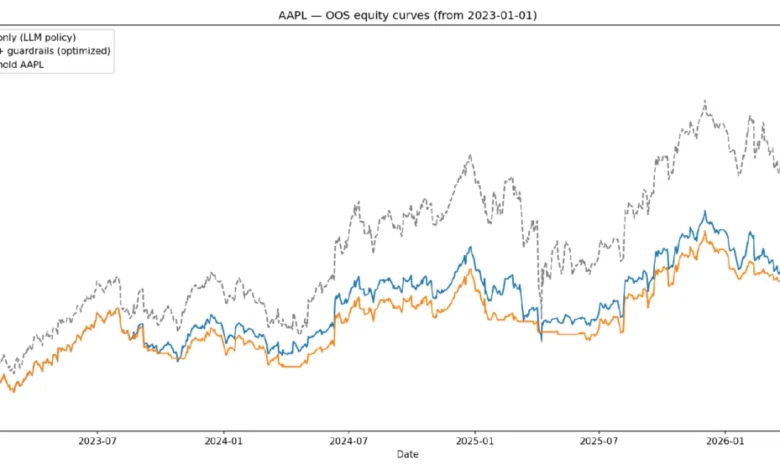
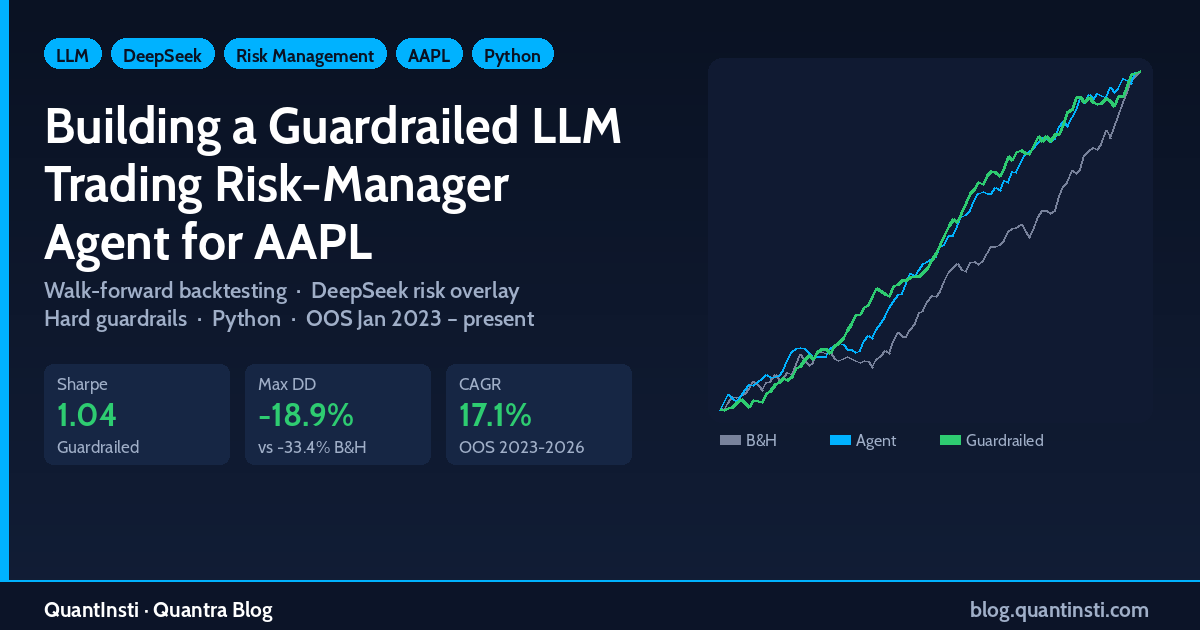
The empirical results from the 2023–2026 testing window provide a clear picture of the strategy’s value proposition. While a standard Buy-and-Hold approach yielded a higher Compound Annual Growth Rate (CAGR) of 27.1%, the LLM-assisted, guardrailed strategy achieved a CAGR of 12.8% with significantly reduced risk.
The crucial metric here is not the raw return, but the risk-adjusted outcome. The strategy reduced the maximum drawdown from -22% to -18% compared to the agent-only model, and the volatility of the strategy was constrained to approximately 14%—significantly lower than the 25% volatility associated with a passive AAPL holding. This demonstrates that the LLM’s primary contribution is not "alpha generation" in the traditional sense, but the preservation of capital during high-risk regimes, leading to a superior Calmar ratio compared to the passive benchmark.
Institutional Implications and Strategic Refinement
The findings suggest that the future of algorithmic trading lies in "hybrid" systems. By separating the qualitative, regime-sensing capabilities of LLMs from the quantitative, rule-based execution of risk management, developers can build systems that are both flexible and resilient.
Industry analysts observe that this methodology could be expanded to a broader universe of assets. Future iterations of this research are expected to incorporate:
- Multi-Horizon Momentum: Assessing 5-day and 63-day trends simultaneously to better gauge market maturity.
- Macro-Regime Filters: Integrating S&P 500 performance as a broader context for individual stock movements.
- Earnings Blackout Protocols: Automatically scaling to flat during known volatile periods like quarterly earnings, which remain a source of "gap risk" that models often struggle to price correctly.
Professional Conclusion
The integration of agentic AI into financial markets represents a shift toward more intelligent, context-sensitive trading. As this study has demonstrated, the goal is not to create an omniscient forecaster, but to deploy a system capable of discerning when to participate in market growth and when to retreat. While the current implementation requires further refinement—particularly in state feature engineering and the granularity of position sizing—it provides a robust, transparent, and reproducible framework for investors looking to harness the power of LLMs.
Ultimately, the success of these systems will not be measured by their ability to outperform an index in a bull market, but by their ability to limit catastrophic drawdowns during periods of instability. As the technology matures, the ability to blend machine intelligence with strict, algorithmic risk oversight will likely become a standard component of institutional portfolio management. For those interested in the evolution of this technology, the focus must remain on the intersection of data-driven feature engineering and the qualitative reasoning capabilities of frontier models.