HaasOnline Launches Full WEEX Exchange Integration Alongside Elite API Trader Tournament

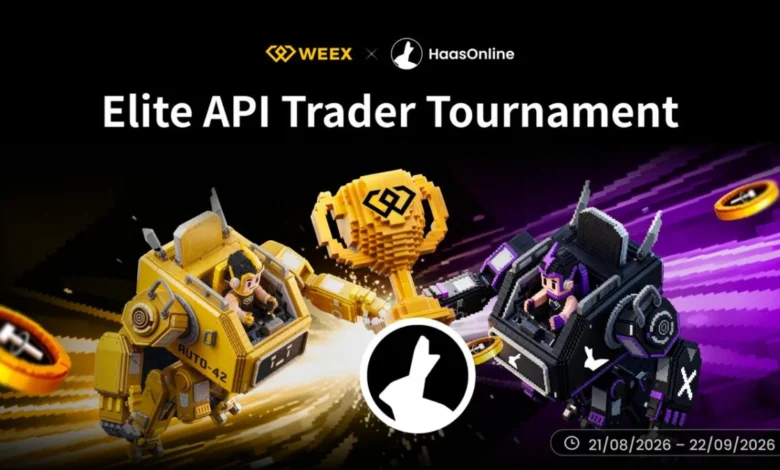
The algorithmic trading landscape has entered a new phase of integration as HaasOnline officially announced support for the WEEX exchange, enabling users to deploy automated strategies across the platform’s extensive suite of spot and derivative markets. This development, effective immediately, allows traders to utilize both the HaasOnline TradeServer Cloud and self-hosted environments to manage complex portfolios on WEEX. Coinciding with this technical deployment is the launch of the Elite API Trader Tournament, a month-long competitive event designed to showcase the capabilities of automated systems on the WEEX infrastructure.
The integration covers over 1,500 spot markets and 950 USDT-margined perpetual futures pairs, providing a high-capacity environment for quantitative traders. By bridging the gap between HaasOnline’s sophisticated automation logic—including HaasScript and grid-based strategies—and WEEX’s high-frequency execution environment, the partnership aims to cater to the growing demand for professional-grade automated trading tools in the digital asset space.
Chronology and Event Parameters
The Elite API Trader Tournament represents the centerpiece of the collaborative effort between the two firms. The event commenced on 21 August 2026 and is scheduled to conclude on 22 September 2026. This thirty-three-day window provides a controlled timeframe for developers and quantitative traders to test the latency, execution speed, and reliability of the new HaasOnline-to-WEEX API bridge under competitive conditions.
Participants are ranked based on their trading volume generated through the API, creating a leaderboard-style competition that incentivizes high-frequency and high-volume strategies. The tournament is specifically tailored for those already familiar with API-based interactions, as it requires the configuration of API credentials to connect HaasOnline bots to the WEEX exchange. This event structure is designed not only to drive volume but also to stress-test the integration under varying market conditions, providing both the exchange and the software provider with valuable performance metrics.
Technical Architecture and Integration Scope
The integration utilizes a unified credential model, a significant departure from more fragmented exchange architectures. WEEX allows for a single set of API keys to govern both spot and futures accounts. For the end-user, this simplifies the onboarding process, as it eliminates the need to manage separate keys for different asset classes.
From a technical standpoint, the HaasOnline TradeServer supports both one-way and hedge-mode positions on WEEX. This flexibility is essential for advanced strategies, such as market-neutral delta hedging or funding-rate arbitrage, which are common in institutional-grade quant trading. The support for cross and isolated margin per contract ensures that users can manage their risk profiles with granularity.
Furthermore, the integration extends to the entire HaasOnline ecosystem, including:
- Grid Bots: Ideal for the high-liquidity spot markets offered by WEEX.
- DCA Strategies: Allowing for systematic accumulation of digital assets.
- HaasScript Logic: Enabling custom-built algorithms that can incorporate proprietary indicators and complex exit/entry conditions.
- Paper Trading: WEEX provides simulated accounts that mirror real-time market data, allowing developers to backtest and rehearse strategies without risking capital.
Background on the WEEX Exchange
WEEX, which transitioned from its original Singaporean roots to a Dubai-based headquarters, has been operational since 2018. The exchange’s strategic shift to the Middle East aligns with the region’s increasing emergence as a hub for financial technology and cryptocurrency regulation.
The platform has focused on building a robust regulatory framework, holding Money Services Business (MSB) registrations with the Financial Crimes Enforcement Network (FinCEN) in the United States and the Financial Transactions and Reports Analysis Centre of Canada (FINTRAC). These registrations provide a layer of institutional legitimacy that is often a prerequisite for professional traders and fund managers looking to deploy capital via automated systems. With a heavy emphasis on USDT-margined perpetual futures, the exchange has positioned itself as a liquid venue for derivatives trading, which remains the most popular segment for the algorithmic trading community.
Fact-Based Analysis of Market Implications
The integration of HaasOnline with WEEX highlights a broader trend in the crypto-finance sector: the commoditization of institutional-grade trading tools. Historically, such sophisticated automation was reserved for proprietary trading firms or individuals with extensive coding experience. Today, the accessibility of platforms like HaasOnline, combined with the global, 24/7 availability of exchanges like WEEX, has effectively democratized high-frequency trading.
For the retail and semi-professional trader, the implications are twofold. First, the ability to use a Binance-compatible API structure reduces the friction associated with migrating strategies between venues. If a trader wishes to diversify their exchange risk, the ability to "plug and play" their existing HaasOnline scripts into WEEX allows for seamless migration. Second, the increase in automated volume on the WEEX exchange is likely to improve market depth and reduce slippage for all users, as algorithmic market-making bots contribute to a tighter bid-ask spread.
However, the proliferation of automated tools carries inherent systemic risks. As the industry notes, bots execute strategies significantly faster than human operators, meaning that an error in logic or a misconfiguration can result in rapid capital erosion. The emphasis by both companies on risk management, including the recommendation to use stop-loss orders and to avoid over-leveraging, underscores the necessity for prudent technical oversight in the automated era.
Official Guidelines and Operational Procedures
To participate in the ecosystem, users must follow a standardized protocol to ensure security and functionality. The process for establishing a connection includes:
- Account Creation: Registering directly via the designated tournament portal to ensure proper tracking for leaderboard eligibility.
- API Key Generation: Creating restricted-access API keys on the WEEX platform, ensuring that permissions are limited to the necessary trading functions while disabling withdrawal capabilities—a best practice for security.
- Credential Integration: Inputting these keys into the HaasOnline TradeServer interface. A common hurdle noted by support teams is the accidental inclusion of whitespace when pasting keys, which can cause connection errors.
- Bot Deployment: Selecting a strategy, configuring the desired leverage and margin settings, and initiating the bot, preferably after an initial trial phase in the paper-trading environment.
Risk Disclosure and Industry Standards
It is imperative for users to recognize that automated trading software, regardless of the quality of the execution venue, is a tool rather than a guaranteed profit-generating machine. The deployment of capital into cryptocurrency markets via perpetual futures involves the risk of liquidation, particularly when high leverage is applied.
The tournament itself and the supporting software are provided with the caveat that past performance—whether in backtesting or live trading—is never a reliable indicator of future results. Participants are encouraged to operate within their financial means and to strictly adhere to risk management protocols, such as limiting the percentage of capital exposed to any single trade.
As the tournament progresses toward the 22 September deadline, the performance data generated by the HaasOnline-WEEX bridge will likely serve as a benchmark for the efficacy of the integration. For now, the partnership stands as a notable entry in the 2026 fiscal year’s list of exchange-software collaborations, reflecting the ongoing maturation of the digital asset trading infrastructure. Users seeking to participate or to utilize the integration for non-competitive purposes are advised to consult the official documentation provided by both HaasOnline and WEEX to ensure all security configurations are compliant with current standards.
Related posts: