Intraday Trend Following in NIFTY Futures: A Quantitative Analysis of Strategy Resilience and Cost Impact

Most intraday trading systems fail not because of flawed entry signals, but due to overtrading, poor timing, and the neglect of transaction costs. In a comprehensive quantitative study conducted as part of the Executive Programme in Algorithmic Trading (EPAT) at QuantInsti, Siddhant Panda, an options trader at Jainam Broking Pvt. Ltd., has developed a robust framework for navigating the NIFTY Futures market. By integrating a multi-factor confirmation stack with stringent session-based constraints, the research provides a candid look at the discrepancy between theoretical backtest results and the reality of capital-intensive, cost-heavy trading.
The study, which spans a decade of market data from June 2015 to December 2024, moves beyond simple crossover strategies. It emphasizes that for highly liquid instruments like NIFTY Futures, success hinges on the ability to filter out market noise—those periods where the index drifts sideways—and ensuring that every trade is backed by a confluence of trend, momentum, and volume-based confirmation.
The Anatomy of the Strategy
The strategy employs a 15-minute timeframe, utilizing a sophisticated indicator stack designed to act as a series of gateways. Central to this approach is a 30-period Weighted Moving Average (WMA), which defines the primary trend bias. To ensure the strategy does not fall prey to whipsaws, additional filters include a 9-period Relative Strength Index (RSI) for momentum, an 11-period Average Directional Index (ADX) to gauge trend strength, and Heikin Ashi candle structures to filter out indecisive price action.
A long signal is only triggered when these conditions hold true for three consecutive bars. This "confirmation delay" is a strategic choice intended to ensure that the trend has established sufficient conviction before capital is deployed. Furthermore, the strategy incorporates a volatility filter via the Average True Range (ATR), ensuring that the entry is significant enough to warrant the cost of execution.

Temporal Constraints and Market Context
The research highlights the critical importance of "session rules" in mitigating risk. By excluding the opening volatility range, the lunch-hour lull, and late-afternoon execution windows (after 2:15 PM), the strategy effectively avoids the most chaotic and least predictable periods of the trading day.
This disciplined approach is complemented by a "fixed loss cap" and a cooldown period following consecutive losses. While these rules were rarely triggered—as the strategy rarely took more than one trade per day—they serve as a structural safety net, reflecting the author’s background in professional options trading where risk management is prioritized over frequency of trade.
Cost Modeling and the Reality of Execution
One of the most valuable aspects of this research is its granular approach to transaction costs. Standard backtests often ignore the "hidden" expenses that erode profitability in real-world environments. Panda’s model accounts for a comprehensive suite of Indian market costs, including:
- Slippage: Estimated at 0.025% for standard entries/exits and 0.05% for stop-loss triggers.
- Statutory Charges: Brokerage, Securities Transaction Tax (STT), Exchange Transaction Charges, SEBI fees, Stamp Duty, and 18% GST on fees.
Over the course of 187 trades, these costs totaled approximately ₹1.63 lakh. This figure represents a significant portion of the gross profit, underscoring a vital reality for institutional and retail traders alike: in high-frequency or medium-frequency intraday strategies, the execution quality is just as important as the alpha generation of the signal itself.
Empirical Findings and Performance Metrics
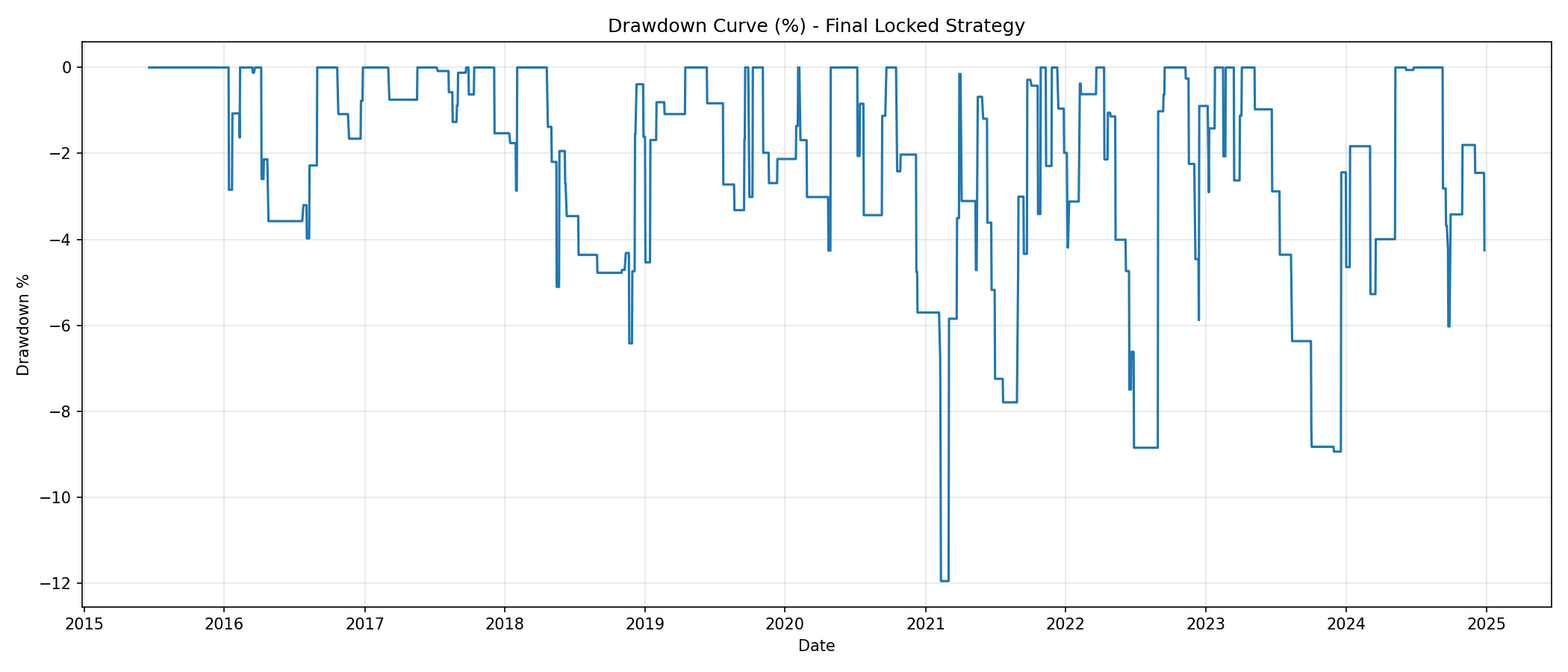
The backtest results, covering the period from 2015 to 2024, demonstrate a net profit of ₹2,02,029 on a nominal starting capital of ₹1,00,000, representing a profit factor of 1.72. The Sharpe ratio of 1.04 and a maximum drawdown of 11.95% suggest a stable, albeit selective, performance profile.
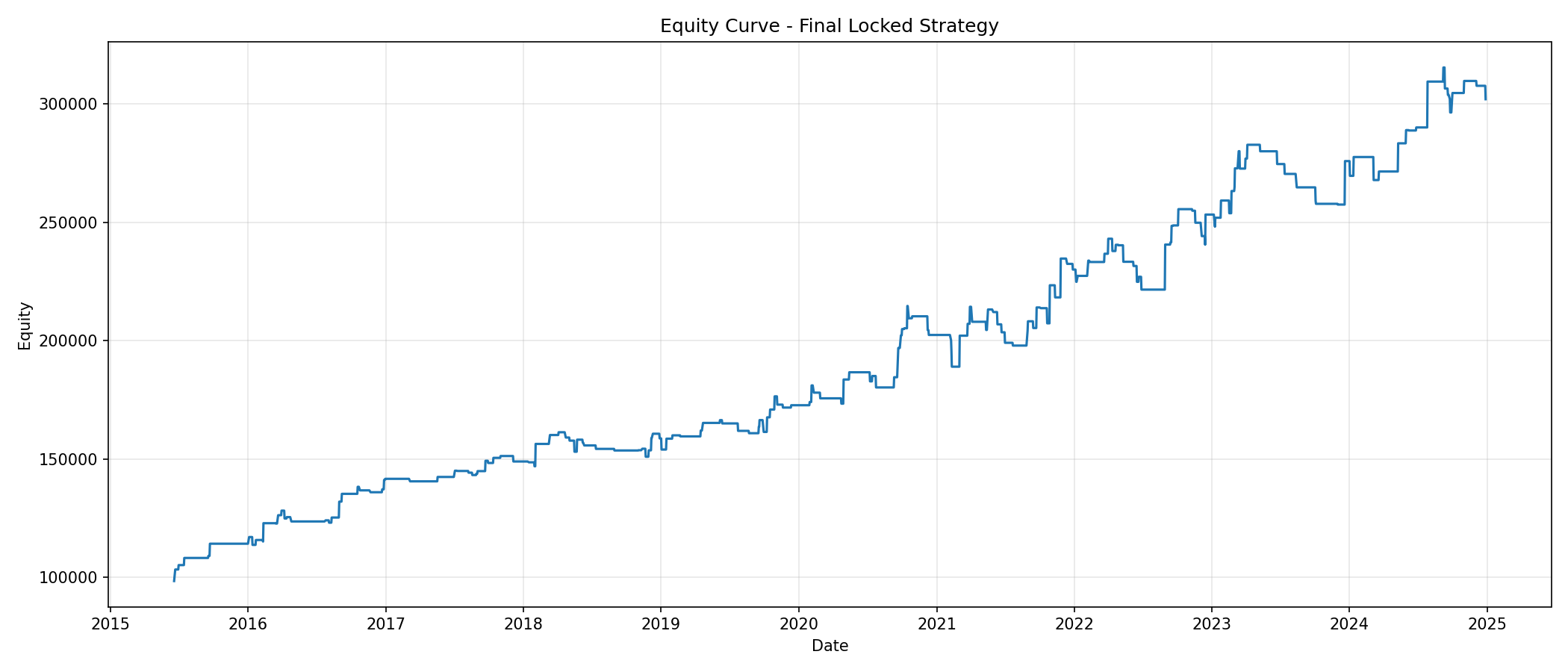
However, the author performs a crucial reality check by re-evaluating these returns against a more realistic capital base. When accounting for the average margin requirements (approx. ₹1.58 lakh) and the peak capital needed to sustain the strategy (approx. ₹3.19 lakh), the Compound Annual Growth Rate (CAGR) adjusts from 12.30% down to approximately 5.3%. This exercise serves as a cautionary tale for the quantitative finance community: headline numbers in backtests can be misleading if they fail to incorporate the actual capital required to maintain positions throughout periods of volatility.
Exit Decomposition: A Surprising Insight
The study provides a fascinating breakdown of how profit is actually generated. The data reveals that the vast majority of net profit—specifically, the gains resulting from the end-of-day square-off—outperformed the sophisticated trailing stop mechanisms.
The WMA-based trailing exit, while theoretically sound as a risk-mitigation tool, resulted in a net loss over the test period. Similarly, the 3R (1.5%) profit target was hit only four times. This indicates that the strategy’s edge is heavily derived from its ability to capture intraday momentum and hold it until the final session close. This insight has profound implications for future iterations: it suggests that the exit logic may be "too tight," potentially cutting off profitable trends prematurely.
Implications and Future Directions
The research concludes that while the strategy is robust, it is not a "plug-and-play" system. The findings suggest that before moving to a live environment, the strategy would benefit from:
- Optimization of Exit Logic: Redesigning the trailing exit to allow for more flexibility during strong trend days.
- Machine Learning Integration: Exploring the potential for Deep Reinforcement Learning (DRL) to adaptively manage the exit, potentially replacing static rules with dynamic, data-driven decision-making.
- Cross-Validation: Testing the strategy across other liquid instruments or different market regimes to ensure the performance is not specific to the NIFTY’s unique volatility profile over the last nine years.
A Professional Perspective
The project stands as a testament to the shift in quantitative trading education. Modern algorithmic trading is no longer about finding the "perfect" indicator; it is about rigorous cost accounting, realistic capital management, and the honest appraisal of performance.
Siddhant Panda’s work effectively bridges the gap between academic theory and practical execution. By openly discussing the limitations of his backtest—such as the exclusion of impact cost beyond standard slippage and the specific reliance on TrueData historical inputs—he provides a template for how junior and senior quantitative traders should approach strategy development.
The broader implication for the Indian financial markets is clear: as retail and institutional participation in NIFTY Futures continues to grow, the ability to automate disciplined, multi-filter strategies will become increasingly competitive. This study proves that while the market is efficient, there remain pockets of opportunity for those who can navigate the noise through disciplined, cost-conscious, and systematic rule-following.
As the financial industry continues to integrate AI and automated decision-making into its core operations, the methodology employed here—combining traditional technical analysis with modern risk-management frameworks—remains a cornerstone of sustainable quantitative growth. For those looking to enter the field, the project underscores that the path to profitability is rarely a straight line, but rather a consistent, disciplined process of refinement and risk mitigation.