Quant-tech platform Build Alpha has officially rolled out its November 2026 software update, introducing integrations for AI-driven automation via the Model Context Protocol (MCP) alongside a specialized Prop Firm Simulator. Developed under the leadership of quantitative strategy veteran David Bergstrom, the latest release addresses major operational bottlenecks for proprietary trading participants by merging advanced algorithmic research frameworks with automated agent controls and evaluation-specific metrics.
The platform update arrives amid a broader structural shift in retail and professional algorithmic trading, where quantitative developers increasingly rely on artificial intelligence not merely as a passive assistant, but as an active operator capable of executing multi-step research routines. By deploying an open standard interface, Build Alpha aims to bridge the gap between heavy computational modeling and seamless natural language orchestration.
Integration of Model Context Protocol (MCP) for Autonomous Workflows
The headline feature of the November 2026 release is the inclusion of a local Build Alpha Model Context Protocol server. MCP, an open standard designed by AI developers to securely connect applications to external databases and software tools, enables traders to link desktop clients such as Claude Desktop, Claude Code, or Codex directly to the Build Alpha software architecture.
Unlike previous iterations—such as version 3.1’s LLM Orchestrator, where Build Alpha retained primary control and intermittently queried an AI model to tune parameters between cycles—the MCP integration reverses the hierarchy. In this configuration, the AI agent assumes command, leveraging Build Alpha as an underlying high-performance quantitative research engine.
Traders can interact with the system via two distinct operational methodologies: guided GUI prompting or fully headless execution. Through user interface prompting, developers can articulate strategy parameters in plain English, allowing the software to automatically populate complex configuration fields. For instance, a user can query the agent regarding specific indicator locations, data ranges, or optimization steps without manually navigating nested menus. Alternatively, headless execution allows background agents to configure, run, filter, and export trading strategies completely isolated from a graphical interface, freeing up human oversight for higher-level portfolio allocation.
Through the MCP framework, connected AI agents gain access to nearly every native feature of the Build Alpha ecosystem. This includes end-to-end genetic search configuration, custom signal construction, database management for alternative data streams, automated filters, sequential testing workflows, and native code exportation. When paired with Build Alpha’s multi-layered robustness gates—including out-of-sample testing, random stream comparisons, noise testing, and Monte Carlo permutations—agents can autonomously cycle through thousands of candidate strategies, discarding fragile systems and surfacing only those that pass stringent statistical validation metrics.
Addressing Prop Firm Realities with the Prop Firm Simulator
Alongside AI integration, the November 2026 update introduces a Prop Firm Simulator designed to tackle a fundamental disconnect in modern retail trading: the divergence between strategy pass rates and actual capital payouts. With thousands of algorithmic traders participating in funded-account evaluations offered by proprietary trading firms, traditional backtesting has often proven inadequate due to its failure to account for complex evaluation rules, drawdown limits, and payout caps.
The newly deployed simulator addresses this by ingesting historical tick and bar data and replaying candidate portfolios—bar by bar—through the explicit challenge and funded-account guidelines of various prop firms. Rather than prioritizing strategies with the highest evaluation pass probability, the simulator ranks portfolios based on Expected Net per Attempt. This proprietary metric calculates the true financial value of a single challenge purchase after factoring in subscription fees, activation costs, and specific payout distribution schedules.
According to internal platform benchmarks, a strategy demonstrating a high evaluation pass rate (such as 59%) may yield lower net cash flow than a portfolio with a lower pass rate (such as 35%), because the latter consistently reaches profit targets earlier and satisfies payout criteria more efficiently. The simulator’s algorithmic engine tracks these nuances, providing metrics on challenge success probabilities, initial payout likelihoods, and overall prop return on investment (Prop ROI).
Built-In Prop Challenge Database and Find Challenges Utility
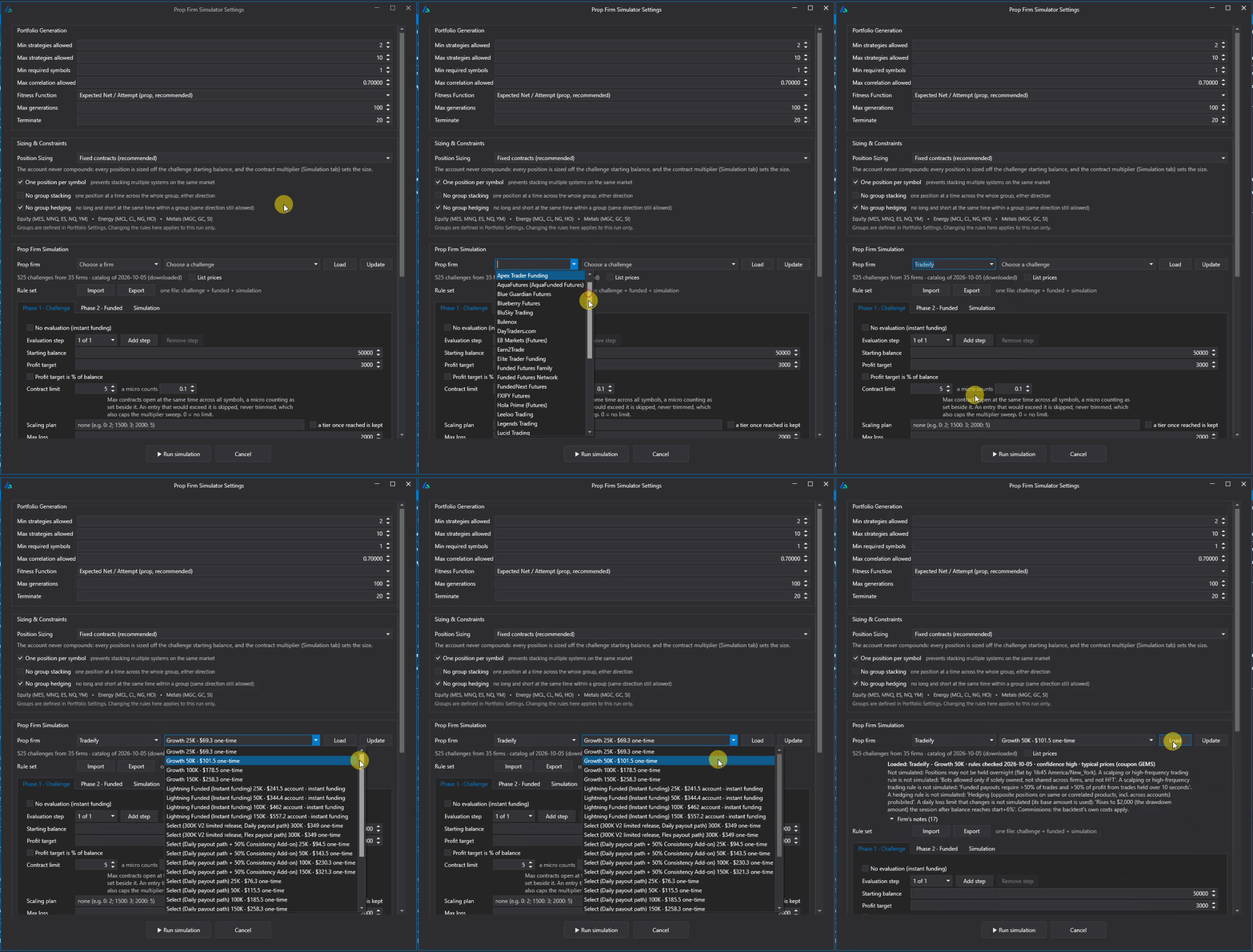
To streamline the evaluation process, Build Alpha has integrated a dynamic database containing over 800 active futures prop firm challenges across 42 distinct institutions. Maintained and updated via automated web-scanning agents, the repository eliminates the need for manual rule entry. Traders select a specific prop firm and challenge tier from the dropdown menu, load the parameters instantly, and run their quantitative portfolios against the firm’s specific drawdown mechanics.
Complementing this database is the Find Challenges utility. Located within the Prop Firm Simulator results interface, this tool allows a trader to input a specific portfolio and automatically test its performance against every challenge listed in the global database. The resulting output is a sortable matrix ranking each challenge by Expected Net per Attempt.
Furthermore, the system isolates non-modelable institutional rules—such as overnight holding restrictions, news trading blackouts, and automation limitations—into dedicated columns. This allows developers to audit regulatory and structural constraints before committing financial capital to a specific evaluation program.
Direct MetaTrader 5 Data Integration and Code Export Refinements
Data acquisition workflows have also been streamlined via a new native MetaTrader 5 (MT5) data downloader. Accessible through the platform settings menu, the tool allows users to establish a one-click connector to their local MT5 broker environment without manual script copying or file migrations.
Traders can query historical price action by symbol, timezone, and timeframe, while simultaneously downloading essential contract specifications including tick size, point value, margin requirements, and swap rates. For advanced research applications, the module supports the extraction of tick data and slippage metrics to improve the fidelity of internal backtesting simulations.
In tandem with data enhancements, the update implements critical bug fixes for live code exportation across multiple brokerage architectures:
- Interactive Brokers (IBKR): Python code generation has been optimized to ensure strict alignment between backtested signals and live execution libraries, resolving prior timezone indexing discrepancies.
- MetaTrader 5 / Darwinex: Generated Expert Advisor (EA) code has undergone a comprehensive stability pass, ensuring seamless execution across Darwinex and alternative MT5 brokers with synchronized bar timestamps.
- NinjaTrader 8 and MT5 Alternative Data: Calculations involving alternative datasets—such as Commitments of Traders (COT) indices—have been patched to eliminate floating-point rounding errors, ensuring exact parity between platform testing environments and live compiled scripts.
Strategic Implications and Future Outlook
The convergence of AI agent control and prop-firm-specific portfolio optimization marks a notable evolution in algorithmic trading software design. By shifting the focus from mere curve-fitting and raw net profit to capital efficiency and payout probability, Build Alpha reflects the changing priorities of modern quantitative developers operating within structured institutional and retail prop environments.
Looking ahead, platform leadership has confirmed that the next developmental phase will introduce a native live execution layer directly into the Build Alpha architecture. This upcoming feature is slated to incorporate streaming profit and loss monitoring, real-time position tracking, and direct brokerage execution pathways, further narrowing the operational gap between initial strategy generation and live market deployment.
The November 2026 update is currently rolling out to existing licensed users. Prospective clients can access platform demonstrations and licensing details directly through the official Build Alpha portal.