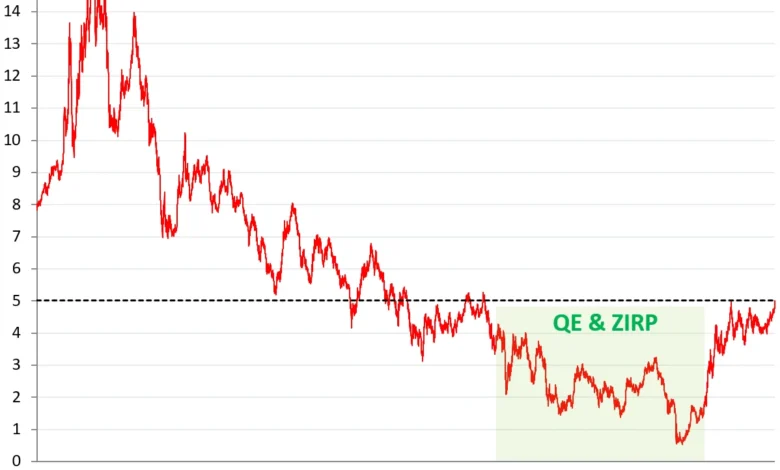
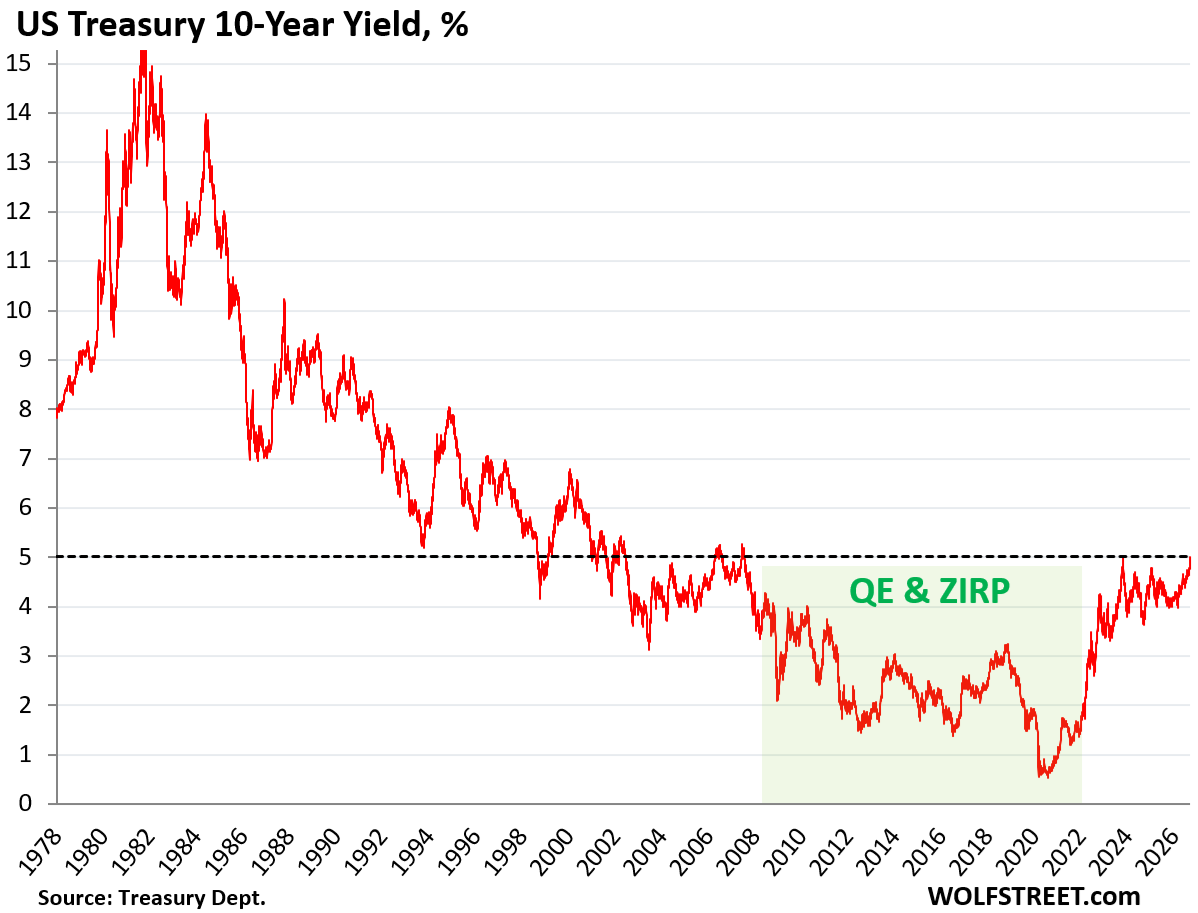
But 5% was considered normal to low in the decades before the Fed’s financial repression kicked off in 2008.

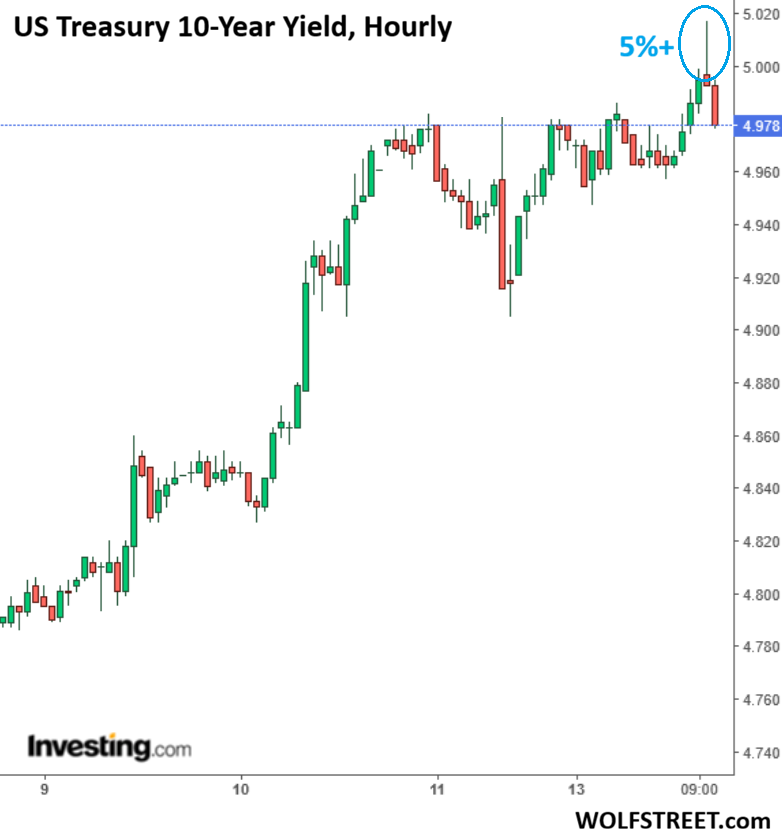
The 10-year Treasury yield, often referred to as the "risk-free" benchmark for global financial markets, briefly touched the 5.01% threshold during early morning trading sessions. This latest movement marks a critical psychological and technical inflection point, representing the highest yield levels observed since 2007. While the figure retreated by several basis points shortly after reaching this peak, the market remains on high alert, assessing whether the threshold signals a permanent shift in interest rate environments or merely a transitory spike in volatility.
The Historical Context of the 5% Threshold
To understand the current market anxiety surrounding a 5% yield, one must consider the era of "financial repression" that followed the 2008 Global Financial Crisis. For over a decade, the Federal Reserve engaged in massive quantitative easing (QE), purchasing trillions of dollars in Treasury securities and mortgage-backed securities (MBS) using newly minted currency. This aggressive intervention suppressed yields, distorting the natural price discovery mechanism of the bond market.
For an entire generation of investors, "low-for-longer" became the baseline assumption. Consequently, a 5% yield—which would have been viewed as a baseline or even attractive return in the 1990s and early 2000s—is now perceived as an anomaly, or even a systemic stressor. However, historical data suggests that from a multi-decade perspective, 5% is well within the bounds of historical normalcy. During the economic expansion of the 1990s, for example, the U.S. economy frequently sustained 10-year Treasury yields in the 5% to 8% range while simultaneously maintaining robust GDP growth and tight labor market conditions.
A Chronology of Recent Yield Volatility
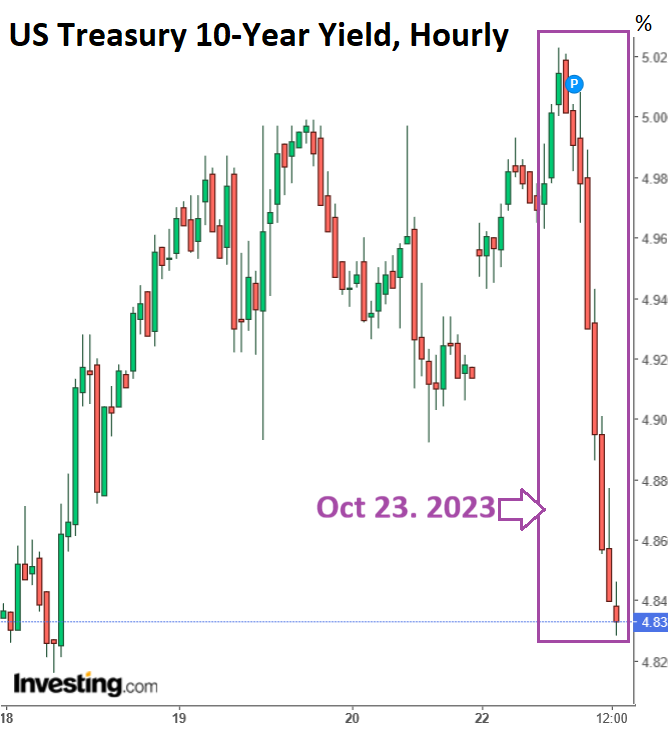
The current market environment draws direct comparisons to the volatility observed in the fourth quarter of 2023. On October 23, 2023, the 10-year yield pierced the 5.02% mark following a relentless six-month surge that saw yields rise by approximately 170 basis points. That specific event served as a stress test for global liquidity.
Upon hitting the 5.02% level in late 2023, the market reaction was nearly instantaneous. A surge of buying interest materialized, effectively acting as a "floodgate" of demand. Sellers pulled back, and the yield environment shifted rapidly, plunging 19 basis points within a single trading day. By the end of that year, the 10-year yield had plummeted to 3.79%, a move of over 120 basis points that underscored the sensitivity of institutional portfolios to rates exceeding the 5% barrier.
Current observers are now parsing the charts to determine if history will repeat itself. The key question facing bond traders is whether the present 5% level will trigger a similar influx of institutional capital, or if structural shifts in fiscal policy—namely the increased issuance of debt by the Treasury—will force yields to find a higher equilibrium.
Supporting Data and Market Mechanics
The volatility in Treasury yields is intrinsically linked to the broader macroeconomic landscape, characterized by persistent inflationary pressures and a shifting Federal Reserve monetary policy stance. Unlike the previous decade, where the Fed served as the "buyer of last resort," the current environment features Quantitative Tightening (QT). The central bank is now allowing its balance sheet to shrink, effectively reducing the amount of liquidity available to absorb new Treasury issuance.
Several factors currently influence the yield curve:
- Fiscal Deficits: The U.S. federal government’s elevated deficit spending necessitates consistent issuance of long-term debt, increasing the supply of Treasurys that must be absorbed by the private sector.
- Term Premium: After years of suppressed volatility, investors are increasingly demanding a higher "term premium"—the extra compensation for the risk of holding long-term debt in an uncertain inflationary environment.
- Global Capital Flows: International demand for U.S. Treasurys, historically a stabilizer for yields, is being recalibrated as central banks globally manage their own currency fluctuations and domestic inflation mandates.
Institutional Implications
The rise to 5% has significant implications for both private and public sectors. For the mortgage market, which is closely tied to the 10-year Treasury, sustained yields at or above 5% translate into significantly higher borrowing costs for consumers. This effectively cools the housing market, as the affordability gap widens for potential homeowners.
Furthermore, for corporate balance sheets, the end of the era of "cheap money" necessitates a fundamental shift in capital allocation. Companies that relied on low-interest debt to fuel stock buybacks and expansion are now facing higher debt service costs. This transition is not merely a financial adjustment; it is a structural change in how businesses value projects and manage leverage.
Publicly, market analysts and government officials remain cautious. While the Treasury Department has historically maintained that the U.S. can comfortably service its debt even at higher interest rates, the sheer volume of debt maturing in the near term creates a "refinancing wall." If yields remain elevated for an extended period, the interest expense on the national debt will consume an increasing portion of the federal budget, potentially crowding out other fiscal priorities.
The Outlook for the Bond Market
As market participants watch the hourly fluctuations in the 10-year Treasury, the focus has shifted from simple price action to the sustainability of demand. The immediate reaction to the 5% level suggests a market that is fundamentally undecided. There are pockets of investors eager to lock in 5% yields, viewing them as a rare opportunity to secure a risk-free return that exceeds inflation expectations. Conversely, there is a contingent of institutional sellers who believe that the long-term trend for yields remains upward, driven by structural inflation and the government’s borrowing requirements.
The "spectacle" of the 5% yield is a reminder that markets are still transitioning away from the artificial constraints of the post-2008 era. Whether this current test of 5% results in a sharp reversal—as it did in late 2023—or a sustained plateau depends on the interplay between incoming economic data (such as CPI reports and payroll figures) and the willingness of the market to accept a new baseline for "normal" interest rates.
Ultimately, the 10-year Treasury yield is the pulse of the financial system. For nearly 15 years, that pulse was kept artificially steady by central bank policy. Now, as the market moves back toward historical norms, the volatility is not just an indicator of uncertainty; it is a sign of a market attempting to find its true footing in a world where capital no longer comes for free. Investors, policymakers, and corporate leaders alike will continue to monitor the 5% threshold as the primary indicator of the health and stability of the broader financial architecture.