The Transformation of Tabular Data Science How Foundation Models Are Challenging the Dominance of Gradient Boosted Trees

A fundamental shift is occurring in the field of machine learning as a new class of pretrained transformers, known as tabular foundation models, begins to outperform traditional gradient-boosted decision trees (GBDTs) on major industry benchmarks. For over a decade, models such as XGBoost, LightGBM, and CatBoost have been the undisputed champions of tabular data—the structured information found in spreadsheets and databases that powers everything from credit scoring to inventory management. However, recent data from the TabArena community benchmark indicates that every single-model entry currently outperforming the best-tuned gradient-boosted tree belongs to this new family of "tabular LLMs." These models, which include architectures like TabICLv2, TabPFN, and Google Research’s TabFM, predict missing columns or labels zero-shot, completing tables in much the same way a large language model completes a sentence.
The Evolution of Tabular Modeling: From Trees to Transformers
The dominance of GBDTs began in the mid-2010s, following the release of XGBoost, which offered a potent combination of speed and accuracy for structured data. Unlike deep learning models, which struggled to find patterns in the heterogeneous and often "noisy" columns of a spreadsheet, GBDTs utilized an ensemble of decision trees to capture non-linear relationships. For years, the standard workflow for a data scientist involved rigorous feature engineering, hyperparameter tuning, and cross-validation to squeeze performance out of these tree-based structures.

The timeline of the current disruption began in 2022 with the introduction of TabPFN (Tabular Prior-Data Fitted Network). Developed by researchers at Prior Labs and the University of Freiburg, TabPFN demonstrated that a transformer could be pretrained on synthetic data to perform "in-context learning" on small tables. This was followed by a flurry of activity: Inria’s SODA team released TabICL and its successor, TabICLv2; Layer 6 developed TabDPT; and most recently, in June 2026, Google Research unveiled TabFM. Unlike the traditional GBDT workflow, where a model must be "trained" on a specific dataset through gradient descent, these foundation models treat the training data as a "context" prompt. They are not trained on the user’s data; they simply read it and predict the outcome in a single forward pass.
Technical Architecture of Tabular Foundation Models
To understand why these models are gaining ground, it is necessary to examine the architecture of a representative model like TabICLv2. While often referred to as "tabular LLMs," these models do not actually process language. Instead, they are designed to handle the unique geometry of a table, where row order is irrelevant but column identity is paramount.
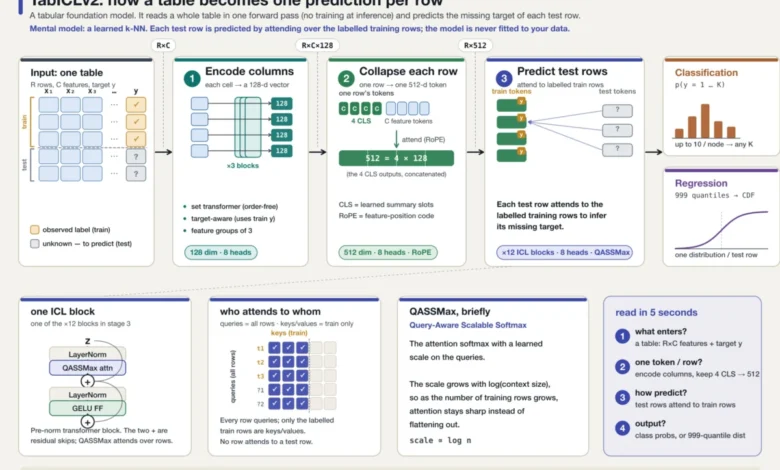
TabICLv2 utilizes a three-stage transformer architecture. The first stage consists of a "set transformer" that reads down each column. This stage is crucial because it allows the model to understand the distribution of a feature—distinguishing, for instance, between the number "450" when it represents a postal code versus when it represents a currency value. By learning the context of a column, the model creates embeddings that reflect where a specific value sits within its own feature set.

The second stage reads across each row, collapsing multiple feature embeddings into a single fixed-length vector. This is achieved through learned query tokens (CLS tokens) that attend to the various parts of a row, effectively summarizing the example into a representative mathematical representation.
The final stage is where the "in-context learning" occurs. The unlabelled test rows attend to the labelled training rows provided in the prompt. Much like a learned k-nearest-neighbor algorithm, the model identifies training examples similar to the test row and reads off a weighted answer. This process eliminates the need for hyperparameter searching or iterative training cycles, reducing what was once a multi-hour "fitting" process to a few seconds of inference.
Independent Verification and Performance Data
The claims surrounding these models have recently been subjected to rigorous independent auditing. In a recent sweep of the TabArena benchmark—a curated collection of 51 datasets ranging from 748 to 150,000 rows—TabICLv2 was tested on independent hardware to verify its Elo rating of 1575. The audit, conducted on an AWS A10G GPU, confirmed that the model’s performance was consistent with official leaderboard standings, landing within the bootstrap intervals at an Elo of 1559.

The data reveals a stark performance gap. On the TabArena board, LightGBM—with full tuning and post-hoc ensembling—reaches an Elo of 1432. In contrast, TabICLv2, which requires no tuning, sits 158 Elo points higher. The most advanced model on the board, Google’s TabFM, currently holds the top spot with an Elo nearly 100 points higher than the best non-foundation model pipelines.
Beyond accuracy, the "serving cost" or efficiency of these models presents a nuanced picture. While foundation models require GPU acceleration, their median "fit" time is approximately 100 times shorter than that of a tuned GBDT protocol. For a table of 1,000 rows, TabICLv2 can predict results in 0.38 seconds, which is significantly faster than a tuned-and-ensembled LightGBM (2.64 seconds). However, for organizations lacking GPU infrastructure, CatBoost remains the most cost-effective baseline, capable of serving 1,000 rows in just 0.08 seconds on a standard CPU.
The "Tree Regime": Where GBDTs Still Hold the Line
Despite the surge of foundation models, the audit identified specific "regimes" where traditional gradient-boosted trees remain superior. The performance of tabular foundation models appears to degrade under two specific conditions: high dimensionality and extreme categorical cardinality.

- High Dimensionality: Of the datasets in the benchmark with more than 100 features, foundation models won only a single instance. For massive feature sets, such as the Bioresponse dataset with 1,776 features, the trees remained dominant. The current transformer architectures appear to struggle with the "attention span" required for extremely wide tables.
- Scale and Categorical Complexity: In datasets like Amazon_employee_access, which features high-cardinality categorical variables, GBDTs outperformed foundation models by a significant margin. Furthermore, while the foundation models dominated small-to-medium datasets, their win rate against tuned trees dropped from 89% for tables under 3,000 rows to 64% for tables exceeding 20,000 rows.
Data Provenance and the Contamination Debate
A critical area of concern for the research community involves "benchmark contamination." Because foundation models are pretrained on vast amounts of data, there is a risk that they may have "seen" the test datasets during their training phase, leading to inflated accuracy scores.
To mitigate this, models like TabICLv2 and the original TabPFN are pretrained exclusively on synthetic data generated from random structural causal models (SCMs). These models have never seen a "real" table during pretraining, making them the most evidence-pure options available. However, newer models like RealTabPFN-2.5 and TabDPT have begun incorporating real-world data from OpenML and Kaggle to boost accuracy. While these teams employ sophisticated deduplication pipelines to prevent overlap with benchmarks, the reliance on real-world pretraining data introduces an "epistemic risk" that researchers are still grappling with.
Broader Impact and Future Implications
The rise of tabular foundation models suggests a looming change in the data science lifecycle. The traditional bottleneck of hyperparameter tuning and feature engineering may soon be replaced by "context engineering" and model routing. Analysis of "hybrid headroom" suggests that the most effective future systems will not rely on a single model, but rather a "router" that chooses between a foundation model and a GBDT based on the characteristics of the dataset.

Current experiments show that an "oracle router"—a theoretical system that always picks the best model—could reach an Elo of 1707, far exceeding any current single-model performance. While a deployable version of such a router is still in development, the complementarity between transformers and trees is clear. Transformers excel at finding deep patterns in small-to-medium, feature-light datasets, while trees remain the workhorses for massive, high-dimensional industrial data.
As these models continue to scale and their architectures are refined to handle wider tables, the default "starting point" for data science projects is likely to shift. For many practitioners, the first step will no longer be "fitting an XGBoost model," but rather "querying a tabular foundation model." The era of zero-shot data science has arrived, and while the decision tree is not yet obsolete, it no longer stands alone at the top of the mountain.