Do Whale Alerts Actually Predict Bitcoin Price Movements or Are They Just Market Noise


The persistent fascination with cryptocurrency whale activity has long been a staple of digital asset trading lore. Every time a massive wallet shifts several thousand Bitcoin onto a centralized exchange, social media platforms and trading terminals erupt with "whale alert" notifications. To many retail traders, these movements represent "smart money" positioning, often interpreted as a precursor to significant market shifts. However, a rigorous quantitative study conducted by Hui Min Neo, a researcher in the Executive Programme in Algorithmic Trading (EPAT), has challenged this prevailing wisdom, suggesting that the predictive power of whale data may be significantly overstated.
By employing a stringent, pre-registered machine learning framework, Neo’s research—titled "Not Confirmed"—sought to isolate whether on-chain network activity and derivatives positioning data could offer a genuine edge over standard price-action models. The findings, which spanned nearly six years of market data, concluded that whale-centric indicators fail to provide consistent, profitable signals when accounting for realistic transaction costs and robust statistical testing.
The Anatomy of the Whale Hypothesis
The core premise driving Neo’s study was the inherent transparency of public blockchains. Unlike traditional equity markets, where large institutional orders are often obscured within dark pools or fragmented through various execution venues, blockchain transactions are visible to anyone with a node or a block explorer. Proponents of the "whale alert" strategy argue that if these movements indicate informed accumulation or distribution, they should logically precede price movements.
To test this, Neo constructed a series of predictive models designed to forecast the next-day direction of the BTC/USDT pair. The research tested three primary hypotheses: whether whale-activity features carry independent predictive information; whether combining these with price data outperforms a price-only baseline; and whether the effectiveness of such signals is dependent on the broader market regime.
Chronology and Research Methodology
The research spanned a total of 1,747 trading days, covering the period from November 15, 2020, to May 7, 2026. The study was structured into three distinct phases to ensure the integrity of the data and to prevent the common pitfall of data leakage.
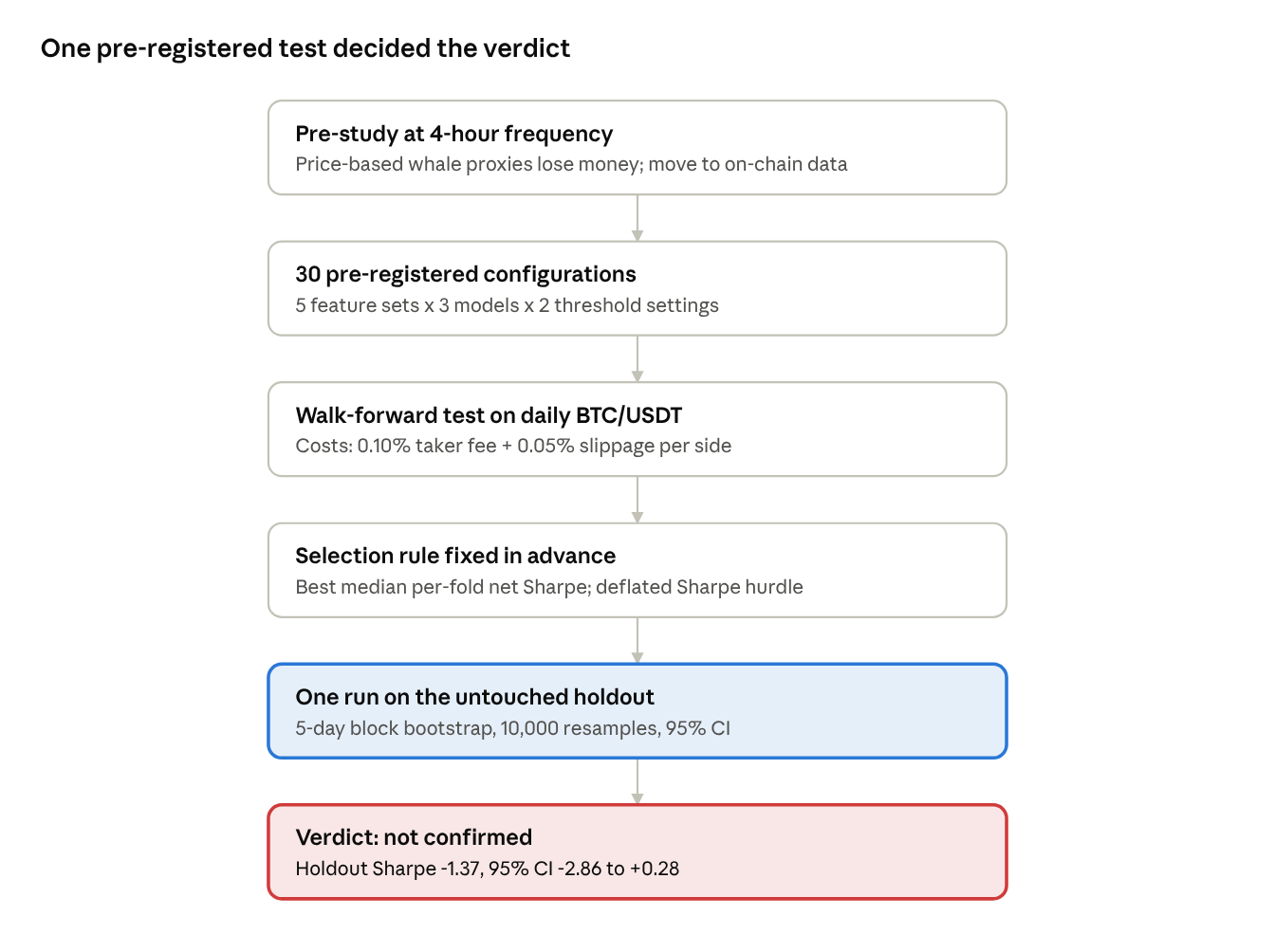
The development phase, which included training and validation, encompassed 1,550 days. This provided the foundation for model fitting. Crucially, Neo implemented a pre-registration protocol—a best practice in scientific research—whereby the selection rules, model configurations, and success criteria were locked in before the researchers examined the final holdout data. This step was essential to mitigate "p-hacking" or the risk of finding a false positive through extensive data mining.
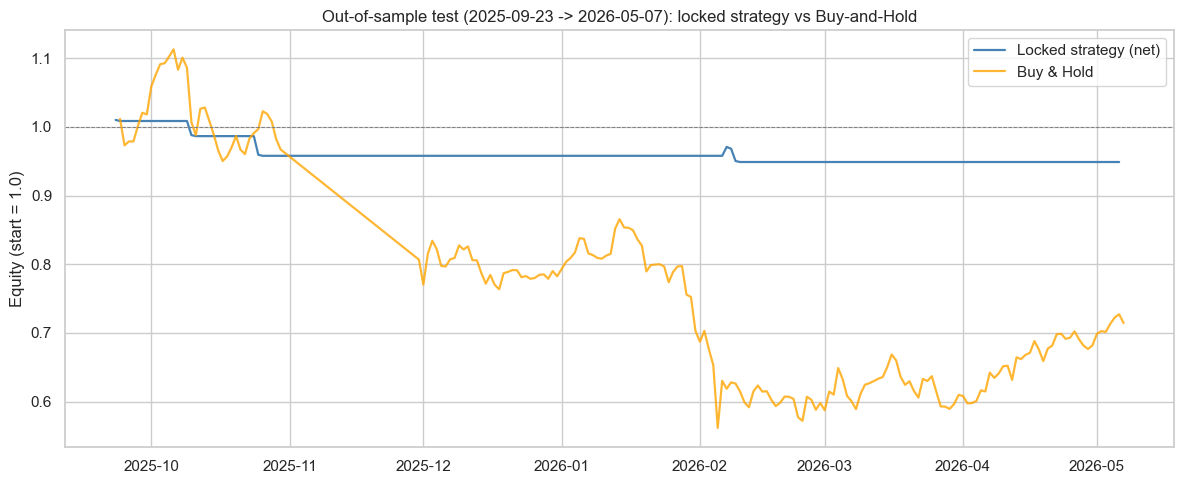
Following the development phase, the model was tested on a 197-day holdout period (September 23, 2025, to May 7, 2026). The results were evaluated using a block bootstrap confidence interval, a statistical technique that respects the temporal dependencies of financial time series data.
Data Inputs and Feature Engineering
The study incorporated a sophisticated blend of three distinct data streams to ensure a comprehensive evaluation of market dynamics:
- Market Data: Utilizing the CCXT Python library, the researchers pulled BTC/USDT OHLCV (Open, High, Low, Close, Volume) data from Binance. This served as the baseline to determine if whale activity provided information that was not already "priced in" by market participants.
- On-Chain Network Activity: Sourced from Blockchain.com’s API, these metrics included transaction volume in both BTC and USD, transaction counts, fee spikes, and mempool sizes. These variables were intended to quantify the physical movement of the underlying asset.
- Derivatives Positioning: Leveraging data from CoinGlass, the study examined the "whale index," funding rates, open interest, liquidation data, and the taker buy/sell imbalance. This data set aimed to capture the sentiment and positioning of large traders in the futures market.
To avoid look-ahead bias, Neo ensured that all features were backward-looking. For instance, on-chain features were compared against their own recent histories, such as rolling Z-scores or momentum indicators, ensuring that the model only accessed information that would have been available to a trader at the time of the prediction.
Performance Results and Statistical Hurdles
The findings were stark. Out of 30 distinct model configurations tested—using logistic regression, random forest, and XGBoost—none yielded a positive net Sharpe ratio after accounting for a 0.15% per-side transaction cost.
In the final holdout test, the "winning" strategy, identified during the development phase, returned a Sharpe ratio of -1.37. While the strategy technically lost less than a simple "buy-and-hold" approach, this was primarily due to the strategy’s low exposure to the market. The algorithm remained in a flat position for the vast majority of the test period, essentially avoiding a market downturn rather than actively predicting a price recovery.
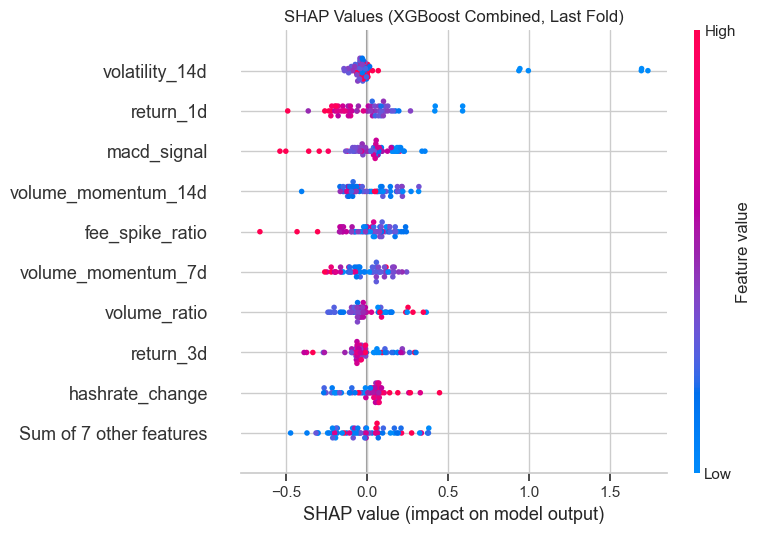
"The directional signal just wasn’t there," noted the study’s concluding analysis. The models’ ability to call market direction was statistically indistinguishable from a coin flip, with an out-of-sample ROC-AUC ranging between 0.49 and 0.53. Furthermore, the winning configuration failed to clear the "deflated Sharpe ratio" hurdle—a calculation that adjusts for the number of attempts made, effectively penalizing the model for the number of configurations tested during the search for a profitable setup.
The Role of Transaction Costs and Market Noise
A significant takeaway from the research is the impact of transaction costs on high-frequency and even daily-frequency signals. For the XGBoost model specifically, any potential edge identified in the on-chain features evaporated once costs exceeded a mere 0.02% per trade. In the real world, where Binance spot fees and slippage combine to create a much higher hurdle, such signals become economically unviable.
The study also highlighted the danger of "curve fitting," where models are trained to find patterns in noise. By implementing a rigorous walk-forward testing framework, Neo was able to demonstrate that earlier, more "promising" results were likely artifacts of over-optimization. As the researchers stripped away look-ahead biases and applied realistic costs, the perceived profitability of the whale-based strategy systematically faded to zero.
Implications for Quantitative Trading
The "Not Confirmed" result serves as a sobering reminder for those developing systematic trading strategies. The findings do not necessarily prove that whale data is universally useless; rather, they demonstrate that at a next-day horizon, this specific type of data does not provide a reliable, tradeable edge under rigorous scrutiny.

For the quantitative finance community, the project highlights the importance of the research design itself. The use of pre-registration, block bootstrapping, and the deflated Sharpe ratio provides a blueprint for traders to validate their hypotheses before deploying actual capital. By adopting these standards, traders can protect themselves against the "illusion of skill" that often arises when strategies are evaluated against the same data used to create them.
Limitations and Future Research
While the study is comprehensive, it is not exhaustive. The researchers identified several limitations that future studies might address. The 197-day test window, for instance, was characterized by a predominantly bearish market. It remains possible that whale behavior could exhibit different predictive characteristics in a bull market or during periods of extreme volatility.
Furthermore, the study relied on general network-level metrics from Blockchain.com. These metrics represent the activity of the entire network rather than specific, tagged "whale" wallets. Future research could explore whether more granular data—such as monitoring known exchange-labeled wallets or institutional custody addresses—might yield a different result. Additionally, the study was confined to a next-day horizon. It is conceivable that whale movements might lead price action over longer timeframes, such as weekly or monthly horizons, which were not the focus of this specific project.
Conclusion
Hui Min Neo’s research provides a valuable service to the crypto trading community by effectively "stress testing" a popular narrative. The conclusion that whale alerts are more likely to be market noise than a predictive signal should prompt traders to be more cautious about the sources of their information. In the pursuit of alpha, the most effective strategy may not be to chase the latest social media trend or whale alert, but to focus on the development of robust, cost-aware, and statistically sound research methodologies. As the industry matures, the ability to discern between meaningful data and incidental noise will continue to separate successful quantitative strategies from those that merely mirror the randomness of the market.