For more than a decade following the devastation of the 2008 global financial crisis, global financial markets were dominated by a single, inescapable market philosophy known by the acronym TINA: "There Is No Alternative." Coined to describe a monetary landscape shaped by aggressive central bank intervention, TINA dictated that equities were the only viable asset class for investors seeking meaningful returns. With the United States Federal Reserve, the European Central Bank, and other major monetary authorities slashing benchmark interest rates to zero—and, in some international jurisdictions, forcing them into negative territory—government and corporate debt instruments offered virtually zero yield.
In this prolonged zero-interest-rate policy (ZIRP) environment, fixed-income assets failed to outpace inflation, pushing institutional and retail capital headlong into riskier equity markets. Reasonably valued equities in the post-crisis recovery phase offered an unambiguous path to capital appreciation. However, as global economic conditions shifted under the weight of post-pandemic inflation and aggressive monetary tightening, the foundational pillars of the TINA paradigm crumbled. Today, analysts and market strategists argue that the investment landscape has transitioned into a new era: TIGA, signifying that "There Is A Good Alternative." With risk-free Treasury yields comfortably sitting above 5% and equity valuations hovering near historical peaks, financial advisors face a vastly different calculus when balancing portfolio risk and reward.

The Evolution of Macroeconomic Policy: From ZIRP to Quantitative Tightening
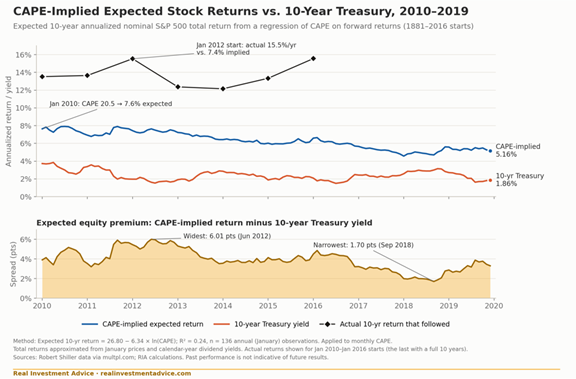
To understand the current market crossroads, one must examine the chronological sequence of monetary policy over the past twenty years. Following the 2008 subprime mortgage collapse, central banks deployed unprecedented measures to stabilize the global banking system. Quantitative easing (QE) flooded the financial system with liquidity, suppressing bond yields across the curve. For roughly ten years, fixed-income investors were starved of yield. A standard 10-year U.S. Treasury note yielded predominantly between 1.5% and 2.5%, rendering traditional balanced portfolios—such as the classic 60/40 stock-and-bond allocation—mathematically challenged.
During the 2010s, this environment produced one of the most remarkable bull markets in modern financial history. The S&P 500 generated an annualized return of approximately 13.6%, rewarding equity investors who embraced the TINA mindset. Earnings yields on stocks—as measured by forward Price-to-Earnings (P/E) ratios hovering near 13—provided an attractive 8% earnings yield, dwarfing the meager 2% returns offered by sovereign debt.
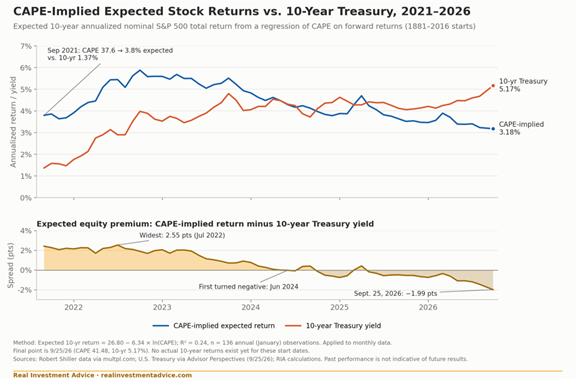
The turning point arrived in 2022. As supply chain disruptions and massive fiscal stimulus ignited generational inflation, the Federal Reserve embarked on one of the most aggressive monetary tightening cycles in its history, raising the federal funds rate from near-zero to a target range of 5.25% to 5.50% by late 2023. This pivot permanently altered the opportunity cost of capital. By September 2026, the landscape had completely inverted. Risk-free 5-year and 10-year Treasury notes offered yields exceeding 5%, while high-grade corporate bonds provided even more attractive income streams.
Valuation Extremes and the Vanishing Equity Risk Premium
The resurgence of fixed-income yields has occurred simultaneously with an historic expansion in equity valuations. Following years of tech-led rallies and resilient corporate earnings, major stock indices sit near record valuation extremes. The Cyclically Adjusted Price-to-Earnings (CAPE) ratio, a widely respected metric popularized by Nobel laureate Robert Shiller that smooths out ten years of earnings inflation, indicates that equities are historically expensive.

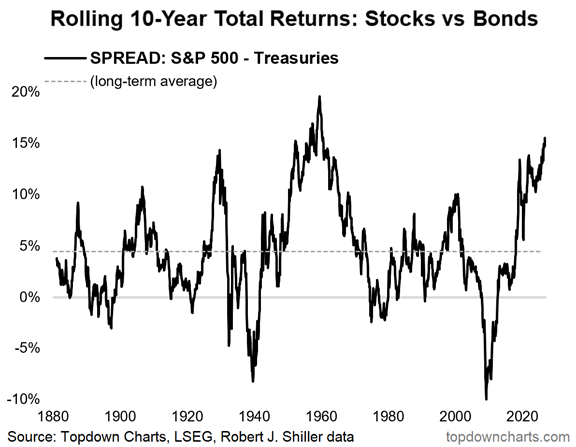
This divergence has severely compressed, and in some cases entirely eliminated, the Equity Risk Premium (ERP)—the excess return that investing in the stock market provides over a risk-free rate, such as government bonds. Historically, investors demanded a substantial risk premium to compensate for the volatility and potential permanent loss of capital inherent in equities. Today, financial models suggest that standard buy-and-hold equity strategies may actually underperform risk-free Treasury bonds over a ten-year horizon.
Market historians frequently draw parallels to previous valuation peaks, most notably the dot-com bubble of the late 1990s. In December 1999, the S&P 500 CAPE ratio surged to an unprecedented 44. Over the ensuing decade, the broad market delivered a negative annualized real return of approximately -0.9%. Conversely, investors locking in 6% yields on 10-year Treasuries in early 2000 preserved their capital and outperformed equity holders with significantly lower volatility. While current valuation metrics may not mirror the extreme excesses of the Y2K tech bubble, the forward-looking return profile for equities remains heavily constrained by high starting prices.
Strategic Implications: Embracing TIGA Without Abandoning Equities
Financial experts emphasize that recognizing the validity of TIGA does not equate to a wholesale liquidation of equity portfolios. Attempting to time market tops and bottoms is notoriously difficult, and equities retain the potential to outperform bonds if corporate earnings growth can decisively outpace elevated borrowing costs and high valuations. However, the margin for error is razor-thin compared to the early 2010s.
Portfolio managers and wealth advisors are increasingly advocating for a recalibration of asset allocation strategies. Rather than aggressively overweighting equities out of habit or fear of missing out, investors are being encouraged to utilize the current high-yield environment to build structural resilience. Key portfolio adjustments recommended by institutional analysts include:
- Rebalancing Fixed-Income Allocations: Utilizing high-yielding short- and intermediate-term Treasuries and investment-grade corporate bonds to lock in guaranteed cash flows.
- Re-evaluating Equity Exposure: Trimming concentrated positions in overvalued growth sectors to reallocate capital into defensive sectors with strong cash generation and reasonable valuations.
- Leveraging Real Yields: Capitalizing on the highest real (inflation-adjusted) yields seen in nearly two decades to generate passive income without taking on unnecessary market risk.
As renowned investor Lyn Alden succinctly noted, diversification often appears inefficient and frustrating during extended bull markets, but it serves as the ultimate source of capital preservation during bear markets and economic contractions.
The Broader Economic Impact and Future Outlook
The transition from TINA to TIGA carries profound implications for retirement planning, institutional pension funds, and individual wealth accumulation. For years, pension funds struggled to meet their assumed actuarial return targets of 7% to 8% in a low-yield world, forcing them into riskier alternative investments, private equity, and speculative real estate. The return of a normalized yield curve relieves some of this pressure, allowing conservative institutional portfolios to meet liability obligations through safe, high-yielding fixed-income instruments.
Furthermore, higher borrowing costs driven by elevated bond yields continue to filter through the broader economy, impacting corporate debt refinancing, commercial real estate, and consumer mortgages. Companies with pristine balance sheets and low leverage are better positioned to navigate this higher-for-longer interest rate paradigm, whereas heavily indebted enterprises face mounting earnings headwinds.
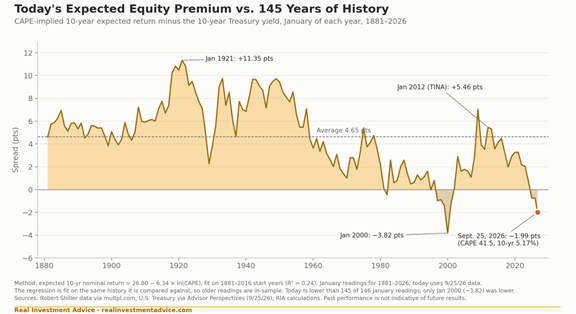
Ultimately, the market environment of late 2026 marks the definitive close of a post-crisis anomaly. The era of artificially suppressed interest rates and compulsory equity risk is over. For the first time in nearly twenty years, investors are being handsomely compensated to diversify, manage risk, and embrace the reality that there is, indeed, a very good alternative.