Has the Bond Market Done the Fed’s Job? A Critical Analysis Ahead of the September 2026 FOMC Meeting

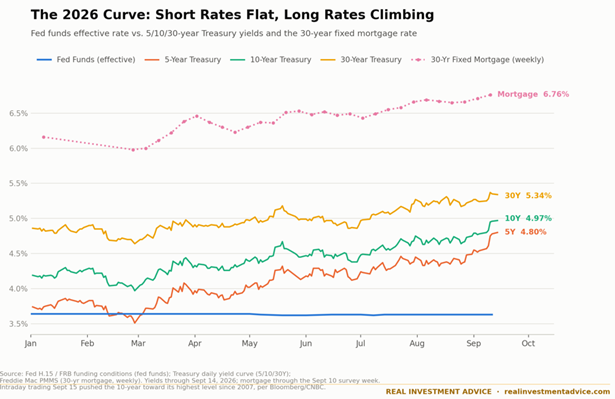
As the Federal Open Market Committee (FOMC) prepares to convene for its crucial September 16, 2026, policy meeting, financial markets find themselves at a fascinating crossroads. For months, the central bank has maintained the federal funds rate at a steady level, even as economic indicators show inflation persisting stubbornly above the Federal Reserve’s stated 2% target. Yet, despite this apparent policy pause from Washington, financial conditions have tightened significantly across the broader economy. This monetary restriction has not been engineered directly by the central bank’s benchmark rate, but rather by the relentless upward march of longer-term bond yields.
With the benchmark 10-year U.S. Treasury yield recently climbing past the psychological 5% threshold, ripple effects have immediately transformed the lending landscape. Mortgage rates, corporate borrowing costs, and equity discount rates have surged in tandem. This curious divergence—where official short-term rates remain unchanged while market-driven long-term rates climb—has ignited a fiery debate among economists, portfolio managers, and policymakers alike. The central question dominating Wall Street trading desks is whether the bond market has effectively done the Federal Reserve’s heavy lifting, rendering further direct policy tightening unnecessary, or if the central bank still has vital work to do.

The Divergent Channels of Monetary Transmission
To understand whether the bond market has stepped into the shoes of the central bank, analysts must first recognize that the short and long ends of the yield curve do not function as interchangeable parts. Both segments ultimately influence Gross Domestic Product (GDP) and inflation, but they do so through distinct economic channels and vastly different timelines.
The short end of the curve—governed strictly by the federal funds rate and short-term Treasury bills—targets immediate household cash flows, consumer revolving credit, and banking liquidity. Conversely, the long end of the curve—encompassing the 5-year, 10-year, and 30-year Treasury yields—exerts profound influence over long-term capital investments, housing markets, corporate financing structures, and the broader valuation of risk assets. Because these transmission mechanisms operate on separate schedules, evaluating the true restrictiveness of current monetary conditions requires a granular examination of how both ends of the curve interact with the real economy.
Long-Term Yields and Their Weight on Economic Activity
The steady climb of the 10-year Treasury yield toward and beyond 5% has systematically cooled several interest-rate-sensitive sectors of the economy. While these adjustments successfully restrain aggregate demand, their full deflationary impact often takes quarters, if not years, to fully materialize in official inflation prints.
The Housing Market Slowdown
The residential housing sector has borne the most immediate and visible brunt of rising long-term yields. Because 30-year fixed mortgage rates historically track the 10-year Treasury yield plus a standard historical spread, the surge in benchmark yields has pushed average mortgage rates dangerously close to the 7% mark.
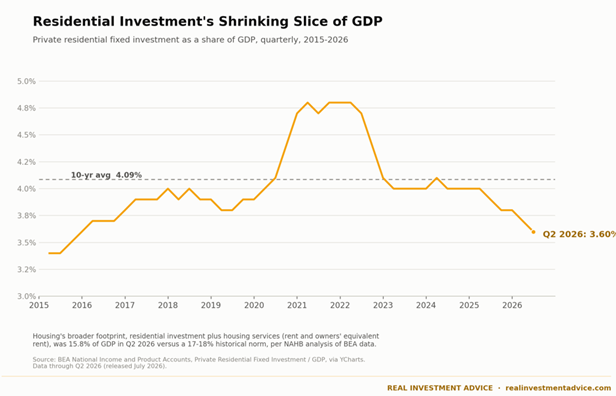
This dramatic escalation in borrowing costs has effectively paralyzed both new and existing home sales, severely depressing buyer affordability and market turnover. Consequently, residential fixed investment as a share of U.S. GDP has tumbled from nearly 5% in late 2021 down to approximately 3.6% today. This contraction underscores how higher long-term yields directly ration credit for one of the most vital engines of American household wealth and consumer spending.
Corporate Financing Pressures and Refinancing Walls
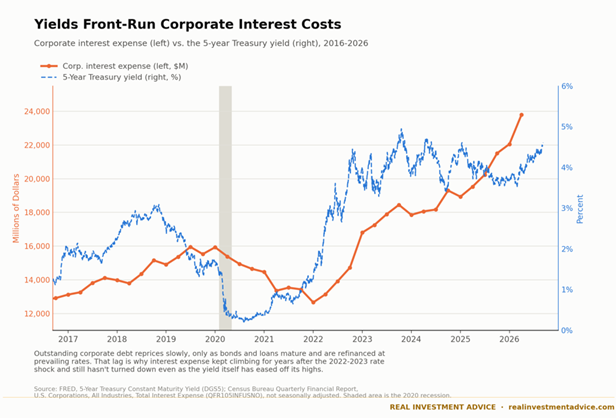
In the corporate sphere, debt issuance is priced directly as a credit spread over comparable Treasury yields. As benchmark yields have scaled new heights, corporate interest expenses have risen correspondingly, while corporate project hurdle rates—the minimum rate of return required to justify new capital expenditures (capex)—have increased.
Higher interest burdens naturally eat into corporate profit margins. To protect profitability, executive management teams frequently resort to cost-cutting measures, including hiring freezes and payroll reductions. Simultaneously, elevated hurdle rates cause firms to postpone or outright cancel long-term strategic investments.
Crucially, the macroeconomic impact of these higher rates may prove far more severe in this cycle than in previous decades. During the historic monetary easing of 2020 and 2021, corporations locked in massive amounts of ultra-low-cost debt. A substantial portion of this cheap debt is scheduled to mature over the next 24 months. Refinancing these maturing obligations at current market rates will permanently elevate corporate interest expenses, acting as a persistent structural headwind to earnings and economic expansion even if benchmark Treasury yields stabilize or decline.
Auto Loans and Consumer Affordability
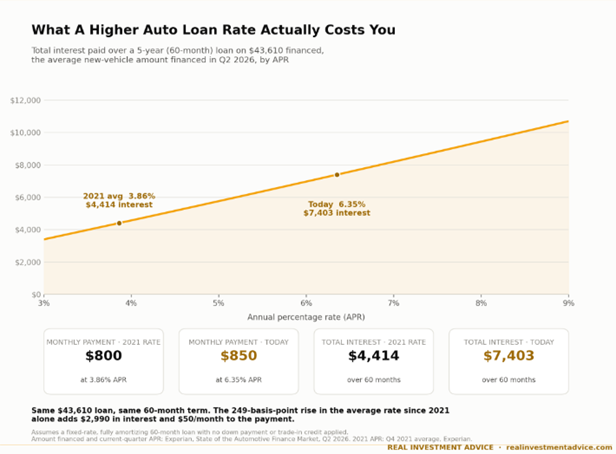
The intermediate segment of the yield curve—specifically the 3-year to 7-year maturities—directly dictates auto loan pricing for both new and used vehicles. Having surged by nearly 100 basis points from their late-February lows, these intermediate yields have dramatically increased monthly car payments for American consumers. Given that the automotive sector and its extensive supply chains account for roughly 5% of total U.S. GDP, sustained weakness in auto affordability represents a substantial drag on broader consumer discretionary spending.

Equity Valuations and the Wealth Effect
From a valuation perspective, equities function as long-duration assets, with average cash-flow durations extending 20 years or more into the future. When long-term discount rates rise, the present value of those future cash flows diminishes, compressing fair-value equity multiples. While the debate continues over whether higher yields have fully compressed stock prices, the statistical probability of a negative feedback loop between rising bond yields and equity market volatility increases daily. Any prolonged downturn in equity valuations risks denting consumer confidence through the psychological wealth effect, further curbing retail spending.
Federal Borrowing Costs and Fiscal Crowding Out
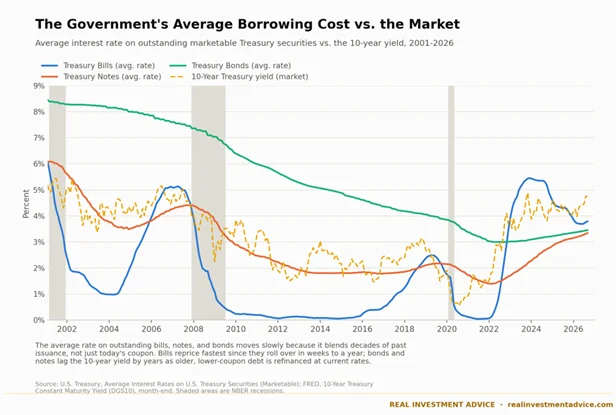
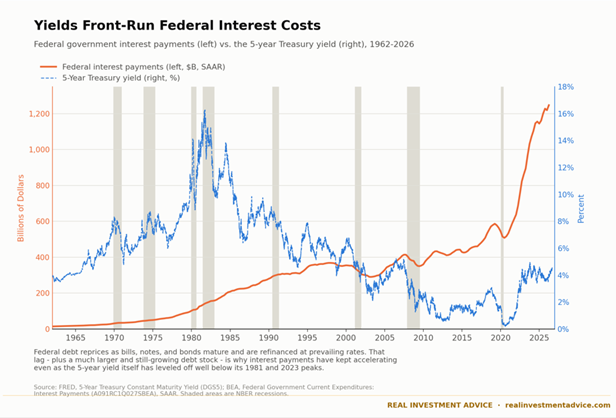
At the sovereign level, higher long-term yields systematically inflate the federal government’s debt-servicing costs. While this expense buildup operates with a lag—since most federal debt is locked in at older, lower rates and only resets upon maturity—the trajectory is stark. Federal interest payments have climbed sharply since 2020.
As the federal government is forced to issue increasing amounts of debt at elevated yields to finance widening fiscal deficits, it inadvertently crowds out private-sector borrowers. This sovereign competition for capital drives borrowing costs even higher for consumers and corporations alike, amplifying the restrictive posture of the broader financial markets.
The Short End: Immediate Transmission and Fed Credibility
While long-term yields create a slow-moving, structural headwind for capital investments and housing, the short end of the yield curve acts as a high-speed lever for immediate monetary policy transmission.
Consumer Revolving Credit and Bank Lending Margins
Short-term borrowing instruments, including credit cards, home equity lines of credit (HELOCs), and floating-rate small business loans, are typically priced directly off the Prime Rate (the federal funds rate plus a fixed spread). Consequently, any adjustment to the federal funds rate alters household and corporate cash flows almost immediately within a single billing cycle.
Furthermore, short-term rates and the slope of the yield curve dictate commercial banking profitability. Banks traditionally fund long-term assets, such as commercial loans and mortgages, using short-term liabilities like deposits. When short-term rates rise and the yield curve flattens or inverts, bank net interest margins compress. This tightening of credit availability discourages banks from extending new loans, materially slowing economic activity.
Savings Incentives and Cash Yields
Yields on money market funds and short-term Treasury bills determine the risk-free return available to savers and businesses. By offering attractive yields on cash, the central bank incentivizes economic agents to save rather than spend. This mechanism operates rapidly, serving as a powerful counterweight to the equity wealth effect by rewarding capital preservation over consumption.
Inflation Expectations and Central Bank Credibility
Ultimately, the federal funds rate serves as the primary credibility signal for the FOMC. Market participants closely monitor the central bank’s benchmark policy rate to gauge its institutional resolve in returning inflation to the 2% target.
While a tightening bond market can suppress economic growth, it does not speak to the central bank’s policy commitment. Federal Reserve Governor Christopher Waller recently highlighted this distinction in public remarks, noting that monetary policy is "currently only slightly restricting aggregate demand" and warning that "it may not take much acceleration in inflation to nudge me into supporting tighter policy." Governor Waller’s comments underscore the viewpoint that the front end of the yield curve remains the essential lever for managing inflation expectations and institutional credibility.
The Supply-Shock Dilemma and the Risk of Policy Error
As the FOMC evaluates its next steps at the September 2026 meeting, policymakers face a deeply complicated macroeconomic environment. Stubbornly high inflation argues logically for continued vigilance and potential monetary tightening. However, a meticulous analysis of the recent inflation uptick reveals that the deviation from the broader downward trend is largely exogenous—driven primarily by geopolitical tensions in the Middle East, ongoing conflicts involving Iran, and subsequent spikes in global energy prices.
Economic history demonstrates that the federal funds rate cannot drill for oil, reopen shipping lanes, or immediately resolve supply-chain disruptions rooted in geopolitical conflict. This reality forces a critical policy question upon the central bank: Is the pursuit of "inflation credibility" via higher short-term rates worth the collateral damage, especially when those rate hikes possess a severely limited capacity to remedy supply-driven energy inflation while threatening significant structural harm to broader economic growth?
Tightening monetary policy further in the face of a supply shock risks compounding economic friction and inducing a policy error. Should the Federal Reserve opt to raise the federal funds rate further under these conditions, the central economic data may soon force them into an abrupt reversal—cutting rates shortly thereafter as an implicit admission of over-tightening. As the September 2026 FOMC meeting approaches, financial markets remain anxious to see whether policymakers will recognize that the bond market has already shouldered much of the restrictive burden, or if they will risk overtightening an already strained economic machine.
Related posts: