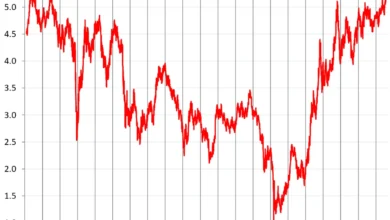
A Turning Point for Semiconductor Equities
The catalyst for the latest downward movement was Qualcomm, which, despite reporting earnings that technically exceeded analyst estimates, provided a forward-looking forecast that signaled significant friction in its supply chain. The company’s inability to meet the high expectations of the AI-driven data center buildout prompted an immediate sell-off. Qualcomm’s shares cratered 9.5% in a single session, contributing to a cumulative 39% decline from their June peak.
This performance is emblematic of a broader trend within the PHLX Semiconductor Index (SOX), which recorded a 12.2% drop in a single trading day—its most significant single-day decline since the market volatility of March 2020. With the index now sitting 38% below its June high, analysts are questioning whether the “AI supercycle” has hit a fundamental valuation ceiling.
Chronology of the Correction
The decline in semiconductor stocks did not occur in a vacuum; it follows months of aggressive speculation that drove valuations to historical extremes.
- March–June 2026: A period of unprecedented optimism. Intel, for example, saw its share price surge 230% between March 27 and June 12. Similarly, SanDisk experienced a 200% rally between early April and late June.
- Late June 2026: Market peaks. Semiconductor firms reached record valuations, fueled by massive capital expenditure projections from major cloud service providers and hyperscalers.
- October 2026: The period of "edgy" markets. As earnings reports began to surface, cracks appeared. Companies reported that while demand for high-end AI chips remained, the logistical costs and component shortages were eroding margins.
- November 2026: The current "capitulation" phase. Major indices saw broad-based selling, with the Nasdaq Composite falling 5.5% and the S&P 500 retracting 4.4% in a single day, as the tech-heavy sector bore the brunt of the risk-off sentiment.
Data-Driven Reality Check
The scale of the value erosion across the sector is substantial. Nvidia, which has been the bellwether for the entire artificial intelligence investment thesis, has fallen below its price from one year ago. The company has shed approximately $1.4 trillion in market capitalization from its October peak. This reversal illustrates the volatility inherent in high-growth tech stocks when market liquidity contracts and speculative momentum wanes.
Other major players are experiencing similar gravitational pulls. Intel’s 63% decline has effectively erased its massive gains from the spring, returning the stock to price levels last seen in the early 2000s. SanDisk, while still holding a 237% gain compared to two years ago, has seen a 66% evaporation of the value added during the summer rally.
The Role of Leveraged Instruments
The volatility has been exacerbated by the proliferation of leveraged financial products. The Direxion Daily Semiconductor Bull 3X ETF (SOXL), a favorite among day traders seeking to capitalize on sector momentum, suffered a 38.7% collapse in a single day. Year-to-date, this ETF has fallen 86% from its June high. The performance of these instruments suggests that the sell-off is not merely institutional rebalancing but a frantic exit by retail and speculative traders who utilized high-leverage strategies to chase the AI narrative.

Broader Market Implications
The impact of this semiconductor rout has spilled over into other sectors heavily tied to the digital infrastructure economy. Tesla, often categorized alongside AI-adjacent tech, dropped 10.8%, while SpaceX saw a 9.0% decline. CoreWeave, a prominent firm in the AI data center space, plummeted 9.8%, extending its decline to 68% from its May high.
The Cboe Volatility Index (VIX), often referred to as the "fear gauge," surged from a relatively tranquil 16.9 to 28.2. While a reading of 28.2 indicates heightened market stress, historical data suggests that during true liquidity crises, this index can escalate toward 50 or higher. The current spike reflects a market that is no longer looking for buying opportunities, but rather one focused on capital preservation.
Fact-Based Analysis of the AI Trade
From a macroeconomic perspective, the "AI trade" is undergoing a necessary, if painful, maturation. For the past two years, equity markets were driven by the belief that generative AI would result in an immediate and exponential increase in corporate productivity and revenue. However, the current earnings season has exposed the reality that hardware production and the infrastructure buildout face bottlenecks that cannot be bypassed by capital spending alone.
While the Nasdaq Composite remains down only 12% from its all-time high, and the S&P 500 remains within 6.3% of its peak, the concentration of the sell-off in the semiconductor and AI-infrastructure sectors suggests a rotation out of growth and into more stable, value-oriented assets. Investors are now scrutinizing balance sheets and free cash flow with a degree of rigor that was largely absent during the first half of the year.
Official Responses and Future Outlook
While company spokespeople generally maintain a stance of long-term confidence in the AI transformation, the market is currently demanding short-term results. Analysts at major investment banks have begun to lower their price targets, citing concerns that the cyclical nature of the semiconductor industry has not been eliminated by the emergence of AI.
The primary question facing the market in the coming weeks is whether the current price levels represent a true bottom or merely a pause before a deeper correction. Historical precedents, such as the Dotcom bubble, serve as a reminder that when sector-specific bubbles burst, they often do so in waves. The "dip-buying" phenomenon, which had previously served as a floor for these stocks, has thus far failed to hold, suggesting that institutional investors may be waiting for more clarity on interest rate policies and macroeconomic growth forecasts before re-entering the market.
As of the latest close, the lack of a sustained bounce-back in the semiconductor sector indicates that the "buy the dip" mentality is encountering significant resistance. Whether the market finds support in the coming days will likely depend on whether upcoming economic data can calm fears of a broader industrial slowdown. Until then, the semiconductor sector remains in a state of high volatility, with investors adjusting to a new, more cautious reality.