Navigating Machine-Speed Cybersecurity: Strategies for Enterprise Leaders in the Age of AI

The modern cybersecurity landscape is undergoing a profound structural transformation driven by the rapid convergence of generative artificial intelligence, automated development pipelines, and escalating global threat volumes. As software engineering teams leverage AI assistants to accelerate feature delivery, the velocity of application development has officially surpassed traditional application-security workflows. This widening gap—frequently characterized by industry analysts as the velocity gap—has left enterprise organizations exposed to a new generation of high-speed, machine-driven threats.
According to research from the Cloud Security Alliance, AI-assisted development is continuously outstripping the manual capacity of legacy security teams. Concurrently, the G7 Cyber Expert Group has issued formal warnings indicating that malicious actors are exploiting these same generative technologies to probe enterprise networks, test defensive perimeters, and execute cyberattacks with unprecedented speed, massive scale, and significantly reduced technical barriers. The operational and financial implications for executive leadership are severe. The National Institute of Standards and Technology reported a staggering 263 percent increase in Common Vulnerabilities and Exposures (CVE) submissions to the National Vulnerability Database between 2020 and 2025. Meanwhile, the Federal Bureau of Investigation’s 2025 Internet Crime Report recorded nearly $21 billion in total reported internet-crime losses across the United States.
Faced with this expanding threat vector, chief information security officers and enterprise risk committees can no longer rely on periodic penetration testing and manual code reviews. Security operations must evolve from reactive, human-bottlenecked review queues into proactive, engineering-native, and automated security platforms.
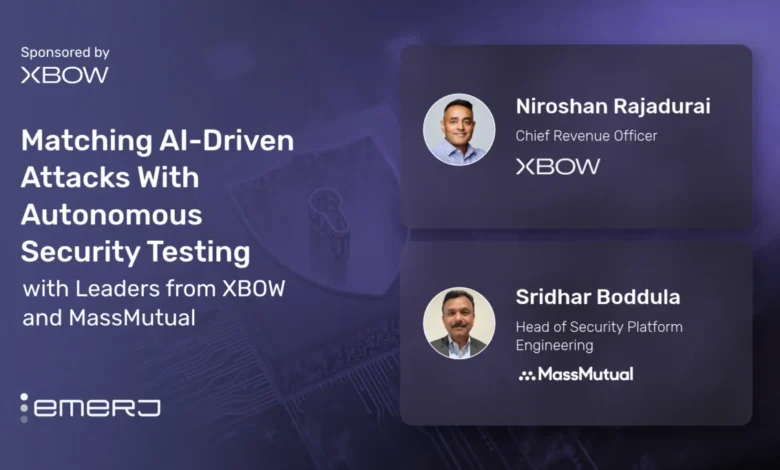
To explore how enterprises can adapt their security architectures to these compounding pressures, the Emerj AI in Business Podcast recently featured an in-depth expert series. The discussions brought together Niroshan Rajadurai, Chief Revenue Officer at XBOW and former Vice President of Go-to-Market Strategy for AI and Application Security at GitHub, alongside Sridhar Boddula, Head of Security Platform Engineering at MassMutual. Their insights illuminate three foundational strategies for enterprise leaders seeking to identify, validate, and remediate critical software vulnerabilities before malicious actors can exploit them.
The Historical Chronology of the Vulnerability Explosion
To understand the current crisis in application security, it is necessary to examine the historical trajectory of software development and cyber threat evolution over the past decade.
The widespread adoption of DevOps and continuous integration and continuous deployment (CI/CD) pipelines in the mid-2010s dramatically accelerated software release cycles. Organizations transitioned from releasing updates quarterly or monthly to pushing code changes daily or even hourly. Security teams struggled to keep pace, giving rise to DevSecOps methodologies designed to "shift left"—embedding security checks earlier in the development lifecycle.
However, the introduction of generative AI coding assistants between 2022 and 2024 compressed the software development timeline even further. Developers could now generate hundreds of lines of complex code with simple natural-language prompts. While productivity soared, the volume of introduced bugs and security misconfigurations scaled exponentially. By 2025, malicious actors began deploying automated, AI-driven offensive agents capable of scanning repositories, identifying zero-day vulnerabilities, and launching multi-stage automated exploits faster than human security analysts could triage alerts.
The National Vulnerability Database struggled under the sheer weight of this output, prompting NIST to implement emergency operational updates in April 2026 to manage the historic influx of CVE submissions. This chronology illustrates a stark reality: human-speed security is fundamentally unequipped to defend against machine-speed attacks.
Exploit Validation: Prioritizing Vulnerabilities by Business Risk
One of the most critical challenges facing modern security operations is alert fatigue. Traditional static application security testing (SAST) and dynamic application security testing (DAST) tools frequently inundate security teams with massive lists of potential vulnerabilities. Many of these findings are false positives, and even genuine bugs may not be accessible to external attackers.
Addressing this issue requires a fundamental shift toward exploit validation. Speaking on the Emerj AI in Business Podcast, Niroshan Rajadurai emphasized that enterprise security teams must distinguish between a theoretical code defect and an actionable, exploitable risk.
"When we think about a security vulnerability, there are actually two parts to it," Rajadurai explained. "One is the original vulnerability. So this is a problem. This code has a bug in it, which can result in something bad happening. But the second part of that is: is that bug actually really reachable by someone who might want to do something bad with it?"
Demonstrating whether a vulnerability can be successfully exploited helps security leaders determine its true priority. An active exploit could allow an adversary to exfiltrate sensitive customer records, execute arbitrary remote commands, or pivot laterally across internal microservices. Conversely, the inability to demonstrate an immediate exploit does not automatically guarantee safety; findings must be evaluated alongside contextual exposure, asset criticality, and potential business disruption.
Sridhar Boddula reinforced this perspective, stressing that vulnerability prioritization must be directly tied to the operational criticality of the affected systems. For instance, in an enterprise e-commerce environment, a vulnerability located within transactional purchasing infrastructure warrants immediate, high-priority remediation compared to a similar bug residing on a non-internet-facing internal staging server.
By combining exploit validation with business asset criticality, organizations can deploy a four-step framework:
- Automated discovery and identification of potential code defects across repositories and cloud environments.
- Contextual evaluation of asset criticality and potential business impact.
- Automated exploit validation to confirm whether the vulnerability is reachable and exploitable by external or internal adversaries.
- Targeted remediation and rigorous re-testing to verify that fixes neutralize the actual threat vector rather than merely masking symptoms.
The final step is particularly vital to prevent what Rajadurai terms a "naive fix." He cited a documented customer case where a development team attempted to block a malicious URL string by inserting a simple string-matching filter into their web application firewall. When testers subsequently swapped a single character for its percent-encoded equivalent, the malicious request bypassed the filter entirely because the rule matched only the raw text. To measure the operational impact of autonomous testing, security leaders should track key performance indicators, including analyst hours spent on manual reviews, time to verified remediation, and total high-priority applications assessed per testing cycle.
Built-in Governance and Safety Controls for Autonomous Testing
As generative AI automates both software engineering and offensive security probing, organizations face a severe velocity mismatch. If an AI model can generate or test code at unprecedented speeds while human reviewers take hours to evaluate individual changes, human oversight becomes an unsustainable bottleneck within the pipeline.
However, removing routine human approvals introduces significant operational risks, particularly when deploying autonomous testing agents against live production environments. Unsupervised AI agents lack human intuition regarding the potential collateral damage of their actions.
"An experienced hacker would say, ‘Don’t do that,’ because if it’s a production system, you’re going to wipe out all the data and that’s a bad thing," Rajadurai noted. "It turns out if you use a model to do the same exercise, the model says, ‘Wow, I found a SQL injection. I’m going to do a drop table.’"
To prevent catastrophic system disruptions, autonomous offensive testing frameworks must incorporate rigorous, built-in governance and safety boundaries. By guiding AI models to emulate the disciplined methodologies of professional ethical hackers—providing explicit operational guardrails and expert instructions during the reasoning process—organizations can safely automate routine testing phases. This allows human security engineers to focus exclusively on complex escalations requiring specialized judgment.
This governance framework also highlights the pitfalls of in-house tool development. Industry insights suggest that while approximately 80 percent of an AI-powered security tool is relatively straightforward to build, the remaining 20 percent—encompassing robust safety guardrails, state-aware exploit handling, and reliable context management—presents formidable engineering hurdles.
Overcoming these operational bottlenecks requires a fundamental restructuring of security teams. According to Sridhar Boddula, security can no longer operate as an isolated review queue that introduces friction into fast-paced development cycles.
"Security cannot remain a review queue that slows down change while attackers operate in hours," Boddula emphasized. "It has to become an embedded, engineering-native function. That means security engineers are working alongside or inside DevOps and DevSecOps pipelines, expressing policy as code, and building automated guardrails that catch these types of issues or these types of risks when they are introduced."
Boddula advocates for the widespread implementation of Zero Trust architecture, which mandates continuous identity verification and strict access controls for all users, devices, and applications. By limiting lateral movement and continuously evaluating access permissions, enterprises can successfully contain potential breaches even if an initial credential is compromised.
Focused Testing of Critical Systems to Guide Security Investment
The democratization of cybercrime tools has drastically reduced the technical expertise and financial investment required to launch sophisticated attacks. Boddula pointed out that nominal investments in advanced AI models can provide malicious actors with the capability to scale automated reconnaissance and phishing campaigns across thousands of corporate targets with minimal marginal cost.
This creates a severe structural asymmetry: defenders must secure every potential attack surface, whereas an adversary needs to identify and exploit only a single vulnerable endpoint to breach an organization. This asymmetry underscores the absolute necessity of continuous, automated security testing.
To combat these threats effectively without overwhelming internal resources, enterprise leaders should initiate continuous testing by prioritizing mission-critical systems that process sensitive or regulated data. Synthesizing the recommendations of both industry leaders, security teams can adopt a practical five-step roadmap:
- Identify and inventory all enterprise assets containing sensitive customer data or core operational workflows.
- Implement continuous, automated vulnerability scanning and exploit validation across those high-priority assets.
- Embed security engineering principles directly into existing DevOps and CI/CD pipelines to establish policy as code.
- Enforce strict governance boundaries to safely automate offensive testing without risking production data integrity.
- Review validation metrics regularly to optimize resource allocation and guide future cybersecurity investments.
Urging leadership to take decisive action, Boddula cautioned against delaying security enhancements until the next fiscal budgeting cycle or external audit.
"An imperfect control operating today creates more value than a perfect strategy that remains on paper," Boddula concluded. "If I were to leave listeners with one action immediately, it would be this: Choose the system, at least one system that holds your most sensitive regulated data and run a focused test on it, and see what are those findings."
Broader Impact and Implications for Enterprise Governance
The transition toward machine-speed security operations carries profound implications for corporate governance, compliance, and board-level risk management. As regulatory bodies worldwide tighten reporting requirements for cyber incidents and data breaches, executive leadership teams are increasingly held personally accountable for organizational cybersecurity posture.
The integration of autonomous AI testing agents and exploit validation frameworks provides boards with verifiable, data-driven evidence of risk mitigation. Rather than relying on qualitative assurances from periodic third-party audits, executives can track real-time metrics regarding vulnerability exposure, remediation velocity, and asset coverage.
Ultimately, enterprises that successfully adapt to the age of AI-driven cybersecurity will be those that transform security from a retrospective compliance checkbox into a proactive, automated, and engineering-native operational discipline. By embracing exploit validation, robust governance guardrails, and continuous testing of critical systems, enterprise leaders can successfully neutralize machine-speed threats and safeguard their organizations against the rising tide of digital risk.