Navigating the Volatile Aftermath of the US Midterm Elections: Markets Reeling From Political Shifts, Geopolitical Pressures, and Evolving Fed Policy

Financial markets experienced a tumultuous week characterized by swift sentiment shifts, driven primarily by the surprise results of the United States midterm elections. The Democratic Party performed exceptionally well, capturing control of Congress and immediately disrupting the anticipated policy trajectory of the current administration. This unexpected transfer of legislative power triggered an initial wave of investor nervousness, which briefly gave way to a strong risk-on appetite before collapsing under the weight of renewed market angst. As asset classes recalibrated to the new political status quo, equities, cryptocurrencies, and commodities saw dramatic swings, leaving traders and institutional investors grappling with a complex macroeconomic puzzle.
The week began with palpable anxiety across major trading floors as early election returns pointed to a divided or opposition-controlled Washington. By Wednesday, however, a temporary surge in risk appetite lifted equities, gold, and bitcoin, helping these assets erase persistent losses accumulated over the preceding three weeks. This relief rally proved short-lived. Thursday’s trading session brought aggressive selling, led heavily by technology stocks. The Nasdaq 100 index underperformed the broader S&P 500 significantly, breaching key technical support levels, including its 200-day simple moving average. Conversely, European stock markets demonstrated unexpected resilience, bolstered by investor expectations that a constrained US president might adopt a less aggressive stance on international trade and tariffs.

A Chronological Breakdown of the Week’s Market Movements
The chronology of the week’s financial events reflects a rapid succession of shocks and reactions that tested the resilience of global portfolios.
Monday and Tuesday set a cautious tone as preliminary midterm election results trickled in. Polls had suggested a tighter race, but the decisive Democratic gains caught institutional algorithmic traders off guard. Currency markets reacted immediately: the US dollar, which had stumbled through the start of November following an uninspiring October, initially extended its losses against major peers like the British pound, the Swiss franc, and even a structurally troubled euro.
By Wednesday, market sentiment abruptly pivoted. Risk assets caught a strong bid as optimists argued that a legislative gridlock in Washington might prevent extreme fiscal policy swings and force compromise. Gold prices surged toward the $4,150 mark, while bitcoin staged a sharp recovery, temporarily reviving hopes of a sustained post-election rally. Concurrently, oil prices experienced a sharp descent, finding firm technical support near the $88 per barrel threshold.
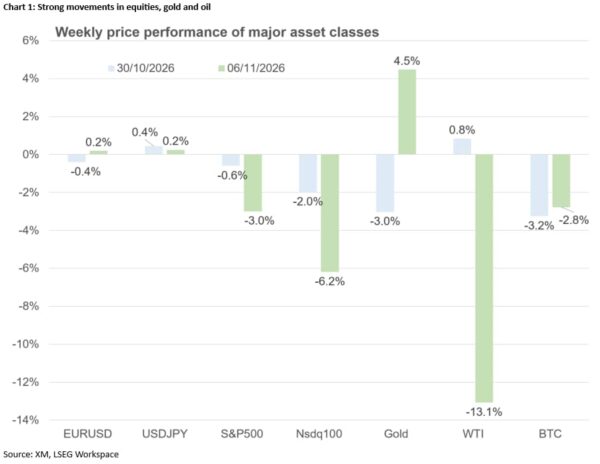
The reversal on Thursday, however, was swift and punishing. Bitcoin’s post-election rally completely fizzled out as market participants confronted the reality of the Democratic Party’s historical skepticism toward loose cryptocurrency regulations and rapid digital asset adoption. Meanwhile, safe-haven flows returned, though the US dollar managed to decouple from falling sovereign bond yields. Supported by resilient bets on a Federal Reserve rate hike at the upcoming mid-December meeting, the greenback regained its footing, overshadowing softer macroeconomic data prints.
Geopolitical Realities and the Shift in Foreign Policy
The altering political landscape in Washington carries profound implications for US foreign policy and ongoing international conflicts. With domestic legislative power now shared or curtailed, the executive branch may find its domestic policy ambitions checked, prompting questions about whether foreign policy will be used more aggressively to secure political wins or if a more conciliatory approach will prevail.
Market participants are closely monitoring potential developments in the Middle East and Eastern Europe. Recent weeks have witnessed fragile diplomatic maneuvers, including Qatari-mediated talks between the United States and Iran, though a definitive framework agreement remains elusive. More promising progress has emerged concerning the Russia-Ukraine conflict, with high-stakes trilateral talks scheduled for the upcoming week in Abu Dhabi. While presidential commentary has struck an optimistic tone, seasoned analysts warn that high market expectations could easily lead to disappointment if diplomatic breakthroughs fail to materialize on the ground.
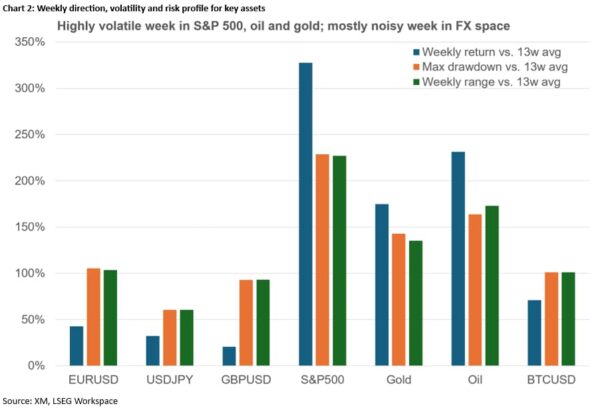
These geopolitical shifts directly influence commodity markets. The recent drop in oil prices toward the $88 support zone reflects speculative beliefs that trade tariffs may be deployed less frequently and that diplomatic pressure might de-escalate regional supply risks. However, energy analysts caution that concrete, verifiable developments are required to sustain any long-term bearish momentum in crude oil. Central bankers across both the Federal Reserve and the European Central Bank are monitoring energy valuations closely; a sustained decline in oil prices could accelerate downward pressure on inflation, potentially prompting a re-evaluation of anticipated December rate hikes.
Federal Reserve Focuses on Incoming Inflation Metrics
As the market digests the latest labor market indicators, the Federal Reserve’s immediate focus shifts decisively toward incoming inflation data. With another crucial nonfarm payrolls report scheduled for publication just ahead of the mid-December Federal Open Market Committee meeting, attention is locked on the upcoming Consumer Price Index (CPI) and Producer Price Index (PPI) reports for October, alongside a heavy calendar of scheduled speeches by central bank officials.
During the pre-election blackout period, Fed members largely maintained silence to avoid perceptions of political interference. Next week’s resumption of public commentary, known colloquially as Fedspeak, will provide critical guidance. The broader deceleration in inflation rates observed since May has shown signs of reversing, with both headline and core metrics ticking upward. This re-acceleration is heavily tied to energy market dynamics, notably a 15% rally in oil prices observed last October contrasted against base effects from previous cycles.
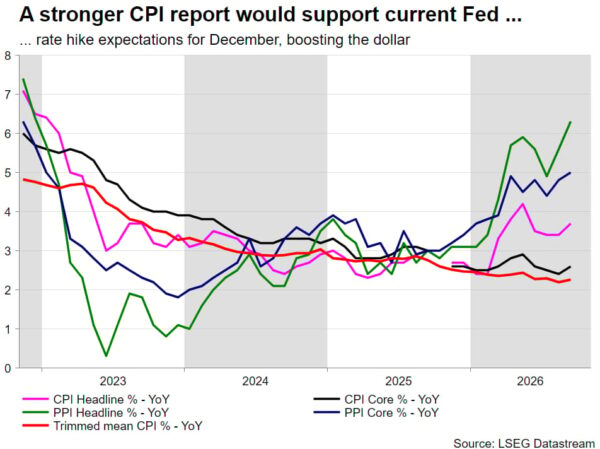
Economists project that Tuesday’s CPI release could yield upside surprises. A headline inflation print moving back above 4%, coupled with a core indicator hovering near 3% and matching momentum in the PPI, would likely cement expectations for a December rate hike. Such an outcome, reinforced by hawkish rhetoric from central bankers, would provide a substantial fundamental tailwind for the US dollar while exerting renewed pressure on non-yielding assets.
Domestic Friction, Artificial Intelligence, and Equity Market Vulnerabilities
Domestically, the central question facing the US economy is whether the executive branch and the newly empowered congressional majority can forge a working relationship on vital issues such as fiscal spending, healthcare policy, and federal budgets. The prevailing consensus in Washington points toward two years characterized by intense partisan friction, legislative gridlock, and frequent vetoes, which could stall major economic initiatives.
Artificial intelligence (AI) has rapidly emerged as a primary ideological and economic battleground. The executive branch and congressional Democrats hold starkly contrasting priorities regarding technological oversight. Democratic lawmakers have consistently advocated for stringent regulatory frameworks, privacy legislation, and environmental accountability. Such policies could directly impact the massive capital expenditures required for data center expansion, energy infrastructure development, and grid integration.
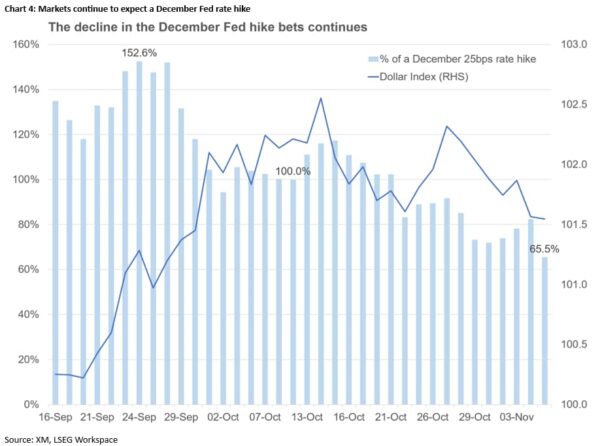
Compounding these regulatory headwinds are underlying investor anxieties regarding profitability timelines, funding sources, and the sheer cost of corporate AI investment plans. Consequently, technology-heavy indices like the Nasdaq 100 face persistent downside risks. The index’s recent breach below its 200-day simple moving average signals that technical damage has been inflicted, suggesting that stock market weakness may linger well into the fourth quarter.
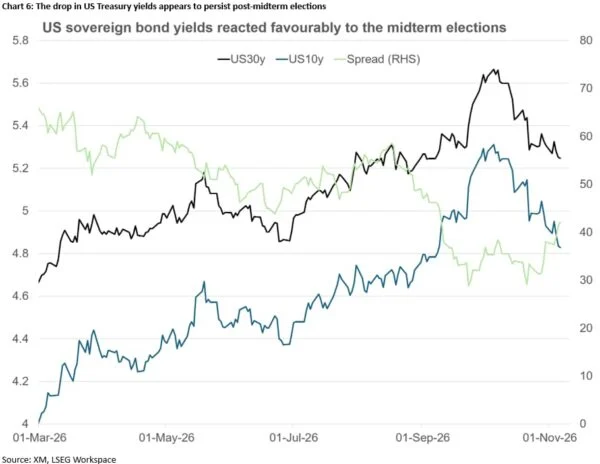
Furthermore, the shifting balance of power in Washington coincides with a pivotal period for the US Treasury Department. Next week’s scheduled auctions for 3-, 10-, and 30-year US Treasury notes—split by a midweek banking holiday—will serve as a definitive stress test for investor demand. With 10-year sovereign bond yields dropping sharply below the 5% threshold, demand metrics will be closely scrutinized. Robust domestic demand could signal defensive risk aversion, whereas weak participation would expose deep-seated structural concerns regarding the expanding US fiscal deficit and investor resistance to declining real yields.
Foreign Exchange Implications: Dollar-Yen at a Crossroads
In the foreign exchange market, the USD/JPY currency pair has remained trapped within a defined trading range since mid-September. Periodic surges in dollar strength and subsequent pullbacks have repeatedly failed to provoke a decisive breakout.
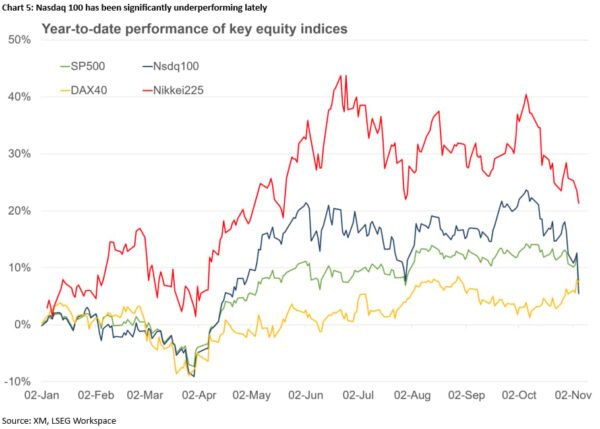
The convergence of tighter fiscal expectations, lower energy prices, softer US macroeconomic prints, and moderated Federal Reserve rate hike bets weighs heavily on the greenback. Conversely, expectations for monetary policy tightening by the Bank of Japan (BoJ) remain alive. The Japanese economy stands to benefit significantly from lower imported energy costs, which bolster real household disposable incomes and consumer spending. Should Fed doves dominate upcoming policy speeches and drive the dollar lower, a confirmed break beneath the 156.74 technical level could clear the path for a deeper descent toward the 155.00 handle.
Gold’s Resurgence and the Path Toward Bullish Consolidation
Precious metals have reacted dynamically to the evolving macroeconomic and political environment. Gold prices climbed aggressively toward the $4,150 region, catalyzed by the shifting political equilibrium in Washington and investor demand for alternative stores of value amid fiscal uncertainty.
Despite this sharp corrective rally, gold’s broader short-term technical structure continues to face headwinds from elevated real yields and intermittent US dollar strength. Analysts note that for gold bears to be decisively neutralized, prices must clear resistance around the $4,280 mark, representing a 50% retracement of the August-to-October corrective slide. A successful breakout above this threshold would refocus market attention on the ultimate bullish objective: the 200-day simple moving average currently situated near $4,470. As geopolitical tensions, inflation prints, and central bank policies continue to evolve, the yellow metal remains a vital barometer of global systemic risk.
Related posts: