Nine Months, Seven Applicants, Zero Licences: Vietnam’s Crypto Waiting Game

The digital asset landscape in Vietnam has entered a period of intense regulatory scrutiny and administrative deliberation as the nation approaches the end of a high-stakes transition toward a formalized cryptocurrency framework. Despite the passage of nearly nine months since the initial application window for digital asset service providers opened, the Ministry of Finance has yet to issue a single operating licence. This delay, occurring against a backdrop of international pressure and ambitious domestic policy goals, suggests that the Vietnamese government is prioritizing the establishment of a robust, compliant financial infrastructure over the rapid proliferation of trading venues.
The Regulatory Chronology
The current impasse is the culmination of a deliberate, multi-year policy rollout. In September 2025, the Vietnamese government enacted Resolution 05, a foundational document that established a five-year pilot program for the domestic digital asset sector. The resolution was explicit in its parameters: all transactions must be settled in the Vietnamese Dong (VND), operations are restricted exclusively to licensed entities, and fiat-backed stablecoins—a cornerstone of global crypto liquidity—are strictly prohibited from the ecosystem.
Following the enactment of Resolution 05, the Ministry of Finance faced an initial hurdle: a lack of immediate market participation. By October 2025, reports indicated that no firms had stepped forward to apply under the nascent framework. This period of inactivity was followed by Decision 96, signed on January 20, 2026, which formally opened the application window. The government’s intent was clear: to move from a state of total prohibition to a state-managed, restricted pilot.
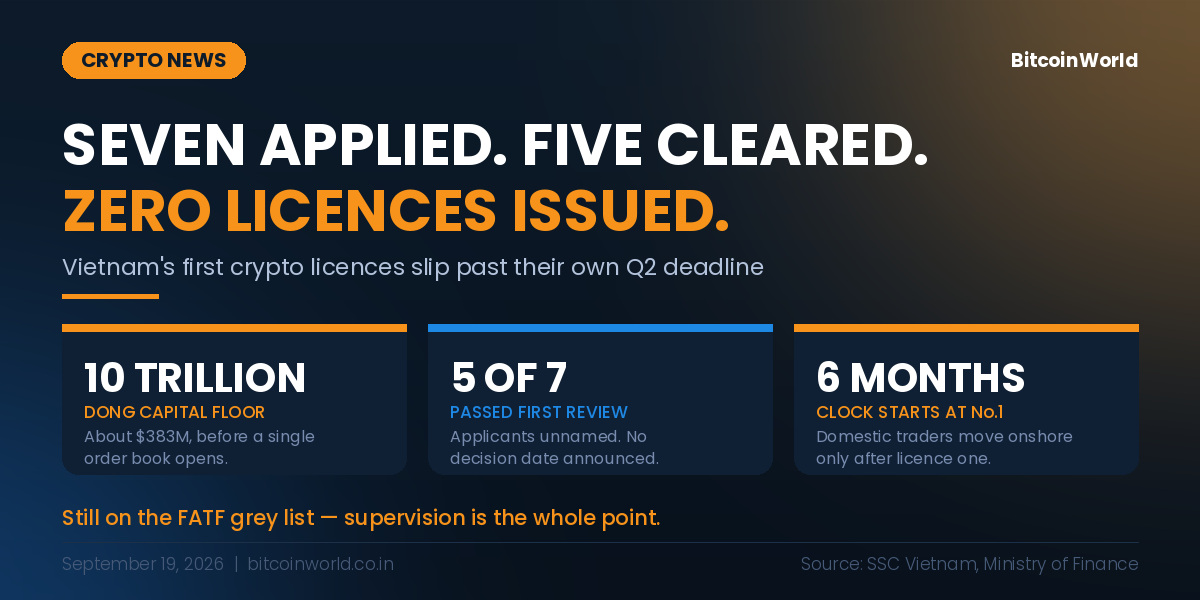
By April 2026, the political pressure for a launch had mounted, with the Prime Minister’s office publicly mandating a second-quarter operational start. At that time, seven applicants had submitted their materials for review. However, the anticipated Q2 launch failed to materialize. On August 30, 2026, officials confirmed that five of the seven applicants had successfully passed the initial vetting stage, yet they declined to identify the entities or provide a definitive timeline for the final approval. The situation took a more urgent turn on September 1, 2026, when a new decree was issued imposing stringent fines for any entity operating without a licence, effectively signaling that the government intends to clear the market of existing, unlicensed operators before granting official status to the new cohort.
The Diplomatic and Technical Context
The recent diplomatic efforts by the Vietnamese delegation, led by Deputy Finance Minister Nguyen Duc Chi, underscore the gravity with which the government is approaching this transition. During a September 15 meeting in Vienna with Mariana Kühnel, who oversees Austria’s Financial Market Authority (FMA), the Vietnamese delegation included the chair of the State Securities Commission (SSC), the Vietnamese ambassador, and senior representatives from the Vietnam Stock Exchange and the clearing corporation.
The composition of this delegation indicates that Vietnam is not merely seeking a legislative template; it is seeking to import the enforcement culture and technical oversight mechanisms used by the European Union. By engaging with the FMA, which manages a highly regulated environment for crypto-assets within the EU, Hanoi is signaling its intent to align its local market with international standards—specifically those recommended by the Financial Action Task Force (FATF).
Vietnam’s inclusion on the FATF "grey list" as of June 2026 remains a significant driver for this regulatory rigor. The grey list status, which signifies a jurisdiction under increased monitoring for anti-money laundering (AML) and counter-terrorist financing (CTF) deficiencies, has placed immense pressure on the State Bank of Vietnam and the Ministry of Finance to demonstrate that they can control the flow of capital within the crypto sector. A licensed, transparent, and domestic-currency-settled venue is viewed as the most effective tool to mitigate these international concerns.
Barriers to Entry: The "Stock Exchange" Model
The reason for the licensing delay is not merely bureaucratic inertia; it is rooted in the high bar set for applicants. Vietnam has chosen to treat cryptocurrency exchanges not as tech startups, but as core financial institutions, akin to traditional stock exchanges.
To be considered for a licence, applicants must meet several rigorous requirements:

- Capitalization: A minimum of 10 trillion VND in charter capital.
- Cybersecurity: A mandatory Level 4 information-system security appraisal.
- Security Clearance: Explicit sign-off from the Ministry of Public Security.
By imposing these requirements, the government is effectively filtering for established, well-capitalized institutions. The "Level 4" security requirement is particularly notable, as it is the highest tier of information security mandated for critical national infrastructure in Vietnam. This requirement reflects the state’s concern regarding the systemic risks posed by cyberattacks, data breaches, and the potential for financial contagion within the national economy.
Market Implications: The Liquidity Gap
The most significant long-term implication of the current policy is the anticipated fracture in market liquidity. Once the first licence is granted, a six-month transition period will commence for domestic traders. During this window, existing unlicensed offshore platforms are expected to face severe restrictions.
However, a fundamental structural challenge remains: the prohibition of fiat-backed stablecoins (such as USDT). Currently, the vast majority of retail crypto activity in Vietnam is denominated in stablecoin pairs. If licensed venues are restricted to VND-only trading, they will effectively be severed from the global liquidity pools that dominate the retail market.
Industry analysts suggest this will lead to a persistent "price gap" between regulated, onshore venues and the broader, global market. While the government aims to channel activity into a safe, auditable environment, the high cost of compliance and the lack of popular trading pairs could drive a significant portion of the retail market into the shadows, or toward decentralized platforms that are difficult for the state to regulate.
Analyzing the Strategic Delay
The current silence from the State Securities Commission regarding the five shortlisted applicants is a calculated strategic move. By delaying the final sign-off, the government is effectively "collecting credibility." In the eyes of the Vietnamese administration, every month that passes without a, perhaps, unstable crypto exchange operating under their banner is a month of reduced systemic risk.

For the applicants, this waiting game is an exercise in endurance. They are required to maintain massive capital reserves and operational readiness without the benefit of revenue from trading fees. This environment favors large, institutional players with deep pockets, likely excluding smaller, innovation-focused startups.
Furthermore, the lack of transparency regarding the names of the five successful applicants may be a defensive measure. By keeping the identity of these firms private until the moment of the final license, the government prevents speculative market movements and political lobbying that could complicate the final selection process.
Future Outlook
The path forward is contingent upon the signature of the first licence. Until that document is finalized, the Vietnamese crypto market remains in a state of suspended animation. The government’s priority is clearly the preservation of financial stability and the avoidance of any scenario that would lead to a loss of public trust—or, more importantly, a conflict with international financial regulators.
As the industry watches for the first official announcement, the focus should not be on the volume of trade or the variety of coins that will be offered, but on the regulatory architecture that will govern them. If Vietnam succeeds in launching these licensed venues, it will have created a unique, isolated, and highly controlled crypto market that functions more like a traditional securities exchange than the decentralized, globalized exchanges seen elsewhere. Whether this model can sustain interest from traders and developers in the long term remains the primary question for the sector as the nation moves into the final months of 2026. The government has made it clear: in the new Vietnam, permission must precede performance.
Related posts: