The Seismic Shift in German Politics: How the Rise of the AfD in Saxony-Anhalt Challenges the Postwar Economic Model

For decades, the bedrock of Germany’s post-World War II stability rested upon an implicit and largely reliable social contract: high-value, precision manufacturing would consistently yield well-paying jobs, robust export revenues, and broad-based national prosperity, while established political institutions would steadily translate these economic gains into enduring social cohesion. However, the relentless acceleration of global economic shifts, exacerbated by formidable industrial competition from China and structural internal weaknesses, has shaken this foundational bargain to its very core.
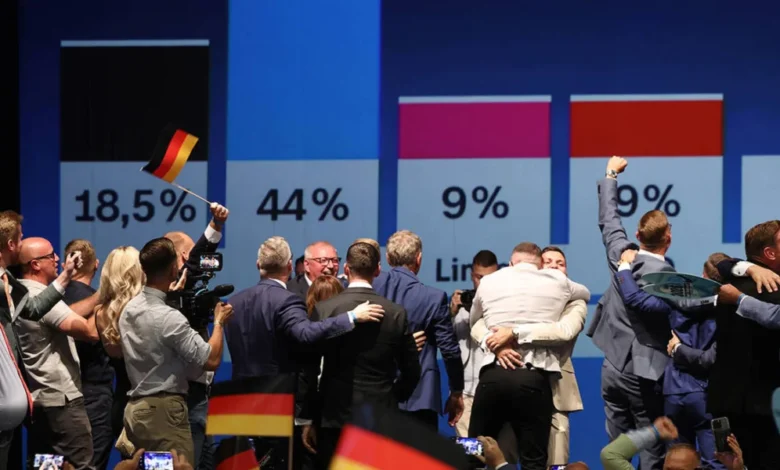
On September 6, 2026, a momentous political earthquake struck Munich and resonated powerfully through Berlin, marking what many historians and political analysts believe could be a definitive turning point in Germany’s contemporary political history. In the regional state election held in Saxony-Anhalt, the far-right Alternative für Deutschland (AfD) surged to an unprecedented electoral triumph, coming within a mere three seats of securing an absolute majority in the state legislature. Capturing an astonishing 43.8% of the popular vote, the party more than doubled its vote share compared to the previous state election held in 2021.
This meteoric rise by the AfD came at the direct expense of the center-right Christian Democratic Union (CDU), the state’s incumbent governing force and the political home of federal Chancellor Friedrich Merz. The CDU suffered a catastrophic defeat, plummeting to a dismal 17.2% of the vote—a steep decline from the 37.1% it commanded just five years prior. This profound realignment of the electorate signals deep-seated public anxieties, transforming regional grievances into a formidable challenge to the federal government’s stability and the traditional political order.
Background Context of the Saxony-Anhalt Earthquake
To understand the magnitude of the September 2026 election, one must examine the unique socio-economic landscape of Saxony-Anhalt and the broader former East German territories. Since the reunification of Germany in 1990, eastern states have experienced persistent structural gaps compared to their western counterparts, including lower average wages, fewer corporate headquarters, and a faster rate of population aging.
While heavy investments were channeled into infrastructure following reunification, the region’s economy has remained disproportionately vulnerable to external shocks. In recent years, these vulnerabilities have been dangerously magnified by compounding global crises: the disruption of cheap Russian energy supplies following the war in Ukraine, persistent inflationary pressures, and the rapid erosion of Germany’s traditional manufacturing dominance.
For ordinary citizens in towns like Magdeburg, Halle, and rural Saxony-Anhalt, these macroeconomic pressures translated directly into a tangible decline in living standards. The AfD capitalized masterfully on these anxieties, framing economic stagnation, high energy costs, and anxieties surrounding immigration as failures of the traditional establishment parties in Berlin. By positioning itself as the sole voice of anti-establishment defiance, the far-right party successfully mobilized disenfranchised voters who felt utterly abandoned by the mainstream political consensus.
Chronology of Events Leading to the 2026 Crisis
The political landscape leading up to the Saxony-Anhalt election was characterized by a steady accumulation of economic strain and declining public trust in federal leadership.
- Late 2021: Following the federal elections, the coalition government assumes power amidst promises of modernization, green transition, and economic resilience. However, external pressures immediately begin to strain public finances and industrial output.
- 2022–2023: The outbreak of war in Ukraine severely disrupts European energy markets. Germany, heavily reliant on Russian natural gas, faces an acute energy crisis that disproportionately hits energy-intensive manufacturing sectors in eastern regions.
- 2024–2025: Chinese industrial overcapacity floods global markets with heavily subsidized electric vehicles, machinery, and advanced tech goods, undercutting traditional German export strengths. Economic growth stalls, and industrial giants announce major restructuring and job cuts.
- Early 2026: Chancellor Friedrich Merz’s administration struggles to implement coherent fiscal reforms amidst internal coalition friction. Public discontent reaches a boiling point in eastern Germany as regional infrastructure and public services show signs of severe strain.
- September 6, 2026: Saxony-Anhalt voters head to the polls. The resulting 43.8% vote share for the AfD shatters regional political norms, instantly elevating local frustrations into a major national crisis for Berlin.
Supporting Data and Economic Realities
The political tremor in Saxony-Anhalt cannot be viewed in isolation from Germany’s broader macroeconomic indicators. Recent data from the Federal Statistical Office (Destatis) underscores the severity of the economic headwinds facing the nation. Germany’s manufacturing sector, which accounts for roughly 20% of the country’s economic output, has experienced consecutive quarters of stagnation.
At the same time, direct trade data reveals that China has successfully pivoted from being a primary consumer of high-end German industrial machinery to a formidable competitor producing equally sophisticated alternatives at a fraction of the cost. German automotive exports to Asia, long the crown jewel of the national economy, have dropped by over 15% since 2024.
In Saxony-Anhalt specifically, the contrast between the macroeconomic promises of the federal government and ground-level reality became stark. Youth out-migration, though slowing, remains a persistent issue, and median household disposable income continues to lag significantly behind the national western average. When the CDU-led state government proved unable to insulate local communities from these broader structural declines, voters turned decisively toward populist alternatives.
Official Responses and Political Reactions
The electoral outcome sent immediate shockwaves through the federal chancellery in Berlin, prompting swift statements from party leaders and institutional stakeholders.
Chancellor Friedrich Merz addressed the press following an emergency cabinet consultation, acknowledging the profound gravity of the defeat. "The results in Saxony-Anhalt are a clear and sobering wake-up call for all democratic forces in our country," Merz stated. "We hear the frustrations of citizens who feel left behind by the rapid transformations of our globalized economy. Our immediate task is to restore confidence in our industrial future, lower the energy burdens on our businesses, and prove that democratic governance can deliver tangible security and prosperity."
Meanwhile, representatives of the Christian Democratic Union emphasized the need for a recalibration of national policy, particularly regarding energy pricing and regional development funding for eastern states.
Conversely, leaders of the AfD hailed the election outcome as a historic mandate for sweeping political change. Co-leader Alice Weidel declared from party headquarters in Berlin that the vote demonstrated a profound desire among Germans to break away from traditional centrist policies. "The people of Saxony-Anhalt have voted courageously for a new political direction," Weidel asserted. "They have rejected the deindustrialization of our country and the failed economic experiments of Berlin."
Other opposition parties, including the Social Democrats (SPD) and the Greens, voiced deep alarm over the normalization of far-right dominance in eastern state parliaments, calling for a unified democratic front to safeguard institutional norms and address the root economic causes of voter alienation.
Broader Impact and Implications for the Future
The ramifications of the Saxony-Anhalt election extend far beyond regional governance, posing critical questions about the future stability of the Federal Republic.
First and foremost, the normalization of a far-right party coming within striking distance of an absolute majority shatters the traditional "firewall" (Brandmauer) that mainstream parties have historically maintained against cooperating with the AfD. While other parties remain publicly committed to refusing coalition partnerships with the far right, governing the state will become an unprecedented logistical and parliamentary nightmare. Forming a stable minority or multi-party coalition capable of commanding a majority against a dominant AfD bloc will severely test democratic resilience at the state level.
Second, the result places immense pressure on Chancellor Merz’s federal administration. With nationwide federal elections approaching in the medium term, the CDU and its coalition partners must urgently devise strategies to revitalize Germany’s industrial core. Failure to counter the structural decline of manufacturing and rein in soaring energy costs risks translating the regional discontent seen in Saxony-Anhalt into a nationwide political realignment.
Ultimately, the events of September 6, 2026, serve as a stark reminder that political stability is inextricably linked to economic well-being. As Germany navigates the turbulent waters of global trade competition, the green transition, and geopolitical fragmentation, the social contract that once guaranteed enduring prosperity must be actively renegotiated. Whether Berlin can successfully rise to this historic challenge will determine not only the fate of the current government, but the long-term viability of the German democratic model itself.